


An inspiring case of women's empowerment
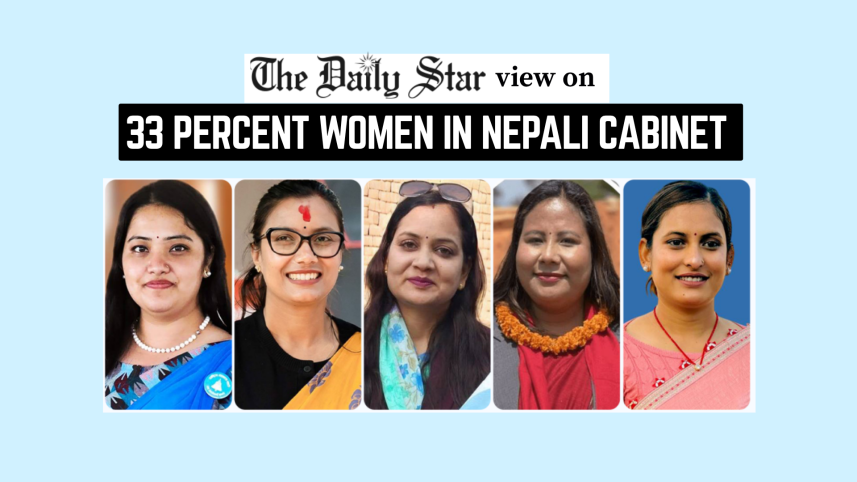
We congratulate Prime Minister Balendra Shah, who was sworn in on Friday, for ushering in the promise of restoring political stability and creating jobs for the poor—aspirations of the Gen Z uprising that led to this new government in Nepal. Its formation marks a decisive political shift in Nepal that is both generational and institutional. It is heartening that Shah has appointed five women ministers in his 15-member cabinet, ensuring, for the first time, 33 percent female representation and thus fulfilling Nepal’s constitutional requirement. Encouragingly, the women ministers have been given important portfolios—law, agriculture, general administration, justice and parliamentary affairs, health and population, and women and children affairs.
Moreover, 96 women became members of parliament—the highest so far in Nepal’s history—though only 14 were directly elected, reflecting the age-old male chauvinism of political parties with regard to nominations. There are criticisms regarding the low number of candidates nominated by the winning party and the choice of women candidates for the proportional representation seats. But the presence of a significantly higher number of women in parliament is certainly encouraging.

This is even more apparent when we compare Nepal’s case with the state of women’s representation in Bangladesh’s new parliament—also formed through a free and fair election following a people’s uprising that was largely led by students. However, unlike Nepal’s parliament, we have only seven elected women MPs, with only three in a cabinet where 94 percent of the posts are filled by men. Most of the political parties participating in the elections failed to nominate even five percent of women candidates, despite pledging to do so under the July National Charter. Even BNP nominated only 10 women candidates; 30 out of 50 parties did not nominate a single candidate.
For a parliament that has evolved from a people’s uprising, with anti-discrimination being the key driving philosophy, it has failed miserably in increasing women’s political participation. This reflects Bangladesh’s entrenched patriarchal culture that has excluded women from real empowerment, especially in the political arena. Political parties, in particular, have not lived up to our democratic expectations in terms of gender inclusivity. Bangladesh's parliament has yet to appoint MPs for the 50 women’s reserved seats. We hope that the selections will be based on merit and capability rather than party loyalty or connection and that, unlike in the past, these seats will not be examples of tokenism. Women MPs’ voices must be heard and their opinions given importance while passing legislation. In the case of Nepal’s parliament, only time will tell whether the appointments of women ministers and the selection of women MPs through PR have been prudent. But just the fact that there is 33-percent representation in the Nepali cabinet with women ministers holding important portfolios is something the rest of South Asia should appreciate and emulate in the future.
 For all latest news, follow The Daily Star's Google News channel.
Comments