


Protect Narsingdi’s rivers
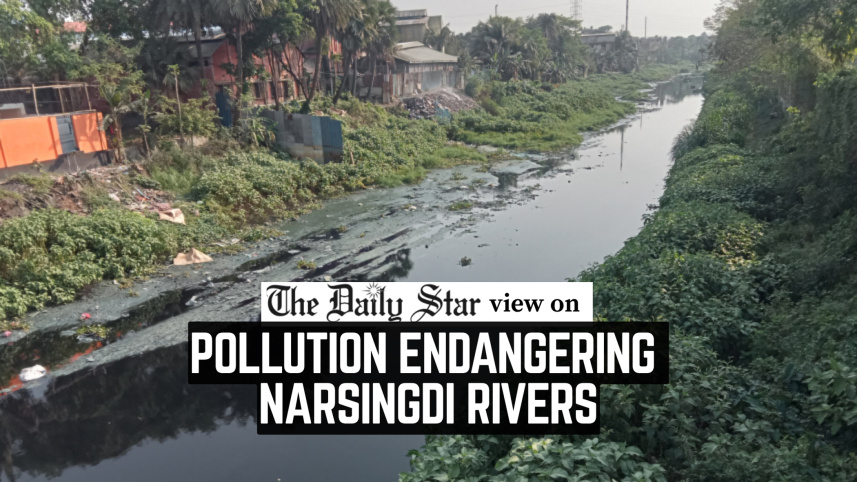
It is deeply concerning that rivers flowing through Narsingdi are facing a severe environmental crisis. Once vital lifelines sustaining surrounding communities and ecosystems, rivers such as the Shitalakkhya, Meghna, Brahmaputra, Arial Kha, Haridhoa, and Paharia are now being pushed to the brink by the unchecked discharge of untreated industrial waste. A report in this daily has laid bare the scale of degradation, exposing the long-standing failure of authorities to regulate industrial pollution in the district.
Over the years, rapid and unplanned industrial expansion along riverbanks has gone on with little regard for environmental protection. Factories have been releasing toxic effluent directly into rivers, severely contaminating the water. Illegal encroachment along the riverbanks has further worsened the situation. For much of the year, even small boats struggle to navigate many rivers due to reduced flow. Several rivers now have critically low dissolved oxygen levels. Even during the monsoon, when water levels typically rise, oxygen remains dangerously low, making survival difficult for fish and other aquatic life.

Among these rivers, the 38-km Haridhoa ranks second among the most polluted rivers in the country. According to a study by the River and Delta Research Centre, its dissolved oxygen level has dropped to a shocking 0.6 mg/L—far below what is needed to sustain aquatic life—while its alkalinity poses serious risks to biodiversity and human health. Although Tk 10 crore was allocated a year ago to address pollution in the river, the funds have yet to be fully disbursed. Such delays allow environmental degradation to continue unchecked. Meanwhile, initiatives such as re-excavating river channels to restore navigability are unlikely to succeed unless pollution is effectively checked.
In 2019, the High Court delivered a landmark judgment declaring rivers as “living entities” and appointing the then National River Protection Commission (now the National River Conservation Commission) as their legal guardian. The court also issued a series of directives to protect our rivers. Sadly, little has changed since then, with most of our rivers still on the verge of destruction. This situation cannot be allowed to continue.
We urge the government to take bold, decisive action against polluters and encroachers. Regulatory bodies, including the Department of Environment and the National River Conservation Commission, must step up efforts to protect the rivers in Narsingdi and throughout the country. Polluting industries must also be compelled to install and operate effluent treatment plants without exception. Without urgent and visible action, too many of our rivers could soon reach a point of no recovery.
 For all latest news, follow The Daily Star's Google News channel.
Comments