


We need a pro-people tax plan
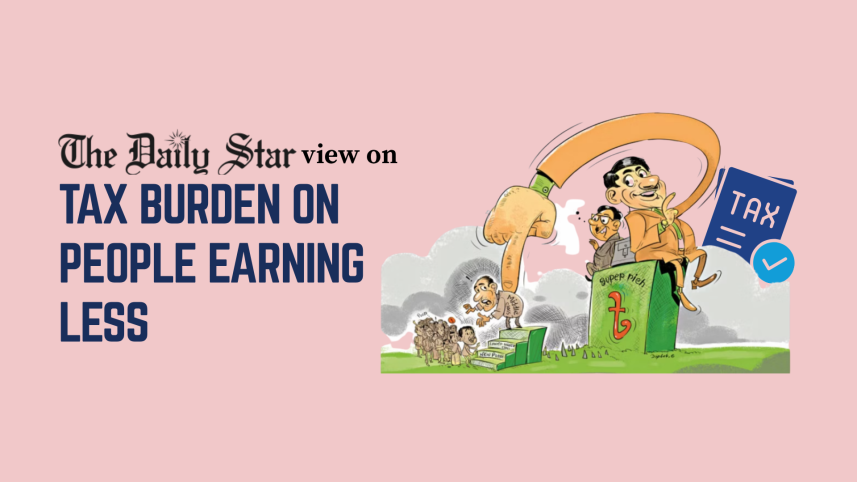
New governments invariably succumb to the temptation to be all things to all people in their first budget, and the BNP administration is proving no exception. The 2026-27 fiscal plan seems to defy arithmetic and buries inconvenient economic realities beneath a veneer of optimistic projections. One of the most troubling issues lies in the revised income-tax structure. Rather than broadening the progressive base that developing economies strive to establish, the new brackets achieve the exact opposite. An analysis by the Centre for Policy Dialogue (CPD) reveals a stark inversion of the ability-to-pay principle, shifting the burden heavily onto middle-income households.
Under the new schedule, taxpayers with annual incomes of Tk 6 lakh face a 12.5 percent increase in their tax liability, while those earning between Tk 10 lakh and Tk 15 lakh will endure a steep 16.7 percent rise. In jarring contrast, the wealthiest cohort—individuals earning more than Tk 30 lakh a year—will see their tax burden increase by a mere 7.6 percent. This analysis is cross-referenced against actual liabilities for the 2025-26 assessment year. The structural inequity sits uneasily with the administration's stated goal of inclusive growth. Compounding it, the tax-free threshold has been increased only marginally, to Tk 3.75 lakh, below the Tk 3.80 lakh that CPD calculates is needed simply to keep pace with inflation. A five-year roadmap promises relief by 2030-31, but that is scant consolation for low-income earners facing financial pressure today.

The budget also risks losing its way when it comes to revenue assumptions and macroeconomic forecasting. The government has set a collection target of Tk 695,000 crore, representing an 18.2 percent increase over the revised figure for the outgoing fiscal year, which is ambitious but poorly aligned with recent performance. This optimistic strain carries through the wider macroeconomic framework, as the administration projects an economic growth rate of 6.5 percent for the coming fiscal year. This, again, sounds plausible until measured against the Bangladesh Bureau of Statistics’ own provisional growth estimate of just 4.14 percent for 2025-26. To make matters worse, the inflation forecast of 7.5 percent requires a fall of more than a full percentage point from current levels, yet the budget outlines no credible supply-side reforms or monetary mechanisms to achieve such a decline.
None of this is to suggest the budget is without merit. The re-prioritisation of public expenditure towards human capital is both genuine and long overdue, with increased allocations for health and education. Businesses have also welcomed the introduction of a five-year corporate tax roadmap, offering a degree of policy predictability that investors have long sought. Additional sensible concessions include reduced tax rates for private educational institutions and extended tax exemptions for freelancers. However, the state’s implementation record casts a long shadow over how much of this new funding will ultimately reach patients and students.
The government still has time to course-correct before the budget passes through parliament. The immediate priorities should be to revise the income-tax schedule to restore its progressive character and anchor revenue projections to realistic baselines. Bangladesh’s economy has demonstrated remarkable resilience in recent years; it now deserves a fiscal framework that matches that track record with analytical rigour.
 For all latest news, follow The Daily Star's Google News channel.
Comments