


What Begum Rokeya knew about changing Bengali Muslims from within

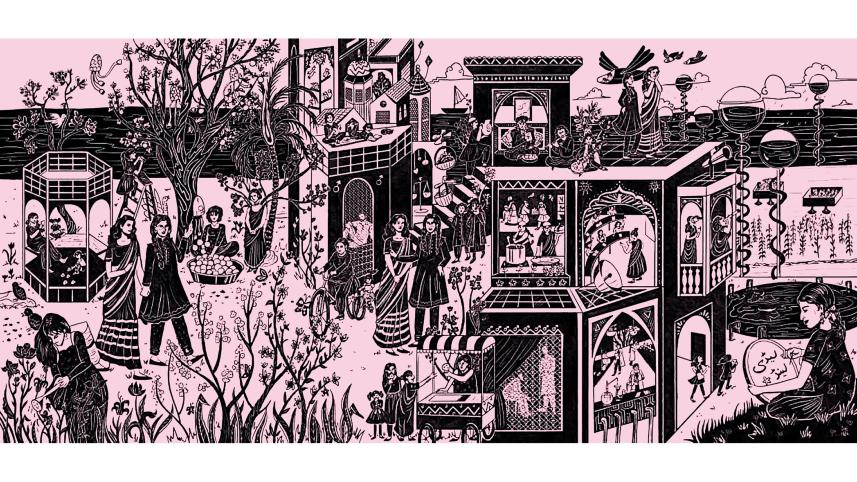
Begum Rokeya Sakhawat Hossain wrote a short story "Souro Jagat" (The Solar System) in the early 1900s in which Gauhar, an enlightened father of nine daughters, was determined to send his girls to the renowned Dow Hill School in Kurseong. His brother-in-law Jafar opposed the decision, fearing that convent education would turn his nieces into Christians. But Gauhar and his wife remained confident this could never happen as they had acquainted their daughters with Islamic ideals and texts from early childhood.
This short story offers the message that individuals grounded firmly in their faith can navigate the modern world without losing themselves. But Begum Rokeya must have had an epiphany that made her change her mind. A few years later, in 1911, Begum Rokeya established the Sakhawat Memorial Girls' School for Muslim girls. This was the first school for Muslim girls in colonial India. The school started with just eight students in a rented room on Walliullah Lane in Calcutta. By the time she passed away in 1932, the school had grown to 149 students.
 For all latest news, follow The Daily Star's Google News channel.
 These numbers spark the question: why was change so incremental? The answer perhaps lies in the population she chose to focus on: middle- and upper-class Muslim girls. The number of bonedi Muslim families that could be convinced to send their daughters to school was limited in pre-Partition India. But it also raises the question: Did Begum Rokeya want to limit education to middle-class women, as that question might imply?
In this essay, I tackle this question to say: it's probably a bit more complicated than that.
The respectable middle class
Begum Rokeya went door-to-door to persuade middle-class, educated Muslim families to send their daughters to school and place them in the public domain. However, she made a promise to them: purdah norms would not be violated. She kept that promise. The school buses that transported the girls were curtained (and mockingly called "moving black holes" by non-Muslim communities). The school had a separate namaaz room with facilities for ablutions. Their curriculum included daily Quran readings. Begum Rokeya herself, despite privately critiquing the practice, maintained strict purdah throughout her life. She understood that without such compliance, her school could not exist. This was a strategic decision that allowed her to do the work she wanted to do. That practice persists today: it is exactly the same strategy that the female labour force in Bangladesh maintains to navigate public space.
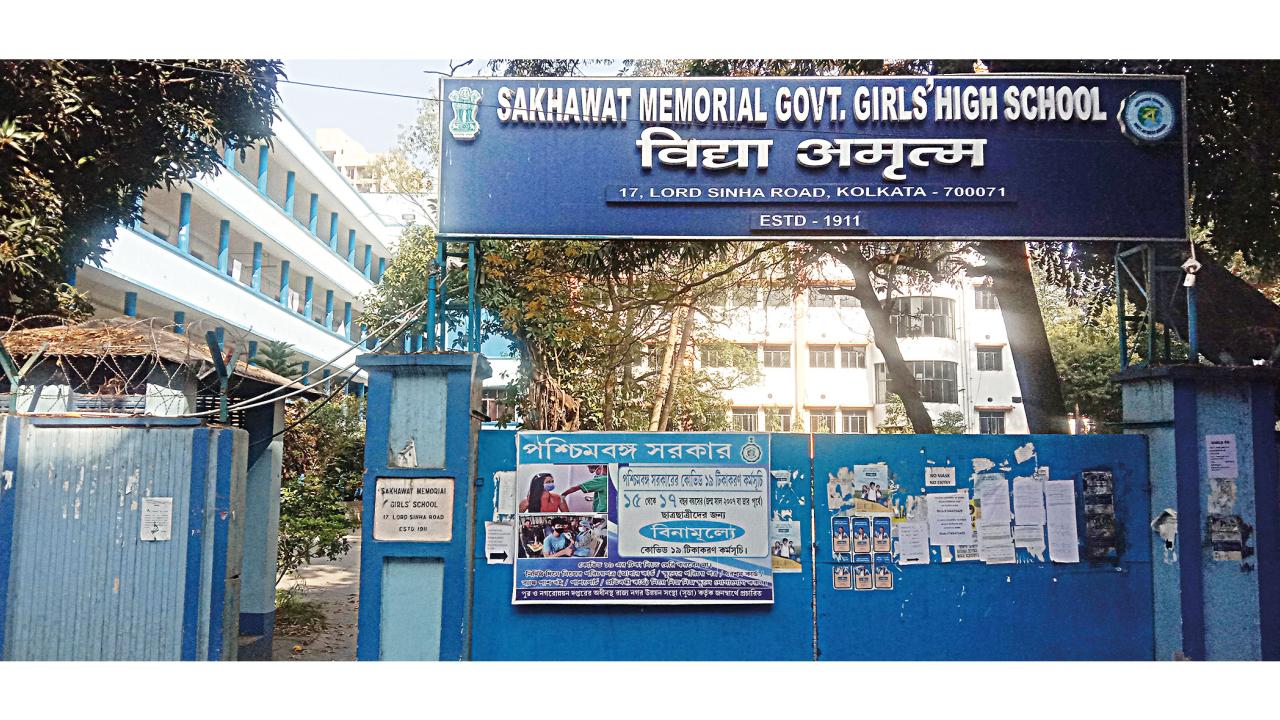
By 1927, the school had become a high school, inclusive of boarding facilities for girls from district towns across Bengal. Middle-class Muslim girls were at the helm of breaking the prohibition against leaving home to study. This is an achievement that would have seemed impossible just decades earlier. The school offered a modern curriculum: English, mathematics, science, geography, history, public administration, alongside "home economics" skills like embroidery. Students participated in inter-school sports competitions and cultural activities. In other words, girls were offered what boys had been getting all along.
However, as I mentioned at the outset, her work primarily addressed the educational needs of upper- and middle-class Muslim girls. Part of the reason was perhaps that school attendance required resources that low-resource families simply could not afford: fees, time away from necessary labour, the ability to maintain purdah observance. However, the critique remains: her class-specific focus seemingly neglected the compounded economic and labour constraints faced by lower-class women in colonial Bengal, women who needed both education and economic mobility. Her writings, including the famous Sultana's Dream, often prioritised intellectual empowerment over material inequalities that precipitate women's subjugation.
One reading of her decision to focus on the middle and upper classes is her own class position. As Farida Akhter observes, "in considering Rokeya's writings and works, we see that the Begum prefix has become a symbol of feminism and helps Rokeya stand as a feminist figure, [but] the honorific 'Begum' itself denotes class status." Begum Rokeya's work, then, remains, at least partly, tethered to the middle-class respectability she both challenged and embodied. Indeed, it cannot be denied that it is her class position that allowed her entry into the homes of middle- and upper-class women. Someone from a lower stratum would not have had that kind of access and subsequent success in setting up a school for Muslim girls.
But, as I said, it is more complicated than that.
Perhaps a more plausible reading is that Begum Rokeya had the foresight to think that if "respectable" families sent their daughters to school, others would follow. It was strategic for her to start her intervention with the middle classes, given the disproportionate power they have in configuring social life and social norms.
But as we can glean from the fairly small increase in the number of students over 20 years, her approach only enabled incremental gains during her own lifetime. The cultural and ideological change regarding Muslim women's education was slow. In fact, one might argue, the ideological rationale for girls' education is still contested if we stop to listen to what our Islamic leaders in Bangladesh have to say about women's place in society. But if we take school enrolment into account, we see that girls have made huge leaps, particularly in completing primary education in Bangladesh. We no longer have to worry about putting girls in school (I hope), our concern is now about the quality of education that students receive.
But during Begum Rokeya's lifetime, she did not see much of these gains, which came much, much later. During her lifetime, she was held back by inadequate grants from the colonial government and, more painfully, by the "colossal indifference" of her own community (Gupta, 2013). Some members went further than indifference; they called Begum Rokeya a "whore and an embezzler of funds" (Gupta, 2013), reminiscent of the vandalised portrait of Begum Rokeya with the word magi inscribed on it that I witnessed during the 2024 uprising in Dhaka.
This was the price of her audacity: a woman who dared to educate girls, who moved through the city managing a school, who handled money and dealt with men in official capacities, became a target for the most vicious accusations her community could level. Indeed, to use the word whore to disparage a woman means to dismiss her, discredit her, render her insignificant.
While the betrayal was a location of psychological pain, the colonial state's neglect led to material harm for the school. Intermittent funds meant she could not maintain enough purdah buses. The school struggled to enrol day scholars at the pace Begum Rokeya had hoped for. Girls from other parts of Bengal who wanted to attend had to be rejected because there were not enough resources to run a proper boarding facility until the late 1920s (Gupta, 2013). Even the government-appointed school inspectors acknowledged that Muslim girls' schools were being short-changed in funding allocations. Hridaybala Bose, Inspector of Schools for the Presidency and Burdwan Divisions, testified in 1934 that Muslim girls were not receiving their fair share of the grants available for female education.
As such, the school never had a building of its own during Begum Rokeya's lifetime, a reminder that she did not chase accolades; she did what she believed in until she died. Her last years, between 1927 and 1932, she exhausted herself trying to secure government approval for a plot of land and funding for a permanent structure. She lobbied relentlessly, facing the government's delays and the indifference of Muslim ministers in the Bengal government. In March 1931, just a year before her death, she addressed the school's managing committee with frustration. She shared that many people considered her a nuisance because she was always begging for her school, and then added that if she had believed in idol worship, she would have badgered a goddess for a building so the school could grow and prosper, gently pointing out the disparity between resources available to Muslim and Hindu girls (Gupta, 2013).
Four years after her death, in 1936, Sakhawat Memorial finally became a fully government-aided institution. In 1937, it moved into a spacious colonial building with extensive grounds on Lord Sinha Road. After Partition, the school opened its doors to girls of all communities. By the end of 1948, the curtained buses that had been essential to its founding were gone. The world had changed, in part because of what Begum Rokeya had done by putting Muslim girls in the public domain.
Indeed, Begum Rokeya helped bring about structural change through the expansion of education to Muslim girls, but her work also demonstrates that working within existing social structures (e.g., by maintaining purdah, observing religious practices) is necessary for survival and success. This "change-from-within-the-system" ideology prevails to this day. But as we now know, change from within can only go so far.
Begum Rokeya, however, made this strategy work. Her strategy extended to making change in intellectual spaces. Her secondary battle was fought in the domain of language, where she challenged entrenched cultural and religious biases that favoured the Urdu language to assert the importance of Bengali for Muslim girls.
The battle for mother tongue
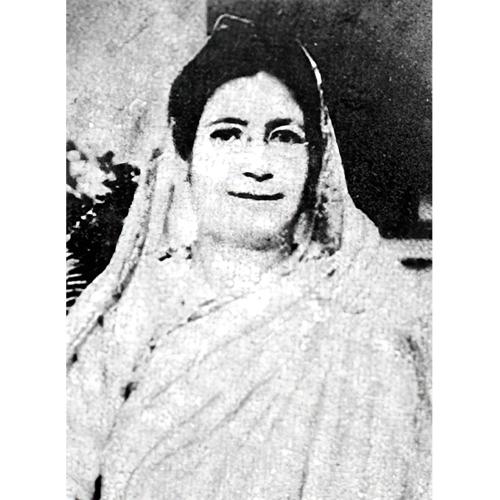
Within the constraints of having to work within the system, Begum Rokeya achieved something revolutionary in her battle over language, perhaps a natural offshoot of her pursuit in the domain of education. In 1917, she introduced Bengali as a subject in her school, defying opposition from families who considered Bengali a "Hindu language" unsuitable for respectable Muslim girls. At the 1927 Bengal Women's Education Conference, Begum Rokeya lamented that "the Muslims of Bengal miss their mother because they don't have a mother tongue," arguing that the Quran must be translated into regional Indian languages (cited in Gupta, 2013). This political intervention created a ruckus, as one can imagine. Respectable Muslim families in Bengal were caught between choosing "Islamic Urdu" and "Hindu Bengali," an odd dilemma given most upper-class Bengali Muslim families spoke what Begum Rokeya called "bad Urdu."
Her intervention did not float well. As soon as Begum Rokeya introduced Bengali in 1917, enrolment dwindled until she had only three students. By 1919, she had to discontinue Bangla as a subject (Gupta, 2013).
She, however, did not forget her project. In the mid-1920s, as Bengali Muslim intellectuals increasingly asserted their ethno-linguistic identity, Begum Rokeya successfully resumed a Bengali section parallel to the Urdu section in her school. This seemingly technical curricular decision had deep positive implications. When students learned to read and write in their mother tongue, they gained the ethno-linguistic identity, Gupta (2013) suggests, in line with the interests of Bengali Muslim intellectuals. Furthermore, they could access the Quran in a language they actually understood, rather than parroting Arabic or struggling with imperfect Urdu (Gupta, 2013).
The "fruits of this labour" became visible in 1952, Gupta (2013) argues, when middle-class Bengali Muslim women poured into the streets of Dhaka to protest the Pakistani government's attempt to impose Urdu as the sole state language. To Gupta, this was astounding, as only a decade earlier Muslim women were sequestered at home at the behest of the ulemas of the 1940s in pre-Partition India. The sari-clad women marching in protest in 1952 represented a break from the idea of the severely secluded woman. Gupta (2013) wants us to consider that it was education that instilled in women a sense of self-respect that was linked to taking pride in the language they considered their own.
Indeed, Begum Rokeya recognised the problem of working in silos. She reckoned educational and linguistic reform are important only if they translate to greater freedom for women. Further, she recognised that true freedom could not be reduced to symbolic gestures like discarding the purdah. Indeed, liberation is not about what one wears or does not wear but about the values they live by. As such, for women to be free would mean for them to be independent, which perhaps underscores her critique of token freedoms one lives by.
Beyond token freedom
Begum Rokeya understood women's oppression and male privilege as intrinsically related. In her 1904 essay, "Amader Abanati," she wrote: "Whenever a woman has tried to raise her head, she has been crushed with the excuse of religion or the holy texts... I have to say that ultimately 'religion' has strengthened the bonds of our enslavement; men are lording over women under the pretext of religion" (cited in Mahua Sarkar, 2013, 13). Religion remains a tool of control wielded by men in positions of real or perceived power. And, because Bangladeshis do not learn the Arabic language, only the notation, it is impossible to know whether it is religion or certain men's reading of the religion that is seemingly against women's emancipation, or whether it is an excuse, as Begum Rokeya suggests, to judge and punish women.
Suffice to say, Begum Rokeya's critique drew fierce criticism from liberals and conservatives alike, as it does even today. By the time Begum Rokeya's essay was republished in 1905, five provocative paragraphs had been removed. Begum Rokeya, however, maintained that women's liberation requires more than men's benevolence (Sarkar, 2013). Indeed, women's liberation requires that people get out of their way.
What is striking is that Begum Rokeya did not simply denounce men; she critiqued women and their complicity in their own subordination, pointing to what we might recognise as internalised misogyny today. For instance, her critique of women's love of jewellery, when she says "prisoners wear iron shackles... we lovingly wear chains made of gold and silver" to imply that women are wilful prisoners, is an indictment that is still relevant (cited in Sarkar, 2013, 15). She was keenly aware that women internalised and celebrated the symbols of their dependence on men in the name of love and devotion. She challenged the notion of femininity as being dependent on men, which she saw as antithetical to the idea of freedom. She distinguished between the token freedoms granted to elite Hindu/Brahmo or Parsi women, such as being allowed to discard purdah, while they were still dependent on men: "When men kept them in the antahpur (inner quarters) they stayed there. And when men forced them to come out they came out of purdah. What is women's achievement in this? Such token opposition to purdah is never praiseworthy" (cited in Sarkar, 2013, 17).
Most radically, particularly for that time, Rokeya insisted that equality required economic independence. "To achieve equality with men we will do whatever is needed of us," she wrote. "If we have to earn our own livelihood, we will do that" (cited in Sarkar, 2013, 16). Although that can be read as wanting women to be like men, as some do, the focus is on women's employment as a path towards gender equality.
This vision of women's autonomy, grounded in self-sufficiency and psychological wellbeing, as well as economic independence, put her in debate and conversation with male reformers and contemporaneous women writers, who, Sarkar (2013) rightly points out, are part of the zeitgeist that made Begum Rokeya. Although Begum Rokeya is singled out as a lone figure in early Bengali feminism, possibly because we like hero narratives, she worked alongside others such as Khaerunnessa Khatun and Masuda Rahman, and inspired a generation of women—Sufia Kamal, Faziltunnessa, even my own grandmother Noorjehan Murshid—who pushed boundaries in their own ways (Sarkar, 2013).
Memory
Begum Rokeya's enduring influence has been institutionalised over time. Her name has been used (and abused) to claim or distance from feminist politics. For instance, a women's residential hall at Dhaka University bore her name. Bangladesh observes Rokeya Day every December 9. Her school stands tall on Lord Sinha Road and has been open to girls of all communities since Partition.
Indeed, Begum Rokeya's legacy is monumental. But it is also instructive. Her work demonstrates that structural change often begins with compromises such as working within the system to create change from within. But, as this essay has argued, such strategies have limits. In Bangladesh, for instance, progress in educational spaces allowed the inclusion of girls, but the quality of education is constrained by a three-tier class-based system that deepens class-based inequity. By focusing on middle-class respectability, Begum Rokeya initiated a cultural shift that expanded the boundaries of what counts as respectable, but the focus on respectability has also become a way to control women's personal lives.
I go back to the initial question: does any of this mean that Begum Rokeya wanted to limit education to middle-class girls/women? The answer is no – she wanted their buy-in, and that of their families, because they set the standard for what is acceptable. That she critiques wealthy women's token freedom is indicative of her desire for actual freedom for all women. Finally, her take on economic independence, ostensibly a way to advocate for women from low-resource households to be able to work without judgement and morality policing, makes clear that the kind of freedom she envisioned is grounded in material equality, which she thought could be bridged through education.
That her work remains in progress is an indictment of us as a society and as a people, not her ideas.
Nadine Shaanta Murshid, PhD, is Associate Professor, School of Social Work, University at Buffalo. She is the author of Intimacies of Violence: Reading Transnational Middle-Class Women in Bangladeshi-America published by Oxford University Press in 2024.
Send your articles for Slow Reads to slowreads@thedailystar.net. Check out our submission guidelines for details.
Comments