


'Don't wait until El Niño risks become a real crisis'

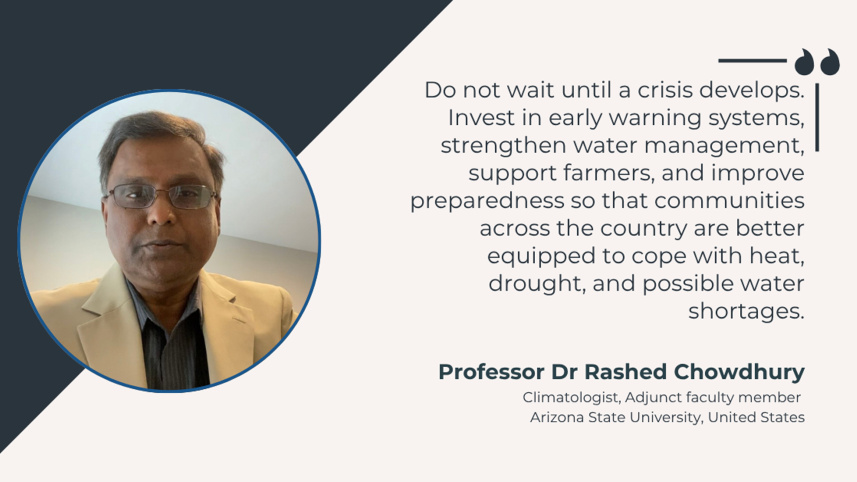
Dr Rashed Chowdhury, a climatologist and adjunct faculty member at Arizona State University in the US, speaks with Pinaki Roy of The Daily Star about the possible impacts of El Niño on Bangladesh, why its different variants matter, and how the country should prepare for the risks ahead.
Last month, the UN weather agency warned of the likelihood of El Niño intensifying later this year. What are the most likely impacts of El Niño on Bangladesh?

We have seen extensive media coverage of El Niño, including from the UN, but much less attention has been paid to its different variants. This distinction is particularly important for Bangladesh because the two main types—Eastern Pacific El Niño (EPE) and Central Pacific El Niño (CPE), also known as El Niño Modoki—can have different impacts.
For example, EPE events during 1982-83, 1991-92, and 1997-98 brought dry conditions and drought to Bangladesh, whereas CPE events during 1987, 2015-16, and 2023-24 were associated with wetter conditions and flooding. The EPE is characterised by the strongest sea surface temperature (SST) warming in the Eastern Pacific Ocean, while the CPE exhibits maximum SST warming farther west in the Central Pacific. Therefore, before linking El Niño to seasonal climate variability in Bangladesh, we must first understand which variant is developing.
Normally, if El Niño develops before or around the onset of monsoon in South Asia, it can have a significant influence on rainfall across the region, including Bangladesh. This year, however, El Niño is expected to develop relatively late, towards late summer or even winter. Because of this timing, Bangladesh may not experience the more typical impacts associated with a strong EPE event, such as the major monsoon failures of 1982-83 or 1997-98.
It is also worth noting that, although the SST pattern associated with the developing 2026 El Niño currently resembles an Eastern Pacific event, the atmospheric response is more characteristic of a Central Pacific El Niño. This is one reason why Bangladesh has so far experienced wetter-than-normal conditions.
People often confuse El Niño with climate change. How are they different?
Yes, El Niño and climate change are not the same thing. El Niño is a naturally occurring climate phenomenon that develops periodically, whereas climate change is a long-term shift in the Earth’s climate driven primarily by human activities. Global warming does not cause El Niño. That said, it can amplify its impacts. In Bangladesh, this can mean more intense heat, greater water stress, increased flood risks, and more severe impacts on agriculture and livelihoods.
A simple way to think about it is: climate change is like raising the baseline temperature, while El Niño is a temporary push on top of that. Climate change gradually increases temperatures and climate risks over decades, while El Niño alters temperature and rainfall patterns over several months.
What risks does El Niño pose to Bangladesh’s rice production and overall food security?
El Niño can reduce rice production by bringing higher temperatures, delayed or weaker monsoon rainfall, and drought conditions, all of which can lower crop yields. Lower rice production can lead to food shortages, higher prices, and increased food insecurity, particularly among low-income households. Overall, El Niño threatens Bangladesh’s food security by affecting agricultural livelihoods, reducing food availability, and increasing the cost of staple foods.
What steps should the government take for farmers if El Niño conditions persist?
If El Niño conditions persist, the government should strengthen early warning systems, promote drought-tolerant crop varieties, improve irrigation facilities, provide financial and technical support to farmers, expand crop insurance, and maintain adequate food reserves to safeguard food security.
In the longer term, Bangladesh could consider developing a comprehensive weather-based insurance programme similar to the Total Weather Insurance (TWI) schemes used in several countries. TWI provides season-long protection against weather-related risks that reduce crop yields and farmers’ incomes. Such programmes use detailed information on weather patterns, climate trends, soil conditions, crop types, field locations, and other factors to design more accurate, farm-specific insurance coverage. This approach could help reduce farmers’ financial losses during climate extremes associated with El Niño, La Niña, and other weather-related events.
Could El Niño worsen water shortages or reduce river flows, especially during the dry season?
Yes. El Niño can have a major impact on Bangladesh’s water resources. It can reduce rainfall and weaken the monsoon, leading to lower river flows and water shortages, especially during the dry season. This can affect irrigation, drinking water supplies, fisheries, and agriculture, increasing the risk of drought in vulnerable regions. Reduced water availability can also put additional pressure on water needed for farming, industry, and households.
If the 2026 El Niño strengthens as projected by some climate-monitoring agencies, Bangladesh may face increased risks of water stress and energy shortages in late 2026 and early 2027. Prolonged dry conditions could reduce water levels in rivers, reservoirs, and other sources, affecting hydropower generation and increasing pressure on electricity supplies. Experience from other countries shows that severe droughts can force the authorities to introduce water conservation measures and manage electricity demand when water shortages disrupt power production.
What effects might it have on groundwater, drinking water availability, and irrigation?
Because El Niño can reduce rainfall and river flows, it can mean less water being available to recharge groundwater. As a result, groundwater levels may decline, especially in drought-prone areas such as northwestern Bangladesh. This can make it more difficult for people to access safe drinking water, worsen salinity intrusion in coastal areas, and create irrigation challenges for crops like Boro rice. For farmers, water shortages can increase production costs and lower crop yields.
How well prepared is Bangladesh to cope with an El Niño year? What should the government prioritise?
 For all latest news, follow The Daily Star's Google News channel.
 Bangladesh has some capacity to cope with El Niño through weather forecasting, irrigation infrastructure, and agricultural support programmes. However, the country still has limited capacity to independently forecast El Niño and prepare for its longer-term impacts, particularly in drought-prone regions. So, as I have indicated earlier, to better manage El Niño risks, the government should prioritise improving early warning systems, promoting drought-tolerant crop varieties, strengthening water management, supporting farmers, protecting groundwater resources, and maintaining adequate food reserves.
An important step forward would be to strengthen the capacity for monitoring and forecasting the El Niño-Southern Oscillation (ENSO). This can be achieved through closer collaboration between Bangladesh’s weather and climate institutions and leading international ENSO research centres. Such partnerships would improve access to climate information and support the development of more localised seasonal forecasts for farmers, policymakers, and disaster managers.
If you could give one message to policymakers and one to ordinary citizens about preparing for El Niño, what would that be?
Although there is still some uncertainty, current indications suggest that we may be heading towards a strong Eastern Pacific El Niño. If this develops as expected, Bangladesh could experience significantly drier-than-normal conditions during the latter part of 2026 and early 2027.
It is also important to remember that El Niño is only one component of a much larger climate system. Bangladesh’s rainfall patterns are influenced by several interacting climate drivers, including the Indian Ocean Dipole (IOD), the Madden-Julian Oscillation (MJO), and other large-scale oceanic and atmospheric processes. A reliable assessment, therefore, would require continuous monitoring of not only El Niño but also these other factors in the coming months.
My message to policymakers, therefore, would be: Do not wait until a crisis develops. Invest in early warning systems, strengthen water management, support farmers, and improve preparedness so that communities across the country are better equipped to cope with heat, drought, and possible water shortages.
My message to citizens: Stay informed through regular weather updates, use water wisely, and follow official guidance. Small actions by individuals and communities can collectively make a meaningful difference in reducing the impacts of El Niño.
Follow The Daily Star Opinion on Facebook for the latest opinions, commentaries, and analyses by experts and professionals. To contribute your article or letter to The Daily Star Opinion, see our guidelines for submission.
Comments