


77 years of Awami League: From people’s vanguard to an autocratic machine

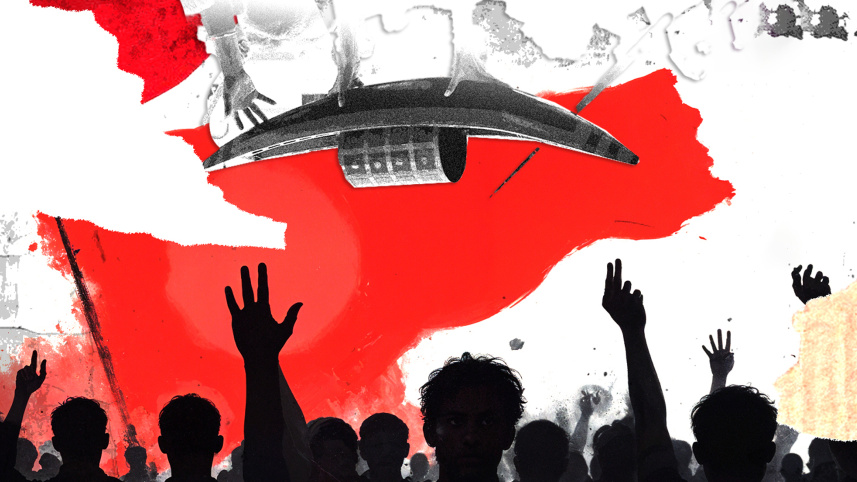
The territory that constitutes Bangladesh has been a political hotbed since the dawn of the 20th century. The country entered a new era in August 1947, after the partition of India, including Bengal. The Bangalee youth played a catalytic role in rallying the masses towards another independence, while the country shed the attire of Islamic brotherhood to linguistic fraternity. During this period, we see the advent of a political party named Awami League (AL), which steered a popular movement for autonomy. The Bangalee Muslim middle-class emerged as a dominant social force. AL cultivated language-based nationalism among them over a span of two decades, paving the way for a new state, Bangladesh.
Awami League’s birth was not an accident. Conditions were ripe. A section of the disgruntled rank-and-file of the ruling Muslim League (ML) convened a meeting in Dhaka on June 23, 1949, to voice their grievances. From there emerged the idea of forming a political party of ML supporters outside the orbit of the official ML dominated by the political elite centred at the Ahsan Manzil. The contradiction between ML and AL sharpened in a couple of years, centring the debate on the state language issue. Subsequently, AL emerged as a formidable opposition party.

At the provincial level, a veteran ML leader Maulana Abdul Hamid Khan Bhashani led AL. At the centre in Karachi, disgruntled ML leader Huseyn Shaheed Suhrawardy provided leadership of the All-Pakistan Awami League. Soon, AL became a serious contender for power. It joined hands with Abul Kasem Fazlul Huq and his Krishak Sramik Party (KSP). Their alliance led to a win-win situation. AL pledged support to Fazlul Haque to form the government in East Pakistan. In return, KSP would support Suhrawardy to become Pakistan’s prime minister. This alliance successfully routed the ML government in the provincial election of 1954. Fazlul Haque became the chief minister of the erstwhile East Pakistan. Suhrawardy had to wait two years to become the PM. These two years and beyond, Pakistan witnessed dirty power politics that paved the way for emergency and military rule in the country in October 1958. Then came the prolonged dictatorial rule of General-turned-Field Marshal Mohammad Ayub Khan. Ayub may certainly be recognised as the founder of a person-centric oligarchy that has been followed by his successors to date.
The 1960s were characterised by an anti-Ayub student movement that was transformed into a mass movement for democratisation and provincial autonomy. AL was the leading party in this respect. During this period, AL’s General Secretary and later President Sheikh Mujibur Rahman rose to prominence. He was successful in establishing himself and his party as the sole spokesperson of Bangalee interests. People of the province started believing that AL would represent their aspirations better than anyone else. This popular support put AL at the helm of affairs. It won the general election of 1970 with a huge mandate.
Then we were caught in a serious crisis. The military powers in West Pakistan imposed a war, indiscriminately killing Bangalees and perpetrating a genocide. An unprepared AL was in disarray. Having failed to have a negotiated settlement, Mujib courted arrest. His colleague, Tajuddin Ahmad, crossed the border, met the PM of India, and formed an exile government for independent Bangladesh, despite the opposition of many of his party colleagues. After nine months of war, Bangladesh was born.
Sheikh Mujib returned to Dhaka from captivity in Pakistan in January 1972. He assumed the leadership of the government. There began the second phase of AL, from opposition to a party in power. However, AL failed to meet the expectations of the people in a war-torn economy afflicted with massive inflation, bureaucratic inefficiency, and random corruption. Instead of addressing the crises, it tightened its grip on politics and switched to one-party rule. This centralisation of power was not an ideological choice, but a desperate move resulting from the government’s refusal to concede political space or accept pluralistic debate. Sheikh Mujib was assassinated, along with most of his family members, in a bloody coup d’état in August 1975. AL then went into hibernation and underwent several splits.
The post-1975 AL was marked by desperate efforts to get the momentum back. After 21 years, it again came to power through a general election. By this time, Mujib’s daughter, Sheikh Hasina, emerged as a new leader, thus ushering in the AL dynasty.
Over the years, the country has repeatedly experienced manipulated elections. In 2007, AL’s actions contributed to a crisis that ushered in a military-backed regime. After two years, the country returned to the conventional parliamentary system, bringing AL back to power. Since then, it has gradually established totalitarian rule and lost its identity to the former PM Hasina. She became the state. Autocracy, dynastic oligarchy, and massive corruption created a situation where a constitutional transfer of power through a genuinely competitive election became increasingly unlikely. After three consecutive farcical elections, the country witnessed a dramatic upsurge in 2024 that toppled her. She fled to India.
The trajectory of AL, from a liberation vanguard to a dominant, heavily personalised, and autocratic political machine within a span of a few decades, is nonetheless interesting. Despite having a collective leadership in its formative years, AL has historically revolved around a single, dominant figure. After 2008, AL underwent a deep transformation, alienating it from its traditional roots, the middle-class. It indulged in a culture of cronyism, power worship, and sycophancy. And it suffered as a result.
Since the July uprising of 2024, AL is officially non-functional; its activities were banned last year. There are rumours that it will return from exile. The party may argue that the people have not rejected them electorally, and that the government, driven by political vengeance, has kept them out of that process. However, does AL truly want to return to or become active in politics? Judging by the attitude of their leadership and their failure to acknowledge and repent for the crimes they committed, it doesn’t seem so. The top leaders of the party are all fugitives. The party chief, Hasina, remains practically the owner of the party. Nothing in her behaviour suggests she wants to return to politics. However, many within AL, reportedly, believe that some external force will once again restore them to power.
It is difficult to predict AL’s fate as it reaches its 77th anniversary. Those who were successful in ousting the AL in the 2024 uprising may feel that the party has been defeated once and for all. However, if the aspirations of the 2024 movement fail, it may create conditions for AL’s return. At this moment, though, that seems a distant possibility.
Mohiuddin Ahmad is a writer and researcher of Bangladesh’s political history.
Views expressed in this article are the author's own.
Follow The Daily Star Opinion on Facebook for the latest opinions, commentaries, and analyses by experts and professionals. To contribute your article or letter to The Daily Star Opinion, see our guidelines for submission.
 For all latest news, follow The Daily Star's Google News channel.
Comments