


Amid water-sharing uncertainty, rainwater harvesting deserves greater focus

Bangladesh has nine months left on a treaty it cannot afford to lose, and no fallback plan if it does. The 1996 Ganges Water Treaty, which has governed dry-season flows from the Farakka Barrage for three decades, expires this December. Renewal talks between Dhaka and New Delhi have still not begun formally, and West Bengal’s domestic politics continue to complicate any future agreement. Meanwhile, the Himalayan glaciers that feed the Ganges, Brahmaputra, and Meghna are retreating faster than at any point in recorded history. Even in the best-case scenario, where the treaty is renewed on favourable terms for Bangladesh, downstream water supply would still be tied to a melting ice reserve it cannot control and an upstream negotiation it cannot dictate.
These realities underscore the need for a parallel strategy, one that can reduce Bangladesh’s vulnerabilities and help secure the water future of almost 18 crore people.

What is striking is that Bangladesh does not actually have a water scarcity problem. It has a water management problem. The country receives between 1,500 and 3,000 millimetres of rainfall a year, among the highest averages anywhere in the world. Almost all of it runs straight off the land, contributing to the flooding and waterlogging that paralyse Dhaka, Chattogram, and Khulna every monsoon, instead of being captured and stored for the dry months when water is needed most.
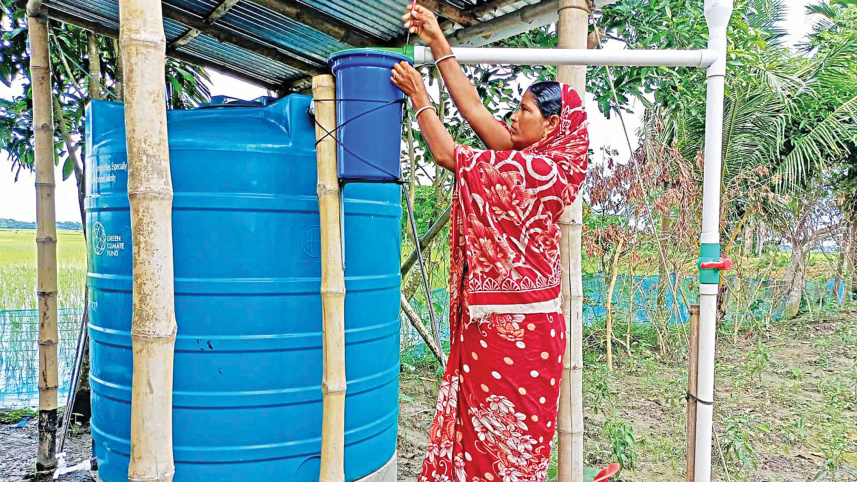
That is a paradox worth solving, and the technology to solve it is there already. Rainwater harvesting at scale, supported by tiered reservoir networks, treatment to international drinking-water standards, and dual distribution systems for households and farms, is already practised successfully in water-stressed regions elsewhere. Bangladesh’s own nationwide canal excavation programme provides a ready-made structure that such a system could be built around, rather than requiring new infrastructure corridors from scratch.
A nationally scaled rainwater harvesting network could extend safe water access to tens of millions of additional citizens within a few years, cut national groundwater extraction, ease urban waterlogging that costs the economy dearly every rainy season, and open many additional agricultural hectares to reliable surface irrigation, while creating substantial employment along the way.
None of this is an argument against pursuing a strong, fair renewal of the Ganges treaty. Bangladesh should absolutely continue pressing for an agreement that reflects climate realities and guarantees proper flows. But treaty diplomacy and domestic water self-sufficiency are not competing priorities; they are complementary, and conflating them is precisely what leaves Bangladesh exposed. A country should never let its water security depend entirely on the goodwill of a neighbour or the pace of a glacier’s retreat, however constructive that neighbour intends to be.
To its credit, the BNP government has already signalled urgency on the treaty front, with the foreign ministers of both countries meeting in April to discuss renewal terms. That same urgency now needs to be matched on the domestic side of the equation.
A feasibility review of a national rainwater harvesting programme, anchored by pilot projects in each of the country’s distinct hydrological zones, could be commissioned within months and begin generating real performance data before the December deadline arrives. Bangladesh spends every monsoon fighting its own rainfall as a hazard to be drained away. It would do far better to instead start treating this water as the national asset it actually is. The only question is whether the country captures and stores it sufficiently, or watches it disappear while continuing to place its water security in the hands of upstream politics and a shrinking Himalayan ice reserve.
Ahmed Mukta is a fellow of the Chartered Association of Building Engineers (CABE), UK and principal of MDM Architects (Mukta Dinwiddie MacLaren).
Views expressed in this article are the author's own.
Follow The Daily Star Opinion on Facebook for the latest opinions, commentaries, and analyses by experts and professionals. To contribute your article or letter to The Daily Star Opinion, see our guidelines for submission.
 For all latest news, follow The Daily Star's Google News channel.
Comments