


Digital cards and the reality of poverty in Bangladesh

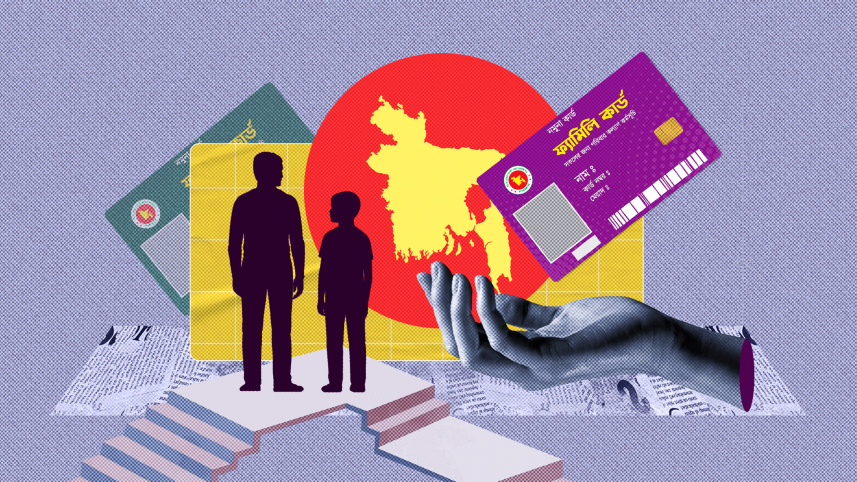
According to the World Bank’s April 2026 Bangladesh Development Update, the country’s poverty rate increased to 21.4 percent in 2025 from 18.7 percent in 2022, adding 14 lakh more poor people in 2025. At present, the government’s increasing number of digital welfare programmes—Family Card and Farmers’ Card—appear to be well-justified. But the question remains whether technology can meaningfully benefit those in the greatest need.
From an administrative perspective, the family card initiative is indeed a landmark project. It was launched on a trial basis last month in 14 upazilas, offering Tk 2,500 per month to over 40,000 women-headed households over four months. Simultaneously, the government is implementing 95 programmes under its social protection budget of Tk 1.26 lakh crore for the current fiscal year, accounting for 1.87 percent of the GDP.

Nonetheless, a fundamental problem within the economy has yet to be addressed. According to the Bangladesh Bureau of Statistics (BBS), inflation has been higher than wage growth for 50 consecutive months till March 2026, despite a gradual rise in pay since February 2022. The BBS also reported a reduction in real wages by 1.9 percent in FY 2024. Given this state of the economy, improving food distribution via digital cards may not be of much use unless the actual volume of assistance keeps pace with rising market prices
A substantial portion of the 21.4 percent poverty rate comprises the new poor—once self-sufficient middle- and lower-middle-class families whose modest savings have been wiped out by successive shocks. The World Bank says that almost one-third of the population is still at risk of becoming poor because of a simple shock such as a natural calamity or illness.
The government’s own family card implementation guidelines acknowledge a structural failure in the existing system: an estimated 22-25 percent of the actual poor are currently excluded from existing social programmes, while fragmentation and weak inter-ministerial coordination cause persistent duplication among the 95 social protection schemes. A complete digital platform will be helpful for avoiding repetition, but it can result in exclusion in rural areas due to a lack of digital skills within the community, poor internet connectivity, and reliance on OTPs.
For digital welfare reform to make a lasting difference, upgraded systems must be paired with meaningful policy changes in three areas: adequate benefit levels, responsive targeting, and proper funding.
First, benefit amounts must be automatically adjusted in line with inflation, ideally using the Consumer Price Index or a food-specific basket relevant to low-income households. Countries such as Brazil—through its Bolsa Família programme—and Argentina—through its Universal Child Allowance—have successfully applied such indexing.
Second, Bangladesh must move beyond static beneficiary lists. The family card’s pilot design, using a dynamic Proxy Means Test and field surveys of 320,000 families across 14 wards, is a step in the right direction. The World Bank has repeatedly noted that dynamic registries linked to national identification systems significantly improve accuracy and the capacity to respond to economic shocks.
Third, present expenditure on core social safety net programmes is still small. Even with the government’s figure of 1.87 percent of GDP overestimates welfare expenditure because it includes public sector pension schemes and savings certificates. The actual rate is closer to 1.32 percent of GDP. In its family card programme guidelines, the government aims to increase social security spending to three percent of GDP by 2028. Meeting this goal requires more efficient revenue generation and resource allocation through targeted interventions rather than misdirected subsidies. It should be noted that, in 2022, the World Bank found that 35 percent of the wealthiest households received social protection benefits in Bangladesh, while half of the poorest families did not.
Technology can facilitate policymaking, but it cannot replace it. Although the family card system can be applied to improve the efficiency and effectiveness of service delivery, it is not sufficient to fully address increasing poverty. Unless policymakers take decisive steps towards fiscal reforms, lower inflation rates, increase in real wages, and job creation, technology alone won’t do much for the poor in Bangladesh. Policymakers should refrain from falling into the trap of looking for technological fixes for socioeconomic woes. Any improvement in technology will not sustain itself for long due to rising inflation and falling wages, unless there are also good economic growth and strong political will.
Md Rakibul Hasan works with Bangladesh Small and Cottage Industries Corporation (BSCIC). He can be reached at rakib4457@gmail.com.
Views expressed in this article are the author's own.
Follow The Daily Star Opinion on Facebook for the latest opinions, commentaries, and analyses by experts and professionals. To contribute your article or letter to The Daily Star Opinion, see our guidelines for submission.
 For all latest news, follow The Daily Star's Google News channel.
Comments