


Ninth pay scale: Govt jobs are getting better, but what about the private sector?

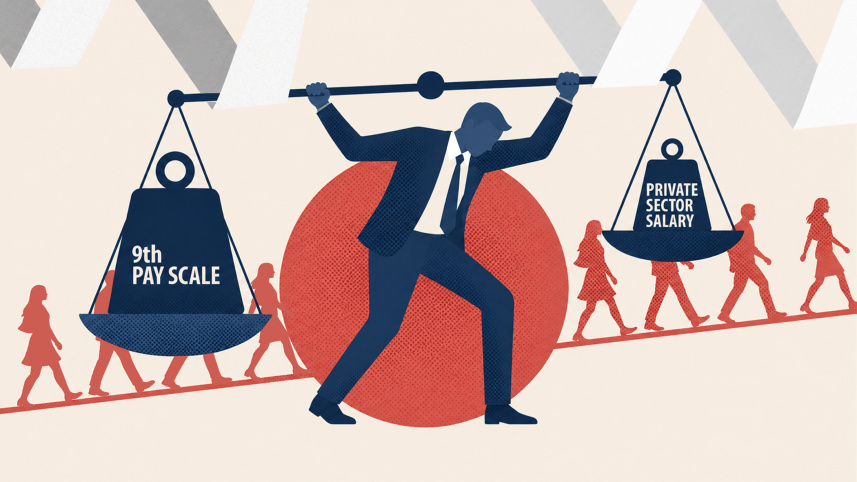
The just-approved ninth National Pay Scale settles one argument and opens another. Government employees now have their desired raise to be rolled out in three phases, with the first starting in July 2026. The fiscal arithmetic behind it has already been debated at length. What has not been discussed enough, however, is what that raise does to the choices many aspirant government job seekers make long before they can draw the salary.
Consider the years that go into getting a job. A BCS candidate often spends years cycling through preliminary tests, written examinations, and interviews, supported by an entire private industry of guidebooks, coaching centres, and evening classes built around that ambition. During these years, a graduate who might otherwise be entering the private workforce, learning a skill or trade, joining a startup, or gaining such professional experience is instead preparing for an exam. This is a rational response to the incentives the state has created and, with this new pay scale, those incentives have become considerably stronger.

The new scale is significant. Basic pay across the 20 grades will rise by 100 to 142 percent. It is, by any measure, a major fiscal commitment, and a defensible one if you consider that the previous scale was introduced in 2015 and government employees have faced the same inflationary pressures as everyone else. The question is what happens when a state substantially improves the rewards of one career path while millions of young people find the alternatives increasingly difficult to access or satisfy their needs.
In Bangladesh, a government job has always offered something the private sector routinely fails to provide: predictability. A fixed pay scale, pension benefits, and job security that survives a bad quarter or a change in management. Now it also offers, at entry level, a basic salary that has roughly doubled. Set that against a private sector where even the government cannot say with confidence what the typical annual salary increase actually is. However, the cabinet secretary has told journalists that private-sector wage increases had been discussed in cabinet and suggested that many organisations raise salaries by 5 to 7 percent annually. This admission is more important than it first appears.
As I have already hinted, the problem is not so much that government jobs are becoming attractive as that the alternatives remain unattractive. For example, for workers at the bottom of the private economy, the current gap is stark. Tea-garden workers, whose daily wage has remained at Tk 187 since 2022, are still fighting for Tk 500 daily wage. Security guards employed through third-party contractors may get monthly salaries of Tk 16,000 to Tk 19,500 (after overtime) for 12-hour shifts. The picture is not much better at the other end of the education ladder. Fresh graduates entering local private firms can find starting salaries of roughly Tk 20,000 to Tk 30,000. Or take doctors. In Dhaka, an MBBS doctor’s starting salary can be Tk 30,000-Tk 40,000 depending on the private hospitals, while outside Dhaka, doctors’ salaries are much lower. These figures may vary. But under the new pay scale, even a grade-20 government employee—such as a cleaner or support staff member—will start with a basic salary of Tk 20,000, matching or exceeding the starting pay of many private-sector workers, including fresh graduates.
This is where it becomes more than a question of public-sector compensation. If the private sector cannot offer comparable security, predictable progression, or competitive starting salaries, the rational response for many graduates is obvious: keep trying for a government job or go abroad, contributing to the country’s brain drain. And that is an expensive choice for our economy. Imagine the cumulative costs of the experience not gathered, the businesses not started, the skills not developed, or the years of productive employment delayed as young people compete for a limited number of government positions.
The pressure is becoming greater because the private sector itself is struggling to expand. Private investment fell to 22.03 percent of GDP in FY2024-25—an 11-year low—and declined further to 21.53 percent by the end of FY2025-26. Private-sector credit growth also fell to just 4.47 percent in June. High interest rates, energy constraints, and continuing uncertainty have made businesses more cautious about investing and hiring.
Bangladesh is thus facing a peculiar convergence: government employment is becoming more attractive just as private employment is failing to offer compelling alternatives. Young people have fewer reasons to leave the BCS queue, and fewer good alternatives when they step out of it. One in five young Bangladeshis, nearly 86 lakh, is neither working, studying, nor training for a job. At the same time, overseas employment—another traditional escape valve for Bangladesh’s labour market—fell to just over 9.69 lakh workers in the last fiscal year, a five-year low.
An estimated 60,000 to 70,000 students also leave the country each year for higher education, drawn by better universities, stronger career prospects and the possibility of a more stable life. For some, the journey is temporary, but for others, education becomes the first step towards longer-term migration through work and further experience. Again, this is mostly because the domestic labour market is failing to offer enough attractive paths forward. That brings us to the government’s own blind spot.
Despite the enormity of the employment crisis in the country, its knowledge of, and response to, the private-sector challenges remain quite poor. The government could establish a regularly updated national wage database by sector, strengthen wage boards and enforcement of the labour law, require greater transparency around pay bands, and ensure that labour protections cannot simply be avoided through job titles. None of this requires the government to arbitrarily dictate private salaries. It just has to properly respond to the labour-market reality instead of leaving workers and employers to navigate it blindly.
The ninth pay scale should not be opposed simply because government employees got a raise, because it was deserved, even though its timing and scale should not be read without context. But the question is why this correction should stop at the state payroll. We cannot build a productive economy by making one career path dramatically more secure while leaving the alternatives uncertain, underpaid, and poorly measured. We cannot keep funnelling young people towards a single, oversubscribed door, while the door that should be opening—private investment, private hiring, and private wage growth—remains only half open.
Nafew Sajed Joy is a researcher and environmentalist. He can be reached at nafew.sajed@gmail.com.
Views expressed in this article are the author's own.
Follow The Daily Star Opinion on Facebook for the latest opinions, commentaries, and analyses by experts and professionals. To contribute your article or letter to The Daily Star Opinion, see our guidelines for submission.
 For all latest news, follow The Daily Star's Google News channel.
Comments