


Our LDC graduation strategy needs revision, regardless of deferral outcome



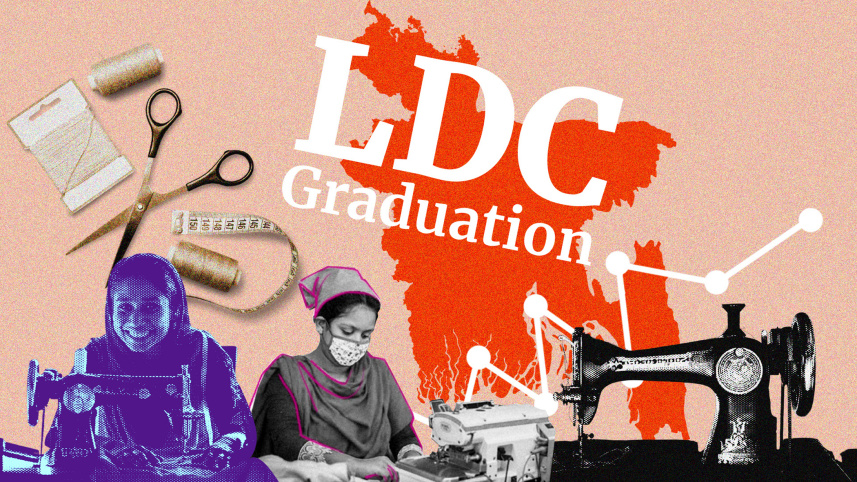
Bangladesh’s graduation from a Least Developed Country (LDC) status is no longer a distant milestone; it is an immediate test of readiness and economic resilience. With graduation set for November 2026 and a possible extension under consideration, the real issue is not timing, but preparedness.
The country first met all graduation criteria in 2018 and in June 2021, the recommendation for graduation from LDC was endorsed with a five-year preparatory period. In early 2025, the Smooth Transition Strategy (STS) to ensure a sustainable graduation was released, providing a sound framework. It is organised around five strategic pillars: ensuring macroeconomic stability; exploring and securing trade preferences and favourable transition measures; promoting export diversification and competitiveness; building productive capacity (including technological upgrading and innovation); and building partnerships and international cooperation. Although it is structurally sound, the context it was prepared in has shifted.
 For all latest news, follow The Daily Star's Google News channel.
 While the UN’s enhanced monitoring process allows for crisis-based review, including deferment, the uncertainty surrounding it carries real costs: delayed compliance, postponed investment, and weakened policy momentum. Bangladesh must be “graduation-ready” regardless of the outcome of this process. The urgency is reinforced by economic realities. Exports fell by nearly five percent to $47.74 billion in 2025 compared to 2024, and RMG, accounting for 84 percent of exports, took a hit due to weak global demand. Meanwhile, the World Bank and several think tanks estimate that poverty has risen above 20 percent since the last the Household Income and Expenditure Survey in 2022. GDP growth has slowed to 3.49 percent in the fiscal year 2024–25, and inflation remains elevated, leaving little room for poorly sequenced transition measures.
In this context, what the STS requires is execution clarity. A strategy becomes credible when it makes tough choices, assigns owners and relevant actors for the specific deliverables, clarifies financing, and includes contingency planning for shocks. The update should therefore focus less on adding more “actions” and more on making the existing actions implementable and measurable so that the STS remains credible whether graduation occurs in 2026 or later.
The preparation timeline itself explains the gap. The STS was drafted in a global environment shaped by expectations of post-pandemic recovery and economic stabilisation. Those assumptions no longer hold. The global economic environment has shifted dramatically. Ongoing wars in Eastern Europe and the Middle East have triggered severe energy market volatility. These shocks directly affect the economic resilience required for a smooth graduation process. Besides, domestic macroeconomic pressures have also intensified. Bangladesh is confronting liquidity constraints, slowing revenue growth, and persistent inflation. At the same time, the country continues to bear major fiscal and humanitarian responsibilities, including hosting over a million displaced Rohingya refugees.
Moreover, trade and investment are increasingly shaped by sustainability, labour, and governance standards. Without aligning the STS with Environmental and Social Governance (ESG) priorities, such as green finance, renewable energy, social inclusion, and governance reforms, Bangladesh risks losing competitiveness in sustainability-linked trade regimes. The policy landscape has also changed following the 2024 political transition, with a new government pursuing stabilisation and structural reforms. The committees formed under the STS in early 2025 also need to be revisited due to massive changes in the political leadership and bureaucracy. This will help address any knowledge gap and hidden pitfalls. Therefore, it is both logical and necessary to reassess whether the existing graduation roadmap aligns with current economic priorities and policy commitments. The following can help recalibrate the STS.
First, a “decision calendar” and scenario annex should be added to the STS. It should list time‑critical decisions for 2026–27, such as market access pathways, rules‑of‑origin and compliance readiness, Trade-Related Aspects of Intellectual Property Rights (TRIPS)/ Intellectual Property (IP) preparedness steps, and reform of incentives with deadlines and named owners. If deferment is granted, the STS should also include a 2027–29 calendar, but the 2026 calendar should remain as a baseline to avoid complacency.
Second, a focused preference transition package centred on RMG but linked to diversification should be introduced. The STS should include a market‑by‑market map showing which preferences change when; a compliance and rules‑of‑origin readiness plan (at both factory‑level and border‑level); and a realistic trade‑negotiation sequencing plan. This package should be paired with a “diversification shortlist” (a small set of non‑RMG product clusters and service exports) and a trade‑cost reduction checklist (ports, customs, standards).
Third, the STS should have a TRIPS/IP and pharmaceuticals readiness annex. World Trade Organization (WTO) decisions give LDCs a general TRIPS transition until July 1, 2034 (for pharmaceuticals, the deadline is January 1, 2033), or until a member ceases to be an LDC, whichever is earlier. Since these flexibilities are linked to LDC status, the STS should include a concrete post‑graduation preparedness checklist.
Fourth, the financing pillar must be strengthened to ensure a clear transition financing strategy. The amended STS should outline how Bangladesh will fund competitiveness and resilience investments despite tight fiscal space. This includes near-term domestic revenue measures, smarter spending that protects social protection and productivity, and a pipeline of bankable projects to attract blended and climate finance.
Fifth, the government should deepen engagement with the UN, technical agencies, and development partners to secure targeted capacity-building support. A core group of professionals from key sectors should be trained to manage the transition, while trade bodies and the private sector develop preparedness plans and strengthen capacity in negotiation, market positioning, and collective bargaining.
Sixth, shock-responsive social protection and stress testing must be embedded in the STS. Graduation will not be sustainable if adjustment costs fall on vulnerable groups. Therefore, those most exposed to graduation risk should be identified by sector, region, and gender and responses should be predefined, including temporary support, active labour market programmes, and targeted safety nets.
Seventh, the STS should mainstream green finance, renewable energy, labour standards, gender equity, and disability inclusion, while strengthening independent monitoring and accountability. Positioning export sectors as ESG-compliant will be essential to access premium markets and meet evolving trade requirements. Clear mechanisms should track macroeconomic performance, ESG indicators, and the business climate, supported by annual public reporting to build confidence and sustain reform momentum.
Revisiting the Smooth Transition Strategy now through clear timelines, preference transition, TRIPS and pharmaceutical preparedness, transition financing, and shock-responsive social protection would strengthen Bangladesh’s position. By embedding ESG principles, improving the ease of doing business, and sequencing reforms with accountability, the STS can become a credible roadmap for a more sustainable and competitive economy, whether graduation occurs in 2026 or later.
Badrul Hassan is a development and humanitarian professional. He can be reached at badrulsocial@gmail.com.
Zahidul Hassan is CEO of CSR and Sustainability at a private conglomerate and a former UN professional. He can be reached at zahidworks@gmail.com.
Khandaker Lutful Khaled is an education and social policy specialist and a former UN professional. He can be reached at lutful.khaled@gmail.com.
Views expressed in this article are the author's own.
Follow The Daily Star Opinion on Facebook for the latest opinions, commentaries, and analyses by experts and professionals. To contribute your article or letter to The Daily Star Opinion, see our guidelines for submission.
Comments