How Trump is destroying the international order

In the moments when the maps of the world shake, the danger of war is not only in the missiles, but in the minds that run them, in the language that justifies them, and in the level of political and moral consciousness among those who sit in the rooms where the decisions are made. Donald J Trump — who is supposed to be driving the most powerful military machine in the world — was allegedly “shocked,” at Iran’s retaliation, and is now dramatically weighing on escalating the war in Iran, while also pushing for diplomacy. Trump’s unpredictability indicates an aversion to analyse facts that will minimise the heavy casualties and costs of warfare on his own people and the international community.
Trump treats war as if it is a show of force to determine which countries’ futures can be controlled from a fortified operations’ room. But history teaches us that wars, especially in areas saturated with complexity, enmities and fragile balances, do not go according to the wishes of those who ignite them. When Trump reportedly admits that he did not anticipate the targeting of other Gulf nations, the question is not only about the efficiency of the administration, but about the ability of this leadership to understand the nature of the world it deals with.
In the midst of talking about a wider war, casualties, mutual targeting and a global energy crisis, the US President suddenly moves on to talk about another country, Cuba, its weather, and then utters “friendly takeover,” and states, “I can do whatever I want with it.” Trump’s repeated utterances of words like “takeover,” is not an expression of a momentary emotion nor is it an indicator of one man’s instability. It is a clear pattern of thinking expanded from the historical, imperialist mindset ingrained in US governance. But the logic of naked force is no longer just a mental background of politics. It has become direct discourse, based on which the fate of the world is intertwined.
Trump’s arrogant language reflects contempt for the idea of international law, a disregard for the sovereignty of other nations, and a disregard for the consequences of any new forms of reckless leadership. When powerful nations begin to believe the myth of their absolute power, they enter the phase of regression. Every force that imagines that it can open additional fronts while it is unable to manage the existing front, reveals a growing separation between discourse and reality.
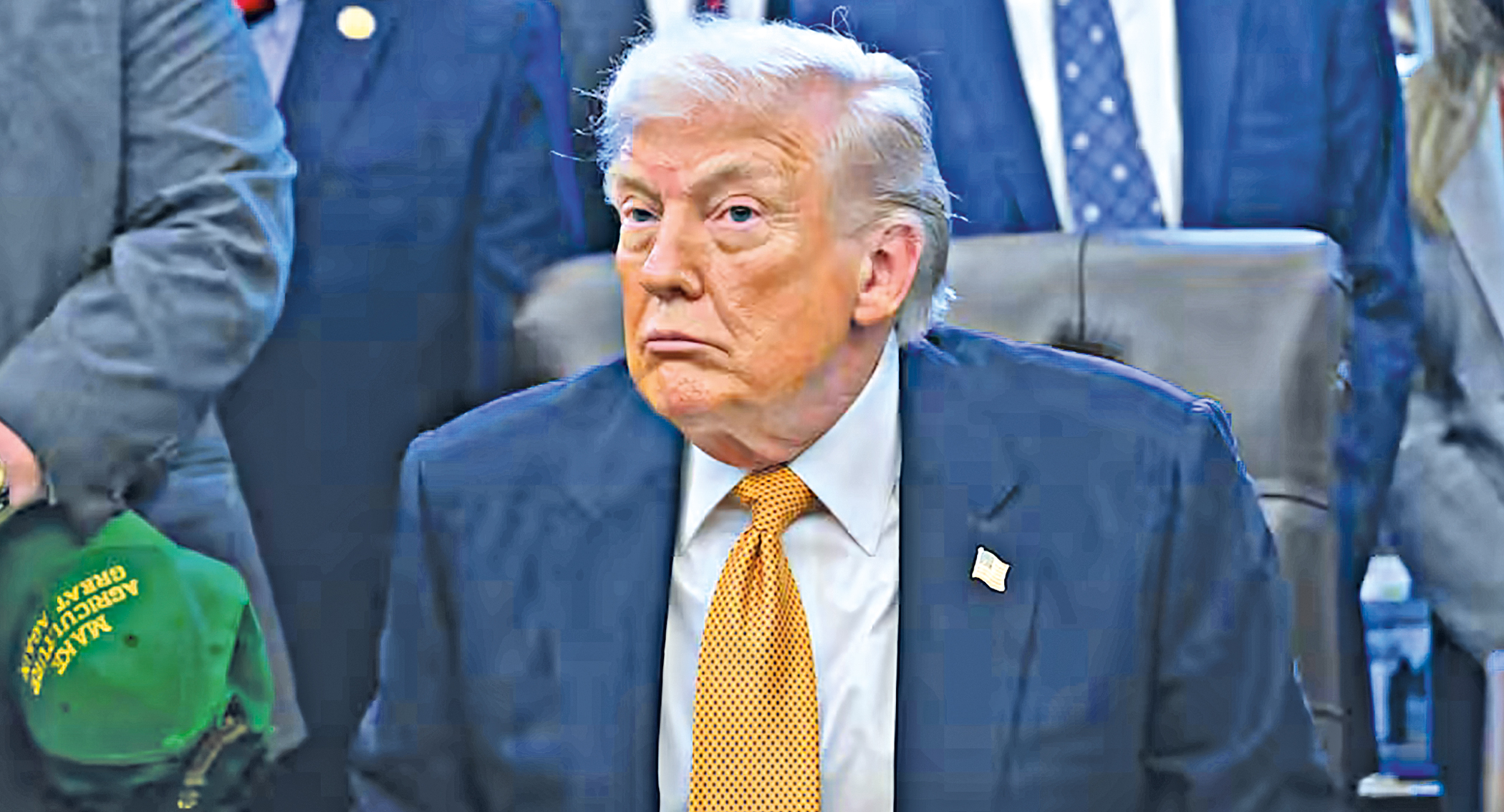
At the same time, the US administration is trying to calm markets and public opinion by promoting secret diplomatic contacts aimed at stopping the escalation. When the statements of the authority become externally and internally questioned, and when the official discourse appears as a tool to calm investors, not to describe reality as it is — we become faced with a management that does not have a clear strategy. The Trump administration’s “management” of its country and foreign policy, is of impressions, manufacturing temporary narratives to sustain itself.
However, the real price of all this confusion is not paid in press conferences or in screens, but on the ground, in the bodies of soldiers, in cities at risk, in diplomatic missions that turn into targets, and in human lives that pay the cost of reckless wars. Reports about the perils of US soldiers, and the targeting of embassies, hotels and allied countries, confirm that the issue is no longer just a containable crisis, but has become an explosive reality that expands the field — both politically and psychologically. The US President seems more preoccupied with mocking and bullying his opponents in degrading personal attacks, than facing questions about the explosive situation in the Middle East and its mechanisms, including its impact on the US.
We are witnessing one of the harshest aspects of contemporary political leadership: the transformation of the highest position in the state into an escape from accountability. Donald Trump has depicted the death of US military personnel as, “part of war.” We are not only witnessing a lack of sympathy, but a breakdown in the moral sense of responsibility. A democratic leader does not run away from difficult questions. A democratic leader does not underestimate death. A democratic leader faces results, recognises the cost, and respects people’s right to know the truth.
The landscape drawn by Trump’s recent actions is that of a troubled capital, a confused leadership, and a foreign policy that moves reactively. From there arises a fundamental question: is there really a real strategy governing the US’ behaviour, or has war become a series of improvisations and attempts to take attention away from internal governance failure that unfolds day after day? Many indications suggest that we are seeing an authority that is trying to cover up its inability to perform, and hide its absence of vision with more shocking statements, using the verbal chaos as a veil over the actual chaos.
The world is not managed by the logic of improvised comments, as major crises cannot withstand this level of lightness. The Middle East is not the scene for electoral messaging. Cuba is not a geopolitical joke. Oil markets are not just a screen that can be deceived forever, and the lives of soldiers and civilians are not a minor detail in the bigger picture. When the tendency to produce verbal shock value results in military decisions, the danger becomes doubled, because war is not only the result of a conflict of interests, but also the result of personal ego and a desire to impose muscle power at any cost.
The most dangerous thing in the shifting landscape of US governance is not just the expansion of its war-mongering tendencies, but the exposure of the fragility of the global leadership it claims to have absolute power over. Wars can sometimes be contained, and crises may find their exits after a high cost, but the real disaster begins when the decision-making itself becomes a source of chaos, and when the leader of a superpower experiments with the boundaries of his authority. At that point, the world witnesses a defect that makes all its entities — allies, opponents, markets and people — prisoners of the mood of one individual who does not seem to be fully aware of the war he launched, nor where it can end. If we continue to see more of the current pattern, the danger threatens not only one region, but the entire international order, because in this case the world becomes hostage to volatile decisions and political whims that may at every moment, open a new door to a greater disaster.
Yousef SY Ramadan is the Palestine Ambassador to Bangladesh.
Send your articles for Slow Reads to slowreads@thedailystar.net. Check out our submission guidelines for details.
Rohingya genocide: Will the ICJ verdict bring justice?
Should Bangladesh join the Mecca Pact?

Documenting Rohingya history / Rohingya repatriation needs more than diplomacy

Nine years on, Rohingya refugees need more than shelter
Myanmar’s partial Rohingya repatriation plan: Another attempt to mislead Bangladesh?
Is Trump’s Gaza peace plan falling apart?

What Japan’s changing Indo-Pacific strategy means for Bangladesh
Can India and Bangladesh build a more equal economic partnership?
Bangladesh First: Rethinking the relationship with India