


Rethinking the Bangladesh-US trade deal following the legal blow

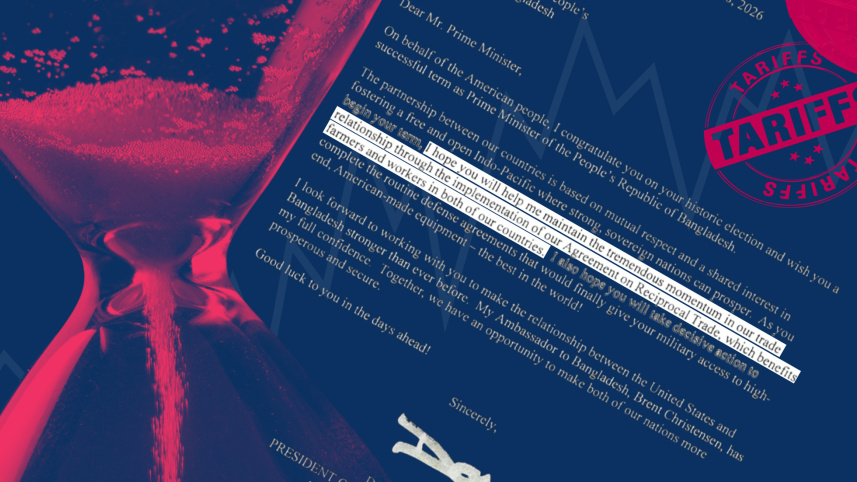
On February 18, a White House congratulatory letter sent to Prime Minister Tarique Rahman urged Dhaka to “maintain the tremendous momentum” in implementing the recently signed Agreement on Reciprocal Trade and to take “decisive action” on pending defense agreements. The message was unmistakable: trade access is being bundled with security alignment. The published text of the trade deal confirms exactly that.
For weeks beforehand, Bangladeshis were told to wait while a deal with the United States was being negotiated under non-disclosure agreements. Now that the text is public, secrecy makes sense: this is not a deal most informed citizens would have endorsed. What has been signed amounts to a comprehensive constraint on Bangladesh’s economic sovereignty. The US gets binding commitments across trade regulation, digital policy, agricultural standards, procurement, and security alignment. Bangladesh, by contrast, gets conditional tariff relief—conditional on compliance as judged unilaterally by Washington and backed by the threat of tariff reimposition.

The interim government rushed to finalise this deal just before the election, locking in long-term commitments it will neither implement nor publicly defend. That is not just bad governance; it borders on being immoral. One does not bind future elected governments to restrictive obligations when one will not be there to bear the consequences.
The interim government signed the deal as if the world were still unipolar. It is not. China is Bangladesh’s largest trading partner. India shares a border and deep economic ties with us. The Gulf, ASEAN, Japan, South Korea, and Europe all represent critical economic relationships. Yet this agreement requires Bangladesh to align its export controls with US policy, mirror the latter’s security-related trade actions, and potentially distance Dhaka from economic partners Washington considers threats. The clause obliging Bangladesh to “adopt or maintain a complementary restrictive measure” in support of US security actions imports US geopolitical conflicts into Bangladesh’s trade policy.
In a multipolar world, small and medium powers survive by maintaining balance. Vietnam trades with all major blocs. Indonesia hedges carefully. Even US allies like Singapore and South Korea carefully preserve economic ties with China while maintaining security relationships with Washington.
This agreement, as it stands, goes beyond controlling what Bangladesh does; it constrains what deals Bangladesh may make with other countries. Dhaka may not, for instance, sign agreements that use technical standards deemed “incompatible” with US standards, including health and safety measures that “disadvantage U.S. exports” or which Washington simply disfavours. Want a free trade agreement with China? The US can view it as engagement with a “non-market country” and reimpose higher tariffs. Want to buy nuclear reactors from Russia or China for power generation? Prohibited. Want digital economy partnerships with countries the US considers rivals? Grounds for agreement termination.
Thus, the United States has virtually granted itself de facto control over Bangladesh’s economic relationships with the wider world. The agreement does, however, offer one significant benefit: Bangladeshi garments made with US cotton and man-made fibre would get zero tariffs in the US market. This could give Bangladesh’s garment sector a competitive edge.
The problem is that the agreement does not specify the extent to which this zero tariff will be applicable. There is a promise of a “mechanism” that will determine volume “in relation to” the amount of US textile input Bangladesh imports, but the details are not set. Bangladesh thus commits to binding obligations across multiple sectors in exchange for a tariff benefit whose actual scope remains undetermined.
The US also retains the right to impose additional tariffs for “unfair trade,” import surges, or “economic or national security” concerns. If Bangladesh fails to comply—as determined by Washington—the US can reimpose the reciprocal tariff rate (the 37 percent tariff proposed on April 2, 2025) on top of normal most-favoured-nation (MFN) tariffs on certain or all Bangladeshi imports. Besides, Bangladesh must “harmonize” with US controls and ensure Bangladeshi firms do not “backfill” gaps created by US restrictions. That is the logic of extraterritorial sanctions, diplomatically softened but unmistakable.
Bangladesh must also “support multilateral adoption of a permanent moratorium” on customs duties on electronic transmissions at the WTO—an unresolved and contested issue with real revenue stakes for developing countries. The agreement also requires Bangladesh to accept the WTO Fisheries Subsidies Agreement—that prohibits harmful government subsidies that drive illegal, unreported, and unregulated (IUU) fishing, overfished stocks, and unsustainable fishing in unregulated high seas—”notwithstanding Article 12,” the very clause that grants developing countries flexibility. In other words, Bangladesh would be asked to accept the deal without the exemptions developing countries are normally entitled to. Finally, Bangladesh must submit to the WTO, within six months, a complete list of all subsidies it provides. Transparency is not the problem, but when disclosure is demanded under threat of tariffs, it stops being cooperative and starts looking like coercion.
Within 24 months of the deal taking effect, Dhaka must allow any agricultural biotech product legally sold in the US to be imported and marketed in Bangladesh without any independent Bangladeshi pre-market review, approvals, or additional labelling. In South Asia, GMO politics involves consumer trust, farmer concerns, and regulatory credibility. Bangladesh is being locked into a permissive regime that could trigger public backlash.
The deal also becomes a procurement ledger: US aircraft, LNG, agricultural products—down to specific values. The shopping list includes 25 Boeing aircraft for Bangladesh Biman (14 firm orders plus options). When a loss-making state carrier faces fiscal pressure and dwindling reserves, embedding aircraft “purchase facilitation” into a trade agreement is not sound policy. It is external compulsion.
Finally, a word about the recent US Supreme Court ruling that has struck down President Donald Trump’s global tariffs as illegal. As per its February 20 judgment, the court did not dismantle the Bangladesh-US “reciprocal trade” framework, but it did punch a hole through its tariff architecture. Key US concessions had been tied to tariff orders issued under the International Emergency Economic Powers Act (IEEPA), and once that legal foundation fell, the deal’s tariff promises—including lower rates and any special treatment for textiles and apparel—have become legally precarious unless reissued under a valid statutory basis.
Trump’s subsequent response indicates that he may not relent despite legal hurdles. Rather than retreating, he has pivoted to Section 122 of the Trade Act of 1974, first imposing a 10 percent across-the-board tariff and then raising it to 15 percent—the statutory ceiling for 150 days without congressional approval—while keeping several other clauses of US trade-related laws in reserve as further fallback options.
So, the pressure is not going away; the legal ground is simply shifting. But Dhaka should read this moment as an opportunity, a chance to renegotiate from a stronger hand and secure terms that are clearer, more equitable, and more durable.
It must insist on at least five changes. First, replace unilateral tariff snapbacks with a neutral dispute-resolution process built on objective benchmarks and proportional remedies. Second, remove automatic “complementary” security restrictions and confine any export-control alignment to clearly defined, evidence-based threats—not blanket coordination. Third, reopen the biotech provisions so Bangladesh retains the right to conduct independent reviews and apply labelling rules consistent with public preferences and a rigorous, evidence-based safety review process. Fourth, delete the procurement “shopping lists” and ensure any purchases are strictly commercial, competitive, and fiscally sustainable. And fifth, end any pre-commitment of Bangladesh’s WTO positions on contested digital issues, including the moratorium on customs duties on electronic transmissions.
Dr M.G. Quibria is a trade and development economist currently working at Morgan State University in the US. He also worked with the Asian Development Bank. He can be reached at mgquibria.morgan@gmail.com
Views expressed in this article are the author's own.
Follow The Daily Star Opinion on Facebook for the latest opinions, commentaries, and analyses by experts and professionals. To contribute your article or letter to The Daily Star Opinion, see our guidelines for submission.
 For all latest news, follow The Daily Star's Google News channel.
Comments