


Saving ourselves through Earth Day

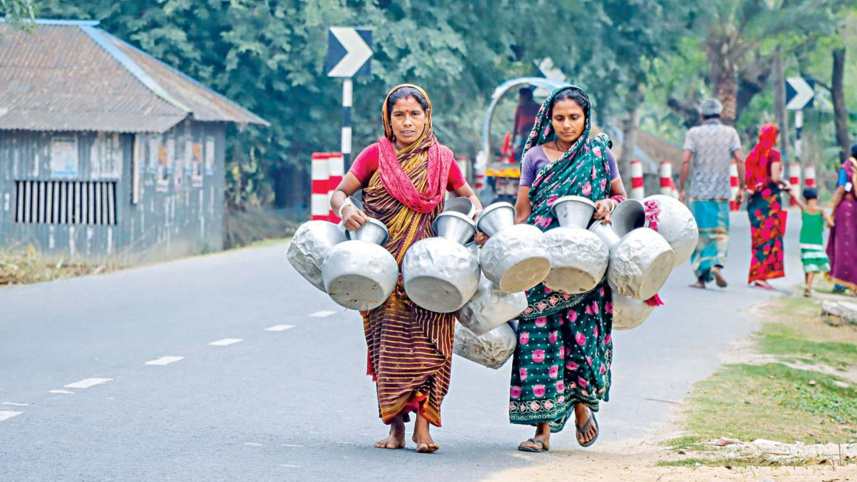
Imagine a summer day in Dhaka: the temperature is soaring but running water is scarce. There is infrastructure in place but the groundwater has dropped so far that the system cannot keep up with demand. This is a reality many Dhaka dwellers have to grapple with on a regular basis.
Dhaka’s groundwater levels have been steadily depleting for years. In a city where almost 70 percent of the water supply comes from groundwater, that is a terrifying reality. Some 2,000 million litres of water are extracted in Dhaka every day and by 2050, Dhaka’s groundwater levels are expected to fall to 100 metres. The situation is equally dire across the country. For example, in Chapainawabganj, water drawn from ultra-deep wells are often too saline for drinking while deep aquifers are contaminated by arsenic. For many households, this means choosing between unsafe or unusable water. Some cannot even rinse their faces with tap water while others walk long distances every day to collect drinking water.
 For all latest news, follow The Daily Star's Google News channel.
 According to a study by the Rivers and Delta Research Centre (RDRC), at least 79 rivers in the country—out of 1,156 rivers—have dried up or are in the process of drying up. All of this points to a system that has been put under immense strain for decades. We often talk about the environment as if it is separate from our daily lives, something that we need to protect, something to care about on days like Earth Day. But in reality, the environment is not “out there.” It is the foundation of everything we depend on: things like water, food, and energy. Yet, we often take them for granted.
Scientists have defined a set of planetary boundaries that help keep Earth’s systems stable—covering areas like climate, freshwater use, land use, and biodiversity. Today, several of these limits have already been exceeded. Global temperatures have increased considerably compared to pre-industrial levels. Almost half the world’s countries now have degraded freshwater systems due to pollution, encroachment, etc. Meanwhile, human consumption of freshwater has risen dramatically, placing many regions under serious stress. This is not something we can dismiss by taking a “not in our backyard” approach. In fact, we are seeing the same pattern locally. For instance, in Khulna, many of the waterways that once defined the city have been encroached upon to make space for roads, buildings, and commercial areas. This unplanned growth often makes even the lightest rainfall result in waterlogged roads. And during the dry season, half the city faces water shortage. What looks like urban development shows up later as unbearable heat, chronic water scarcity, persistent pollution, and instability.
And every major global conflict reminds us of the same underlying fragility. During the pandemic, supply chains slowed down across the world, affecting everything from food to manufacturing. When the Russia-Ukraine war began, fertiliser and energy markets were thrown into shocks. More recently, the US- Israel war in Iran has disrupted global energy flows and trade routes, sending ripple effects across economies worldwide. Countries like Bangladesh feel these shocks almost immediately—through higher prices, tighter supplies, and growing pressure across sectors. While these are not environmental crises in themselves, they reveal something important: systems that appear stable can unravel quickly when they rely on limited and tightly connected resources. Environmental stress, however, does not arrive as a sudden shock. It shows up in the rising price of rice, in the cost of electricity, in the irregular transition between seasons, and in the growing unpredictability of everyday life. And here is the twist: it does not affect everyone equally. These shocks hit hardest where resilience is lower, for example, low-income households, people employed in the informal sector, or those who have to rely on the land for their livelihood. What begins as a resource stress eventually turns into an economic and social stress. Saving the environment isn’t only about the environment; it’s about securing the livelihoods of people who are less resilient to these shocks and this is why the conversation around development needs to shift.
Bangladesh’s growth story is real. Over the past decades, the country has achieved steady economic expansion, built a globally competitive apparel industry, and lifted millions out of poverty. But growth built on the extraction of huge amounts of natural resources is not without consequence. The rivers that absorb industrial waste keep absorbing it till they can’t. Consider the Sundarbans. It has absorbed every major cyclone in recent history including Sidr, Aila, Amphan, Mocha, by reducing wind speed, weakening storm surges, and by protecting millions of lives inland. Today, the Sundarbans covers over 6,000 square kilometres, having already lost significant area over the past decades. Bangladesh’s total forest cover also remains far below what is considered necessary for ecological stability.
To absorb systems shock, there is now an opportunity to govern resources as interconnected systems. That means treating rivers as shared systems, not dumping grounds. It means implementing long-term plans not just on paper, but in practice. It also means pricing resource use and pollution in ways that reflect real costs. It means designing industries to use less water, reuse more, and pollute less. Most importantly, it means paying attention before strains turns into crises.
My father often gets upset when we throw away leftover rice. To him, it is one of the most disrespectful things you can do to the people who grow it and to the resources that go into producing it. My mother saves every plastic bag and cup so that we can reuse them later. Throwing away clothes is not a concept we are familiar with in our household; they always go to someone in need or serve another purpose. The concept of resources being thrown away or wasted is next to impossible to my parents. They come from a generation where resource strain was real on a personal level. The resources we consume are complex, intertwined in ways that we sometimes can’t even conceptualise. That is why it is important to understand how to mitigate the shocks before they reach us. And the shock on environmental resources is something that we must reconcile with, and the sooner we do it, the better. However, the question remains whether we will reframe this as something to save the earth, or ourselves.
Raida A.K. Reza is doctoral researcher at United Nations University’s Institute for Integrated Management of Material Fluxes and of Resources (UNU-FLORES), Leibniz Institute of Ecological Urban and Regional Development (IOER), and Dresden University of Technology.
Views expressed in this article are the author's own.
Follow The Daily Star Opinion on Facebook for the latest opinions, commentaries, and analyses by experts and professionals. To contribute your article or letter to The Daily Star Opinion, see our guidelines for submission.
Comments