


Security should not be a pretext for moral policing or erosion of liberties

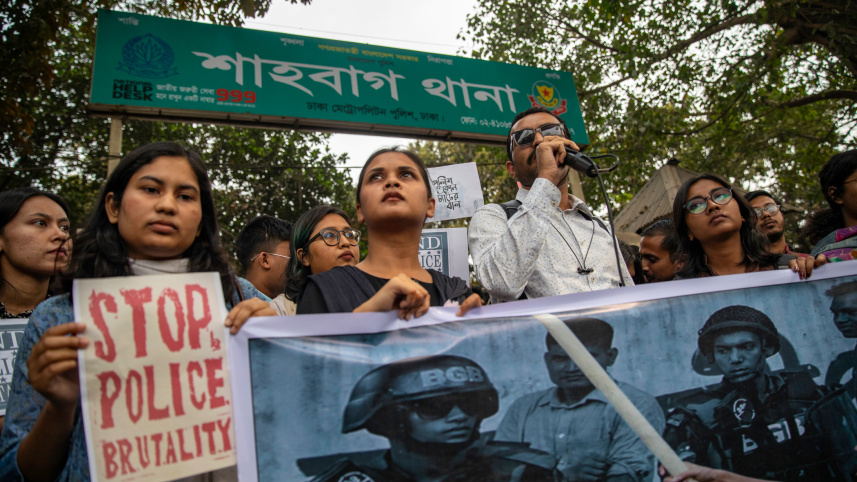
The memory of the July uprising remains vivid in my consciousness. As a student participant, I recall those afternoons of protests not only as a struggle against an authoritarian regime but also as a decisive rejection of an entrenched culture that treated citizens with suspicion, turned streets into sites of surveillance, and used the police as instruments of fear. We marched for a Bangladesh where the relationship between the governed and those who govern would be rooted in dignity and mutual respect.
Recent debates about nighttime policing and public safety show that changing rhetoric does not necessarily alter institutional mindsets. The education minister’s call for nighttime policing, framed as protection for students and citizens, has prompted an important conversation. Although the intention is to ensure security, the implementation tends to reveal an authoritarian reflex we had pledged to overcome. The state’s duty should be to expand freedom and enable citizens to live without fear, not to regulate their movements.

When police officers harass people in parks or on streets at night, question their right to occupy public space, or use physical or verbal aggression, we must ask whether the nature of law enforcement has truly changed. The July uprising reflected a generation’s determination not to let a policing mentality seep into everyday life, to live under constant supervision, or to allow dissent to be crushed.
Security should never serve as a pretext for moral policing or the erosion of civil liberties. If an area is unsafe, the right response should be to increase visible patrols or introduce transparent, formal restrictions when necessary. It must not be left to individual officers to act as arbiters of public morality and to decide who belongs on a street based on the officers’ private bias. The power to protect must not be confused with a licence to humiliate. When a citizen is harassed for simply being present in a public space, that is an abuse of power and a breach of trust.
The recent incidents of assault and harassment by police officers are therefore not merely a string of isolated incidents, but a signal about institutional health. Public anxiety has increased, evidenced by the comment section of videos circulating on social media showing verbal harassment of youths by law enforcers. Many interpret this as a reversion toward policing that requires constant contestation. Thus, there is a renewed call to disentangle policing from arbitrary authority and to establish a clear and enforceable accountability mechanism to rebuild public trust.
For decades, police have been trained to maintain order through intimidation. That muscle memory does not disappear overnight. The current administration has a historical mandate to recalibrate the existing system. The demand is not for a perfect tomorrow but for a clear break with the past. Leaders must speak and act in ways that demonstrate commitment to a rights-based framework. Directives for nighttime security should be accompanied by training and oversight of law enforcers, as well as swift consequences for misconduct.
During the July uprising, we saw how quickly a force lost legitimacy when it stopped protecting and began preying. To avoid repeating that chapter, we must move toward consent-based policing. Police presence should be justified by the safety it produces, not by the fear it provokes. Physical violence employed against the public is not a security measure. It is a human rights violation that corrodes the foundation of the democratic state we are trying to build.
We should not have to protest every instance of administrative heavy-handedness. We need a government that addresses abuses proactively and recognises institutional reform as a prerequisite for lasting stability. The authoritarian practices and the urge to moralise and control through force persist within institutions. The reform we seek must prioritise institutional change and restore public trust by replacing coercive behaviour with a spirit of service, transparent procedures, and accountable oversight.
Our expectations are high because the sacrifices were high. We deserve a governance structure that treats youth not as problems to be managed but as architects of a free society. This demands more than policy adjustments. It requires a reimagining of what the state owes its people and an honest admission that the state is not the parent of citizens but their employee.
Progress should be measured not only by economic growth or political stability, but by how citizens feel when they see a police officer at night. Until citizens feel unequivocally safer, the work of the state remains unfinished. Upholding the constitution through comprehensive institutional reform is the difficult but necessary path to securing a democracy that protects rights and enforces the rule of law. What we ask for is a state that respects our presence in it and that secures the street for the people both by day and by night.
Tagabun Taharim Titun is a content executive at The Daily Star.
Views expressed in this article are the author's own.
Follow The Daily Star Opinion on Facebook for the latest opinions, commentaries, and analyses by experts and professionals. To contribute your article or letter to The Daily Star Opinion, see our guidelines for submission.
 For all latest news, follow The Daily Star's Google News channel.
Comments