


The structural flaw in how we support entrepreneurs
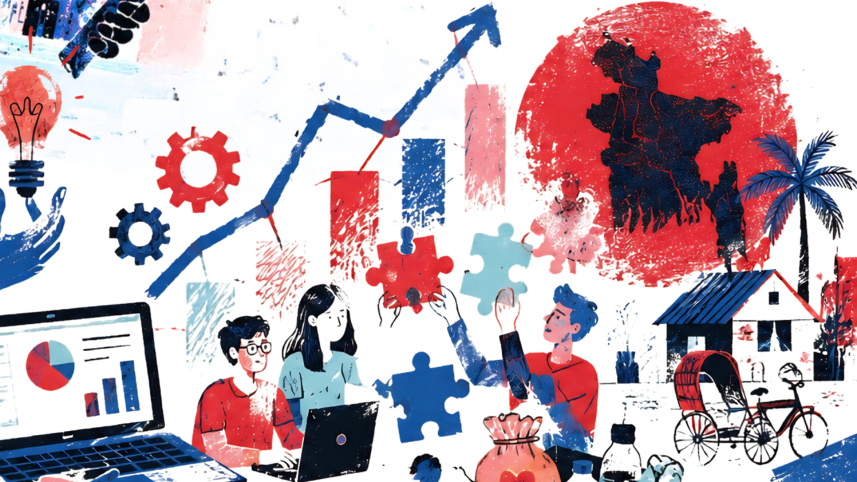
A woman in Mirpur sells jamdani bags of a quality that would hold their own on shelves in London or New York. She completed a World Bank-backed entrepreneurship programme to reach the next stage but remains trapped at artisan scale. Her social media presence is inconsistent, and her logistics manual and access to working capital are non-existent. She sources fabric from weaver clusters in Narayanganj, hand-selecting at a Friday dawn market and commissioning custom designs from those who remake patterns to her specification. Her success depends on their capacity to deliver. Their success depends on her capacity to absorb and sell. If she scales, their market scales with her. She and the producers behind her are the kind of non-tech entrepreneurs who are central to inclusive growth. They don’t need another training programme. They need a buyer—and a system of intermediaries around that buyer—with the capital and infrastructure to formalise the demand running through them.
This is the structural condition of Bangladesh’s informal economy. Millions of entrepreneurs sit outside formal markets not for lack of drive or product quality but because the support architecture has a foundational design flaw: it does not listen.

For decades, development institutions, bilateral donors, and government agencies have approached entrepreneur support through a template. They identify a beneficiary category—women, youth, artisans—allocate capital, and launch “entrepreneurship” programmes. The jamdani bag seller is one such beneficiary. The World Bank programme trained her but did not map the friction points in her supply chain, customer acquisition, or access to logistics. Neither did it connect her to the agencies, SMEs, or startups capable of solving those problems at scale, treating her as an endpoint rather than as a node in a supply chain whose upstream participants depend on her growth. The limitation is the absence of information. Development programmes and entrepreneurs operate in separate intelligence vacuums.

The result is waste at scale. Marketplaces multiply in categories where long-term profitability is improbable. Training programmes produce confident entrepreneurs pursuing ideas that are neither necessary nor financeable with the capital the market can realistically supply. Most programmes underestimate how difficult it is to access funding or working capital. Intermediaries capable of solving real problems never get funded, because no one has identified those problems through structured stakeholder dialogue.
The deeper inefficiency is resource allocation. Development capital should flow to entrepreneurs capable of becoming intermediaries themselves—tech-enabled SMEs sourcing from smaller producers, startups solving problems for hundreds of thousands of artisans at once. When such an entrepreneur scales into a functional e-commerce and logistics operation, every producer they buy from is lifted with them, because their revenue depends on localised supply. Yet, the startups and SMEs equipped to serve these entrepreneurs—logistics platforms, digital marketing agencies, working capital fintechs, B2B marketplaces—remain capital-starved. A grant to an artisan produces marginal improvement. The same capital deployed into a logistics startup serving artisans across three districts builds durable infrastructure that lifts hundreds of operators at once. Funding the growth of high-potential startups and SMEs is inclusive development, executed through the channel with the highest multiplier.
BRAC and H&M’s Stitch for RMG programme, run once in 2021, began with listening. Stakeholders across the garment supply chain were interviewed, critical problems identified, and entrepreneurs capable of scaling solutions were funded. Agroshift emerged from that single cohort and today reaches a substantial network of farmers and rural supply chain participants. That a single cohort produced a venture-backed company serving the informal economy is strong evidence for the approach and a reminder that no donor, government agency, or development institution has replicated the programme since. The system did not learn from the model.

Bangladesh’s informal economy can follow the same trajectory, but only if government agencies and development institutions invert their current approach. Support programmes must begin with structured stakeholder research to identify specific friction points: supply chain gaps, digital literacy barriers, logistics costs, and credit access. Then, the focus must shift to intermediaries: which startups, SMEs, or agencies can solve those problems at scale, and what funding, regulatory clarity, or customer acquisition support those solvers require.
Done at scale, the second-order effects compound, and non-tech entrepreneurs become the largest beneficiaries. Intermediaries that absorb informal output formalise the producers behind them, pulling households into recorded employment, taxable income, and access to credit. Tech-enabled SMEs and high-growth startups, properly capitalised, become the largest non-public source of jobs in the country. Bangladesh stops exporting its most ambitious operators to Dubai and Singapore and begins retaining the talent that builds the next generation of intermediaries.
The informal economy does not need to be dragged into formality. It needs intermediaries with the capital, infrastructure, and market access to make formality the more profitable option. That is the architecture worth building.
Rahat Ahmed is founder and managing partner of Anchorless Bangladesh.
Views expressed in this article are the author's own.
Follow The Daily Star Opinion on Facebook for the latest opinions, commentaries, and analyses by experts and professionals. To contribute your article or letter to The Daily Star Opinion, see our guidelines for submission.
 For all latest news, follow The Daily Star's Google News channel.
Comments