


Too many holidays are bad for any growth economy

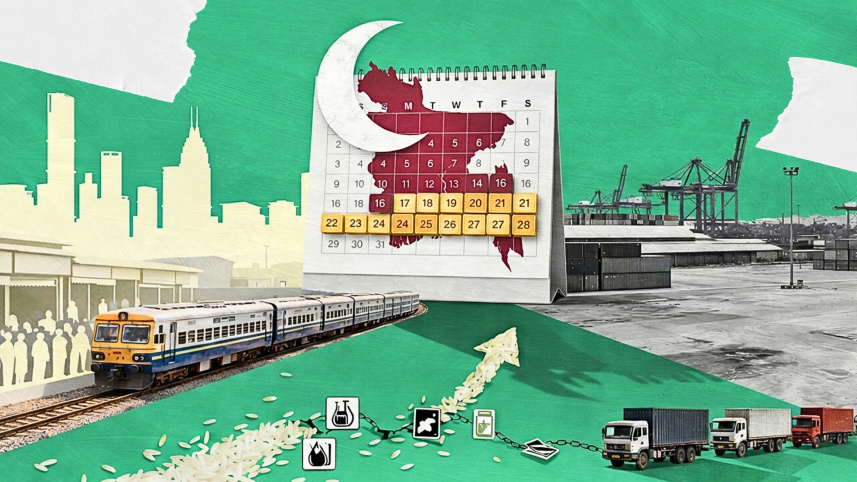
Amid the prevailing Middle East crisis and economic lull, Bangladesh is heading into a prolonged holiday period around Eid-ul-Fitr. Officially, the government has declared a seven-day holiday beginning on March 17 and ending on March 23. Offices will reopen briefly on March 24-25, but the Independence Day observance on March 26, followed by the Friday-Saturday weekend, will effectively extend the holiday atmosphere across the country. In reality, many officials and employees are likely to take additional leave on the two working days in between, meaning that economic activity would considerably slow down for 12 consecutive days.
At first glance, extended holidays during festivals appear harmless, even desirable. Festivals are deeply embedded in the country’s social fabric. Eid, in particular, is not merely a religious event but a powerful cultural moment that reconnects families and communities. However, the economic implications of long, veritable shutdowns are often underestimated.

Our recent experience suggests that extended holidays can disrupt supply chains, slow down production, and ultimately contribute to inflationary pressures. The country witnessed a clear example of this in 2025. During Eid-ul-Fitr that year, it observed a nine-day holiday between March 28 and April 5. Later in the same year, the Eid-ul-Azha holiday stretched even longer from June 5 to June 14, effectively suspending economic activities for 10 days. In the weeks that followed, prices of essential commodities such as rice, eggs, poultry, and vegetables increased noticeably. Various surveys and studies confirmed that the extended holidays had disrupted agricultural supply chains and contributed to price increases.
One important factor behind these price movements is the seasonal shift in consumption patterns during Eid. Millions of people travel from major cities to their hometowns and villages to celebrate the festivals with their families. This mass migration alters the geographic pattern of demand for food and consumer goods. Goods that are usually consumed in urban centres must suddenly be transported to rural markets located far from traditional supply hubs. This shift increases pressure on the transport system and raises logistics costs. When goods need to travel longer distances within a limited time frame, freight charges inevitably rise.
This year, however, the situation is further complicated by fuel shortages caused by the ongoing Middle East crisis. Business leaders and transport operators report that many filling stations are struggling to meet demand, even after the withdrawal of fuel rationing. Drivers are forced to wait in long queues to refuel, and transport operators are already reporting freight cost increases by 20-25 percent. Truck shortages are also emerging in long-distance routes, a problem that may intensify once the Eid holiday progresses.
Such developments matter because Bangladesh’s economy is currently navigating a fragile macroeconomic phase. High inflation, weak investment growth, rising unemployment, and concerns about energy security have already placed the economy under stress. In such circumstances, extended nationwide shutdowns can amplify vulnerabilities.
The economic logic here is straightforward. Each additional day of nationwide closure interrupts production, slows trade, and weakens supply chains. Factories suspend operations, banks close their counters, administrative decisions are delayed, and port activities slow down. Even if these disruptions are temporary, their cumulative impact can be significant.
Trade and logistics are particularly sensitive to such interruptions. For example, if a cargo vessel is forced to remain idle at a port for several days due to reduced operations or banking closures, demurrage charges begin to accumulate. Eventually, these additional costs are passed on to consumers through higher product prices.
Agricultural supply chains are even more vulnerable. Following the extended Eid-ul-Azha holiday last year, the Bangladesh Bank conducted a study covering 61 upazilas across 18 districts to examine the efficiency of agricultural value chains. The findings were revealing. During the survey period, the retail price of coarse rice stood at Tk 61 per kg, compared with Tk 55 in the same period of the previous year. Fine rice was selling at Tk 78 per kg, up from Tk 70 a year earlier. In other words, prices increased by around 10.9 percent for coarse rice and 11 percent for fine rice within a single year.
The study indicated that extended holiday closures were one of the contributing factors. Many rice mills remained closed for around 10 days during Eid. At the same time, banking services were suspended, preventing normal transactions between farmers, traders, and mill owners. As a result, farmers and wholesalers delayed selling their paddy and instead held onto their stocks. When the mills reopened after the holiday, they attempted to resume production simultaneously. This created a sudden surge in demand for paddy while supply remained limited. The imbalance pushed up paddy prices, which quickly translated into higher rice prices for consumers.
Of course, extended holidays were not the only reason behind the price increases. Rising labour costs, higher irrigation expenses, shrinking arable land, and import duties also played roles. Nevertheless, the study clearly highlighted that prolonged holiday shutdowns can aggravate supply disruptions.
This brings us to a broader question: does Bangladesh have too many holidays?
Compared with many emerging economies, the country observes a relatively large number of public holidays throughout the year. In addition to religious festivals, there are numerous national commemorations and administrative holidays. When combined with two days of weekly breaks, the total number of non-working days becomes substantial.
In contrast, many growth economies, including our neighbour, maintain a more concentrated holiday structure. China, for example, observes a long holiday during the Lunar New Year but maintains a strong work culture during the rest of the year. Bangladesh, apart from regular earned, casual, and sick leave, however, experiences multiple extended holidays throughout the calendar, each of which temporarily slows economic momentum. Government-declared special holidays particularly impact the growing private sector most.
This does not mean that cultural traditions should be diminished. For us, the challenge is not to eliminate holidays but to manage them more strategically. A balanced approach, where cultural priorities co-exist with economic efficiency, would be essential. Otherwise, celebration may gradually translate into supply disruptions, higher inflation, and additional pressure on an already strained economy.
Mamun Rashid is an economic analyst and chairman at Financial Excellence Ltd.
Views expressed in this article are the author's own.
Follow The Daily Star Opinion on Facebook for the latest opinions, commentaries, and analyses by experts and professionals. To contribute your article or letter to The Daily Star Opinion, see our guidelines for submission.
 For all latest news, follow The Daily Star's Google News channel.
Comments