


We must never forget what led to the July mass uprising

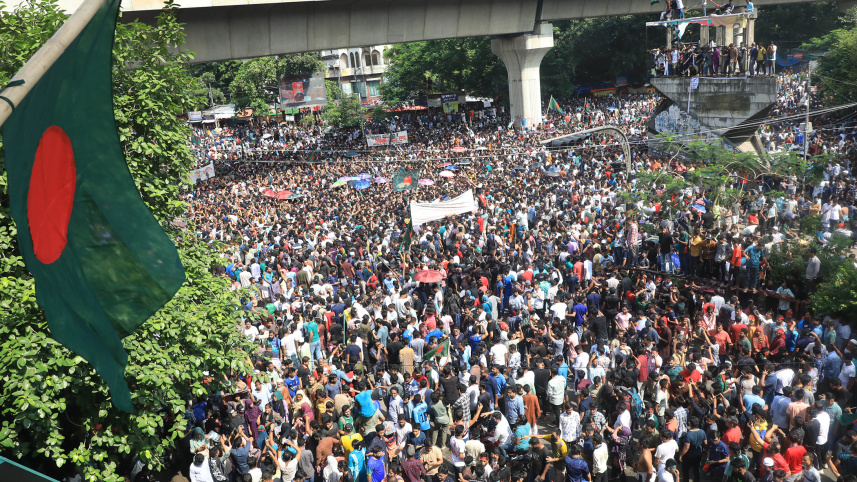
Nearly three years ago, on January 6, 2024, I wrote in this newspaper that it would take “something of a miracle” for Bangladesh’s economy to continue thriving under democratic autocracy without a major social and economic collapse by 2025. Seven months later, on August 5, 2024, Sheikh Hasina’s government collapsed, sooner than I had expected and not in the form I had anticipated. My warning was not a prediction of revolution. It was a diagnosis of an increasingly unsustainable political-economic settlement. For years, the implicit bargain underlying Hasina’s rule had been straightforward: citizens would tolerate diminishing political freedom and accountability in exchange for growth, stability, and expanding opportunity. Bangladesh’s record of poverty reduction, infrastructure development, and social advancement gave that bargain considerable credibility.
By early 2024, however, the bargain was failing on both sides. Three successive elections had deprived citizens of meaningful political choice, while inflation, banking-sector disorder, capitalism, and declining opportunities for educated young people were eroding the regime’s performance legitimacy. The state still possessed formidable coercive power, but it increasingly lacked a persuasive answer to why citizens should continue to accept political exclusion. This tension had been visible for years. A 2019 analysis described Bangladesh’s “double paradox”: sustained growth alongside persistent corruption and deteriorating governance. Growth had not generated stronger institutions; political and business elites had instead become tied through an entrenched system of mutual privilege.

Yet the immediate rupture did not begin with a macroeconomic crash. It came through a dispute over quotas in public-service recruitment. That was not accidental. In an economy producing too few secure and desirable jobs, government employment had become an unusually important route to status and upward mobility. The quota system therefore represented far more than an administrative formula. To many young Bangladeshis, it symbolised a state in which inherited identity and political proximity could prevail over merit. Only weeks before the uprising, I asked in these pages whether the national budget was another exercise in “youthwashing.” The government celebrated young people in slogans but failed to match its rhetoric with credible investments in quality education and decent employment. The protesters were not simply excluded from the development process; many were its frustrated achievers: more educated, connected and aspirational than their parents, but unable to convert educational progress into suitable jobs, upward mobility or political voice. Hasina-era development had helped produce this generation, and Hasina-era politics could no longer accommodate its expectations.
This is why the Supreme Court’s quota reform did not end the movement. By July 25, at the height of the crackdown, it was already apparent that the protests could expand into a wider anti-government movement. The court had changed the recruitment quota provisions, but it could not resolve the unemployment, political exclusion and state violence that now sustained the mobilisation. Hasina’s reference to the “grandchildren of Razakars” then became a moment of moral rupture. Whatever her intended meaning, protesters heard it as a denial of their patriotism and legitimate citizenship. By ironically appropriating the label, students challenged the ruling party’s assumed authority to decide who belonged to the nation. Repression completed the transformation. Instead of rebuilding trust through dialogue, the government relied on its student wing, security forces, curfews, mass arrests, and an internet shutdown. The subsequent UN fact-finding enquiry, following the uprising, found reasonable grounds to believe that the former government and its security apparatus had systematically committed serious human-rights violations in an effort to suppress the protests.
Violence did not restore authority; it destroyed what remained of the regime’s moral legitimacy. A distributive grievance became a demand for justice and then for political change. The uprising became regime-ending when the students’ revolt converged with wider social anger against inflation, insecurity, corruption, and arbitrary power. Hasina’s fall, therefore, represented more than the removal of an authoritarian ruler. It was an assertion of youth political agency and a demand for good governance and a merit-based society. Yet democratic renewal was only a possibility, not a guaranteed outcome.
Now, if we refer back to the caution I issued in my January 2024 article, it correctly identified that Bangladesh’s combination of economic fragility, institutional decay, and democratic autocracy was approaching a breaking point. What it could not anticipate was that students would lead the decisive rupture—or that a dispute over job quotas would so rapidly unite educated aspiration with broader social anger. The deeper paradox is now clearer. Hasina was not overthrown simply because Bangladesh had failed to develop; she was partly overthrown because her development agenda had created a larger educated and rights-conscious generation whose aspirations her closed political system could not satisfy. Past economic achievement was treated as a permanent claim on political obedience. But development does not give any government unlimited credit. When it ceases to produce opportunity, dignity, fairness, and voice, its frustrated achievers may become the most powerful challengers of the order that produced them.
That lesson now applies directly to the newly elected BNP government. Its manifesto promised a merit-based, transparent, and accountable state, yet recent appointments have already revived concerns that partisan affiliation may once again be displacing professional merit—including in the selection of public-university vice-chancellors and appointments to other important state institutions. These controversies do not make the new government equivalent to its authoritarian predecessor, but they are an early warning. July’s demand for meritocracy cannot be satisfied by replacing one patronage network with another. If the BNP treats its electoral mandate as a licence to reward loyalists, it risks recreating the same broken social contract that turned frustrated achievers into political challengers. Honouring the spirit of July requires more than celebrating the uprising; it requires changing how power and opportunity are distributed.
M Niaz Asadullah is an economics professor at Dhaka University.
Views expressed in this article are the author's own.
Follow The Daily Star Opinion on Facebook for the latest opinions, commentaries, and analyses by experts and professionals. To contribute your article or letter to The Daily Star Opinion, see our guidelines for submission.
 For all latest news, follow The Daily Star's Google News channel.
Comments