


What a historic ADP low tells us about our development governance

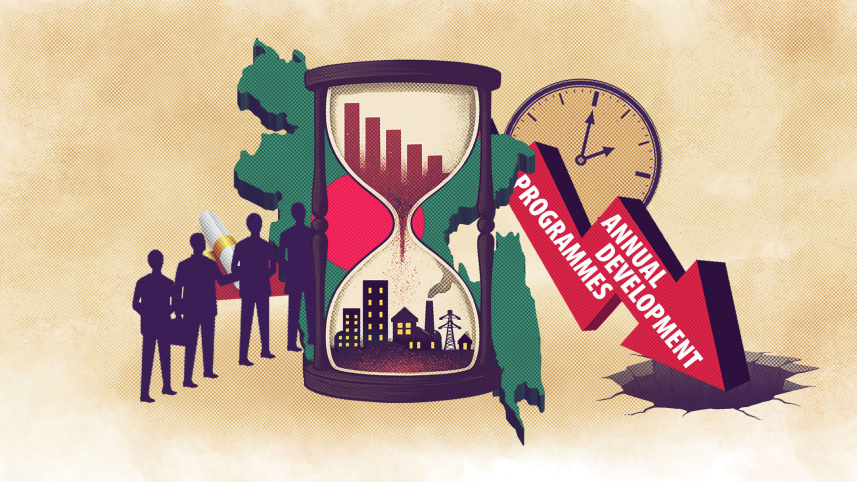
Bangladesh has recorded another historically weak year in implementing its Annual Development Programme (ADP). According to the latest data from the Implementation Monitoring and Evaluation Division (IMED), only 67.5 percent of the revised ADP was implemented in FY2025-26, the lowest implementation rate in 53 years. The previous fiscal year also ended with an exceptionally weak implementation rate of 67.85 percent. Yet these numbers tell only part of the story. The more important question is what this reveals about the resilience of Bangladesh’s development governance.
The picture becomes clearer when viewed over a slightly longer period. Bangladesh implemented 92.79 percent of its revised ADP in FY2021-22, 84.16 percent in FY2022-23 and 80.63 percent in FY2023-24. The trajectory changed significantly over the following two fiscal years, with implementation falling to around 68 percent. While one year’s weak performance may be explained by exceptional circumstances, two consecutive years following three years of much stronger implementation deserve a broader reflection. How did Bangladesh’s development governance, which achieved more than 92 percent implementation just a few years ago, become so vulnerable to disruption?

Naturally, the immediate explanation can be found in the extraordinary circumstances Bangladesh has faced over the past two years. The political transition of August 2024, together with mounting macroeconomic pressures, foreign exchange shortages and tightening fiscal conditions, placed Bangladesh’s public investment system under exceptional pressure. Any assessment of the latest implementation figures must recognise that context. Yet difficult times show whether a public investment system is resilient enough to keep delivering. The more important question, therefore, is whether our public investment system responded to these shocks effectively while continuing to deliver development actions.
That perspective also explains why the current slowdown should not be viewed only through the lens of recent events. Long before the political transition, government reviews and development partners had repeatedly identified procurement delays, unresolved land acquisition, repeated design revisions, weak coordination among implementing agencies, and limitations in project management capacity. These weaknesses did not suddenly emerge over the past two years. Rather, the recent shocks exposed and amplified vulnerabilities that had long existed beneath the surface.
From this perspective, this year’s historic low is more than a disappointing statistic. It reminds us that development governance is ultimately tested not during periods of stability, but during periods of stress. If development governance struggles to sustain implementation when financing becomes constrained, administrative priorities shift or external conditions deteriorate, the challenge extends beyond the fiscal year. It raises a more fundamental question about whether Bangladesh’s development ambitions are supported by institutions resilient enough to sustain them.
If resilience is the real question, implementation is only part of the answer. Bangladesh’s annual ADP debate has traditionally focused on how quickly ministries spend their allocations. But the experience of the past two years suggests that implementation should be viewed as the outcome of a much longer chain of decisions rather than the starting point of the discussion.
Every year Bangladesh announces its largest national budget or one of its largest development programmes, and such ambition reflects the aspirations of a growing economy. But ambition cannot make development governance resilient. A resilient ADP requires development priorities matched by realistic financing, institutional capacity and projects that are genuinely ready for implementation. When these elements become disconnected, even well-intentioned development plans become difficult to deliver.
Recent fiscal trends also illustrate why resilience begins with realistic financing. Domestic revenue mobilisation has remained under pressure, external financing has become less predictable and fiscal space has become increasingly constrained. These realities inevitably affect development spending.

The same principle applies to project readiness. Over the past few years, it has emerged as a central concern in Bangladesh’s public investment discourse. At its core, it means ensuring that feasibility studies, land acquisition, procurement planning, technical design and institutional responsibilities are substantially in place before implementation begins. Projects prepared in this way are not only easier to implement but also more likely to stay on track when economic, administrative, or political conditions become less favourable. In that sense, it is not merely a technical requirement. It is a prerequisite for a resilient public investment system.
This way of thinking is reflected in international development policy and practice. Across the Organisation for Economic Co-operation and Development (OECD) and major international development institutions, international development practice has gradually shifted from expanding public investment towards strengthening public investment management. The emphasis is no longer only on how much governments spend, but on how effectively they select, finance, prepare, implement and monitor investments throughout the entire project cycle. The strongest public investment systems are not those that avoid crises but those that keep delivering through the crises.
Bangladesh’s development journey is entering a further complex phase. Public investments are becoming larger, more complex and more interconnected. Climate resilience, energy transition, transport, urban development, health and education all require institutions capable of managing uncertainty alongside ambition. Larger budgets and larger ADPs will therefore remain important, but they are no longer sufficient indicators of development success. The more enduring measure of success will be whether Bangladesh’s development governance can deliver when the next shock inevitably arrives.
The latest IMED figures should therefore be read as more than another disappointing implementation statistic. They provide an opportunity to rethink how Bangladesh plans, finances and governs public investment. The challenge now is not simply to improve next year’s implementation rate but to strengthen development governance so it can sustain the country’s growing development ambitions. If the lesson is taken seriously, this year’s historic low may ultimately be remembered not only as a warning, but also as a turning point towards more resilient development governance.
Muhammad Muktadirul Islam Khan is principal researcher and head of consultants at the Sustainability Action Learning Lab. He can be reached at muktadir@sustainabilitybd.org.
Views expressed in this article are the author's own.
Follow The Daily Star Opinion on Facebook for the latest opinions, commentaries, and analyses by experts and professionals. To contribute your article or letter to The Daily Star Opinion, see our guidelines for submission.
 For all latest news, follow The Daily Star's Google News channel.
Comments