


Women farmers and the fight for climate resilience

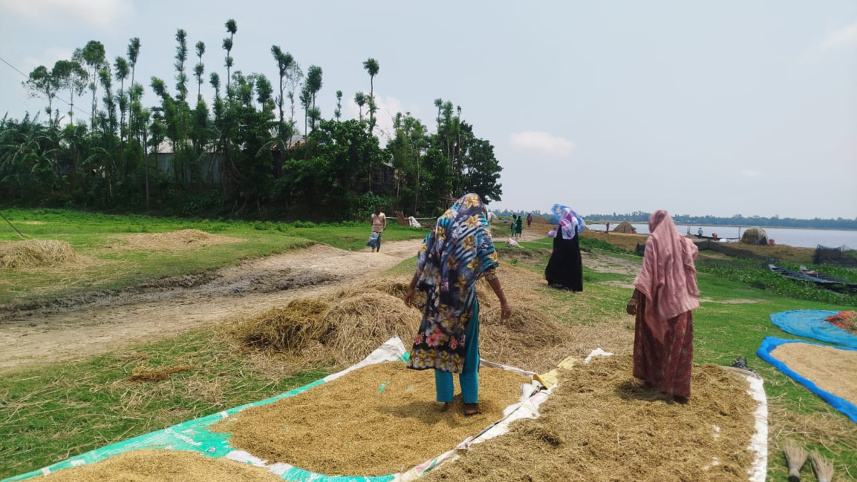
Bangladesh is among the world’s most climate-exposed nations. Between 2000 and 2019, the country experienced 185 extreme weather events, resulting in approximately $3.72 billion in economic losses. The average temperature has been rising by 0.20 degrees Celcius every decade. Yet, as the country scales up its climate adaptation architecture, the people absorbing the sharpest household-level impacts—women smallholder farmers—remain structurally underserved.
Women comprise 58 percent of Bangladesh’s agricultural workforce, but are rarely recognised as farmers in official classifications or extension services. Despite constituting the majority of agricultural labour, only 4.8 percent of women in agriculture hold land under their own names—the lowest in South Asia. They work the land without owning it, generate food without controlling its sale, and carry generations of agricultural knowledge without institutional support to apply it.

This invisibility is structurally enforced. Women farmers typically earn Tk 400 to Tk 500 per day, against Tk 600 for men performing equivalent work. Extension services are overwhelmingly directed at male farmers. A 2023 CGIAR study drawing on 1,230 surveyed households in Bangladesh found that gender disparities persist in agricultural losses, damage, and family food consumption, and that climate change restricts women’s market access relative to men’s.
Moreover, climate change is not gender-neutral. Research confirms that women in Bangladesh face heightened post-disaster food insecurity, and the gender gap in food insecurity has been growing. When harvests fail, women typically reduce their own food intake to protect children and other family members, a coping mechanism with severe long-term consequences for their health and adaptive capacity.
Salinity intrusion illustrates the intersection of climate stress and gender vulnerability. Salinity-affected land has expanded from 8.3 lakh hectares in 1973 to more than 10.56 lakh hectares in 2019. More than 70 percent of coastal residents confirmed that salinity worsened over the past decade, while 74 percent expect conditions to deteriorate further. With the soil now too salty for standard farming, the agricultural rules have completely changed. Women who have managed traditional cropping systems for generations find their knowledge made redundant, without viable alternatives offered to them. Meanwhile, the transition to capital-intensive aquaculture that follows salinity-driven land conversion is controlled predominantly by men.
As climate stress drives men towards urban wage labour, women are left to manage farms without legal land rights, agricultural identities in official systems, or institutional support. Studies from coastal Bangladesh show that female-headed households tend to rely on NGO assistance as a primary adaptation strategy—a survival response, not a resilience pathway.
The FAO’s 2023 flagship report estimated that closing the gender gap in agricultural productivity and wages could boost global GDP by nearly $1 trillion and lift 4.5 crore people out of food insecurity. The World Bank’s Groundswell report projects four crore internal climate migrants in South Asia by 2050. Bangladesh will be among the most affected. The household scale, where women are already carrying climate adaptation without adequate support, cannot hold against that pressure.
LoGIC won the Global Center on Adaptation (GCA) Locally Led Adaptation (LLA) Champions Award precisely because it treated women not as beneficiaries, but as adaptation agents.
The LoGIC project, implemented across 72 unions in seven climate-exposed districts, reached 11 lakh people, 63 percent of them being women. It trained 34,953 women in 23 types of climate-adaptive livelihoods, formed 247 Climate Smart Cooperative Societies, and delivered a measurable outcome: 76 percent of grant recipients reported economic improvement. LoGIC won the Global Center on Adaptation (GCA) Locally Led Adaptation (LLA) Champions Award precisely because it treated women not as beneficiaries, but as adaptation agents.
Bangladesh’s National Adaptation Plan (NAP) 2023-2050 commits to gender-responsive budgeting and equitable access to resources across agriculture. These commitments need an implementation architecture. For this, three shifts are essential.
First, recognition—women’s agricultural labour must be counted in national statistics and reflected in farmer classifications. The NAP’s 12 agricultural interventions covering irrigation, seeds, extension, and value chains must each specify how they will reach women as primary actors, not residual beneficiaries.
Second, access—only 4.8 percent of female farmers hold land, yet land ownership is a precondition for formal agricultural credit. Collateral-free, flexible credit products calibrated to women’s smallholder realities are largely absent from mainstream agricultural finance in Bangladesh. This gap has a direct cost for climate adaptation.
Third, voice—women smallholder farmers hold place-based knowledge about environmental change that no satellite system captures. Locally led adaptation (LLA) is meaningless if women within climate-exposed communities remain at the margins of programme design. LoGIC’s cooperative model, which embedded women’s voice in governance structures as a condition of programme access, offers a replicable template.
A woman smallholder farmer is not a beneficiary waiting for a programme. She is a practitioner of adaptation, working under constraints that policy has the power to remove. Recognising her as such is not a concession to equity. It is a precondition for any climate strategy in Bangladesh that intends to last.
Mohammad Julfiqar Haider is an independent researcher working on climate change and development. He can be reached at julfiqarrobin@gmail.com
Views expressed in this article are the author's own.
Follow The Daily Star Opinion on Facebook for the latest opinions, commentaries, and analyses by experts and professionals. To contribute your article or letter to The Daily Star Opinion, see our guidelines for submission.
 For all latest news, follow The Daily Star's Google News channel.
Comments