


Crisis Of Capitalism: An old debate and the US elections
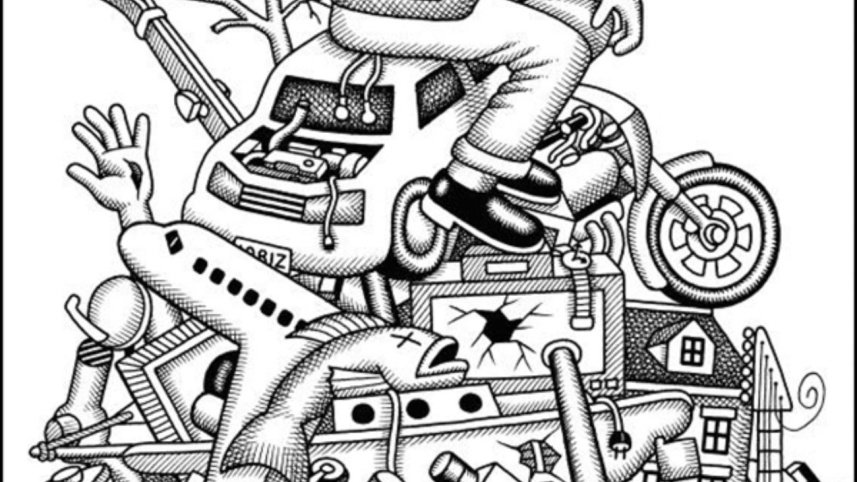
In January 1973, Paul Sweezy, a renowned Marxist economist, published an article in the Monthly Review Magazine on the causes of the decline of the US economy, and why stagnation and increasing dependence on a permanent state of war had become its regular features. He further asserted that this tendency is integral to the nature of monopoly capital in the 20th Century. This article reflected the central argument of his and Paul Baran's famous book Monopoly Capital: An Essay on the American Economic and Social Order published in 1966. During the height of the Cold War and the heyday of monopoly capitalism, such a critique of mainstream economic order could not go unchallenged. As expected, the response was predictably vigorous and, to an extent, vicious.
In March 1973, Paul Samuelson and Kenneth J. Arrow, two Nobel Laureate economists, followed by a few others, published several scathing critiques of Sweezy's article in The New York Times. They argued that in the Keynesian era, the chances of the reoccurring of the ancient scourge of intermittent shortage-of-purchasing-power are remote or next to impossible even in the distant future. Samuelson further argued that military spending and wars were no longer necessary to stimulate the economy, as the Keynesian economists knew how to generate demand through prudent fiscal policy in peacetime that virtually guarantees crisis-free reliable economic growth.
 For all latest news, follow The Daily Star's Google News channel.
 Arrow also refuted the claim by the Paul duo that in an advanced capitalist economy, the government can ensure full employment only through socially wasteful and destructive means such as war. He pointed out that in the 60s, while the US spent less on defense and more on social sectors, it experienced an apparently booming economy. Sweezy responded by presenting figures that if the increase in the share of military related employment in 1970 compared with 1938 was eliminated, the US economy would have real unemployment levels equal to those of the Great Depression. He also empirically demonstrated that the incredible growth of the US economy in the second half of the 20th Century was due to WWll and the subsequent Cold War. The much celebrated successes of Keynesian economics had really been heavily dependent on military spending. Thus, a key lesson of monopoly capital's global reach in the 20th Century was that it only thrives on a permanent state of war.
The internal impact of monopoly capital's ever increasing grip on the socio-economic and political arenas in the advanced capitalist states, especially in the US, over the past three to four decades resulted in several developments. First, massive profits are no longer derived from investments in the manufacturing sector (the Smithian model), but through manipulation of finance, service, and bureaucratic paper-shuffling. Profits without production became the new mantra of the ultra-rich. Thus, bank and insurance company executives, lawyers, merger specialists, speculators, hedge fund managers, investment and portfolio handlers, stock market players and the exchange rate manipulators (together with some service entrepreneurs and high-tech convenience providers became part of the new wealthy 1 percent who amassed huge fortunes. The rest of the economy stagnated, and the condition of the working class worsened in terms of wages, comparative buying power, social satisfaction or their hopes for the future. No wonder they are venting their pent up rage and frustration at the political establishment through supporting the Trump platform in spite of all the deplorable and damaging aspects of the candidate that have come to light.
Second, the globalisation of production and exchange has changed many of the previous country-specific analyses that had been attempted by classical and neo-classical economists. Moreover, as the world economy has become more integrated, the problems in one major economy has a ripple effect on the rest of the world in immediate and profound ways, and economic policies in just one country cannot fully protect it from the ravages of capitalism elsewhere. Also, the frequency of monopoly capital's inborn tendency of periodic boom-bust cycles has only increased since its sudden appearance in the Great Depression of the 30s, and has become globalised. Though Keynes had only patched up that open wound with much insight and expertise, he couldn't offer any permanent solution to the problems inherent in capitalism itself, or ways in which it is manifesting itself today.
Third, modern capitalism has been unhinged from the "moral anchor" on which it had been originally based. Initially, capitalism had been considered to be an ethical system of market-oriented production and supply where free competition and transparent mechanisms were supposed to make the economy competitive, dynamic and fair. Moreover, there would be no coercion and the people would be free to make their own decisions about work, consumption and leisure. Now, workers are increasingly denied that choice. They are paid at progressively meagre rates, work is outsourced to countries where wages are cheaper and working conditions less safe, advertising can be manipulative and false, there is price-fixing and collusion, and the system is wilfully blind to environmental degradation unsustainable for the planet. The glitter of capitalism can sometimes blind us to its ugly realities. The pursuit of profits, fundamental to capitalism, has never been as ferocious, as insensitive, or as disruptive.
If we consider the recession of recent times, we see that there is very little sign of recovery in spite of massive transfer of wealth in the form of bail-outs from the taxpayers to the wealthy (which really translates into private profits at public risk, i.e., economic successes are enjoyed by individual capitalists, failures are borne by all citizens). After 50 years, Paul Sweezy and Paul Baran's predictions of monopoly capital's inborn pitfalls rooted in Marxian analysis of capital stand vindicated, while Samuelson and Arrow, the two famous neoclassical economists in the second half of the last century have been proven wrong. On the positive side, concerns about the crises inherent in monopoly capital, and all the havoc that it entails, has now entered the mainstream discourse. Bernie Sanders and Jeremy Corbyn are its political manifestation, while economists such as Krugman, Stiglitz, and Piketty are raising sharp and pertinent questions.
The broad lesson is simple - unbridled capitalism riding on the shoulders of unregulated laissez faire goes on accumulating thus, inevitably, turning monopolistic. And for preserving the control over this monopoly, and to satisfy its need for further profits, it must go on waging wars, and manufacturing enemies, foreign or domestic. One wonders if the war on terror or the aggressive attempts by the Pentagon to trigger a new cold war with Russia and China stem, at least partly, from this consideration. Does Eisenhower's warning of a military-industrial complex ring a bell?
This piece is based on the editorial note of the Monthly Review Magazine's July-August 2016 issue.
The writers are Professor Emeritus, Black Hills State University and Director of Gyantapas Abdur Razzaq Foundation, and a freedom fighter, researcher and author, respectively.
Emails: Ahrar.Ahmad@bhsu.edu, and aliahmedziauddin@gmail.com
Comments