

Private Universities: Successes and Challenges
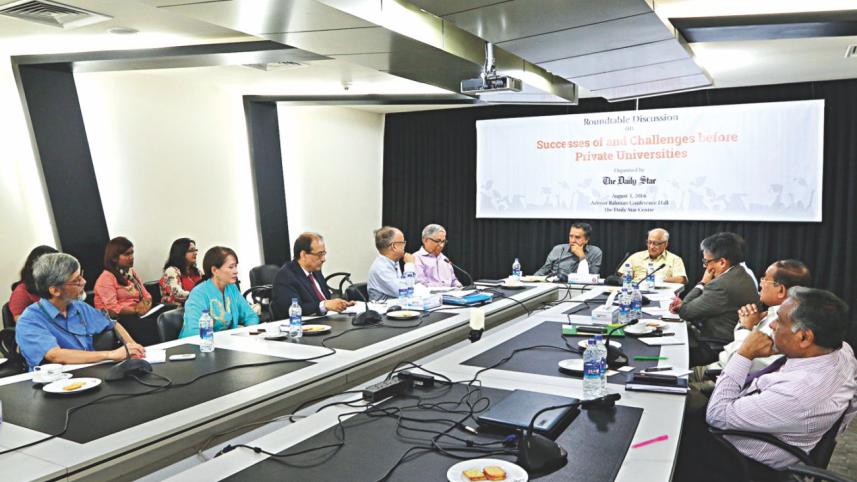
On August 3, vice-chancellors of several renowned private universities along with the chairman of the University Grants Commission were present for a roundtable emphasising on the “Successes of and Challenges before Private Universities,” hosted by Mahfuz Anam, editor and publisher of The Daily Star.
The discussants talked about how private universities have been constantly scrutinised despite their strong establishment in the country in the early 1990s. These institutions are often mistakenly regarded as a higher education choice for the affluent, whereas the reality is: a good number of students from the middle and bottom tier of the financial pyramid are also enrolled here, speakers said. Private universities have also contributed to the economy by reducing the number of students opting for higher education abroad.

Despite such favourable outcomes, their image has been further tarnished due to the current issue of militancy. VC of North South University, Professor Atiqul Islam, said that his university is taking all the preventive measures to tackle further deterioration of the situation. NSU has drawn harsh scrutiny as some of the terrorists involved in the recent attacks had been former students of the institution.
Highlighting NSU's success, Professor Islam talked about zero unemployment among its graduates and the recent research arrangements with NASA and Johns Hopkins University which he hoped would bring in gains for the country.
“Private universities are no longer a mere back-up plan for those who fail to get admission in public universities,” said Professor M. Omar Rahman, VC of Independent University, Bangladesh. He said, “We must be offering something that makes these institutions an attractive first choice.” He credited a competent team of faculties, good infrastructure, and a curriculum that is on par globally for the success.
Professor Syed Saad Andaleeb, VC of BRAC University, talked about value addition and also focused on how these institutes were producing a driven and skilful set of future employees. “The general education courses that are being offered equip students with all the core competencies that the job market demands,” he said.
Building on which, Professor Imran Rahman, VC of University of Liberal Arts Bangladesh, talked about their provision of co-curricular activities that equip students with soft skills that are not taught in classrooms and also the diverse teaching body.
As a challenge, he pointed out, they receive no form of capital or financial aid from the government but must go through a difficult bureaucratic process even when they try to make curricular changes.
The VC of United International University, Professor Mohammad Rezwan Khan pointed out the delicate matter that, despite being non-profit establishments, private universities have to pay 15 percent tax which, he suggested could have been directed towards research and development instead. About the state of affairs of students, he said, “The rise in undeserving GPA 5's disrupts and dilutes the uniformity, as it makes it hard for us to distinguish between a student who is ready for university-level education and one who isn't. We have to go back and start from scratch.”
Mahfuz Anam concluded the session by saying that private universities are here to stay, and should be given the credit and recognition they deserve. He emphasised on the need for collaboration among private universities – as proposed by Dr. Carmen Z Lamagna, VC of American International University Bangladesh – to work as a unit, utilising each other's resources to thrive and tackle all the challenges.
 For all latest news, follow The Daily Star's Google News channel.


Comments