


Book & DVD on Tagore released in Dehli
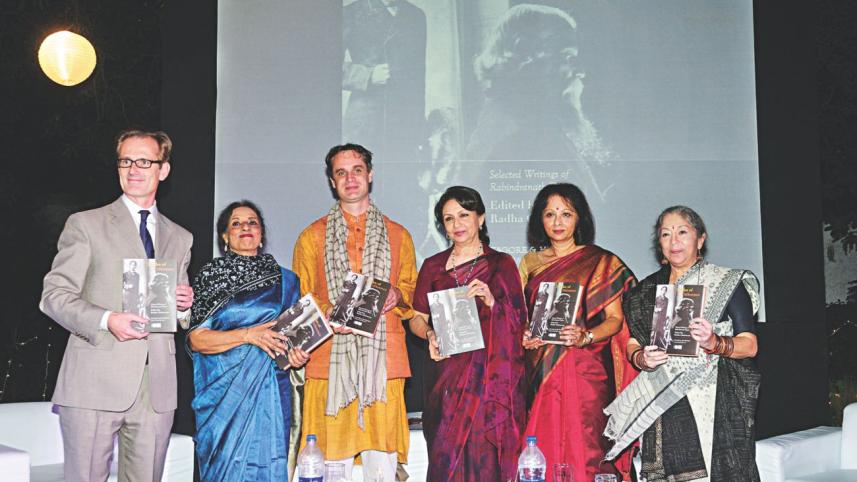
Today on this propitious occasion of the launch of a very thought-provoking book on Tagore, it is wonderful to be here to, together, celebrating our shared passion for the Nobel Laureate. The DVD volume includes a performance of Shadhona's performance on Tagore. Many of you may be aware that in Bangladesh, Tagore is an iconic figure within our urban cultural practices. For many he is not merely a poet, but a way of life.
There is a very potent and compelling reason for this.

In Bengal, starting from the 6th Century Buddhist Charya songs to the present day spiritual folk Baul songs, music has always been a bridge that connects the mundane with the spiritual. So, for the Muslims of Bangladesh, reciting their daily Islamic prayers in Arabic, a language not known to most, the cultural distance from the reality of Bengali land and life gives rise to a vacuum in their need to personally address spirituality within themselves.
Culturally at conflict with both the 'Muslim' traditions of the Middle East and the overt religiosity inherent in the musical traditions of the land, especially dance; the Muslim in Bengal readily enriches the boundaries of its cultural tradition with Tagore's music and dance. It is wonderful that Social Science Press thought of including audio-visual material where you can get a glimpse of Robindronritto, as practiced in Bangladesh.
Today, however, we need to ask ourselves, how Tagore is contextual in an increasingly intolerant South Asia, where 'free-thinkers' are being murdered and 'freedom of choice' is being victimized, literally to death.
We know that Tagore recognized that the crux of the problem lies in the way education created a division between learning and wisdom. Unhappy with modern educational institutions and the teaching methods employed in them, he began his exciting experiments in education at Santiniketan.
Very interestingly, of the few 'mantras' recited, by the students, at Visva Bharati, there is the 'Shanti Mantra' of the Taittiriyya Upanishad -
saha nAvavatu saha nau bhunaktu
saha vIryaM karavAvahai |
tejasvi nAvadhItamastu
mA vidviSAvahai ||
oM zAntiH zAntiH zAntiH ||
"May the Lord protect us together.
May He nourish us together.
May we work together uniting our strength for the good of humanity.
May our study make us illumined and purposeful. May we never hate one another.
May there be peace, peace and perfect peace."
The operative words in the mantra are 'may our study make us illumined'. Tagore understood that education was, increasingly, becoming more about information, rather than about formation of moral and ethical character. 'Perhaps at no other time have men been so knowing and yet so unaware, so burdened with purposes and yet so purposeless, so disillusioned and so completely the victims of illusion. This strange contradiction pervades our entire modern culture'.
Remarkably, as one of the means for redressing the woes of modern educational systems, Tagore introduced Art as a necessary and integral part of schooling. Today cognitive science recognizes the fact that art and ethics are both imaginative enterprises.
Corroborating this, Martha Nussbaum writes:
Moral knowledge...is not simply intellectual grasp of propositions; it is not even simply intellectual grasp of particular facts...It is seeing a complex, concrete reality in a highly lucid and richly responsive way; it is taking in what is there, with imagination and feeling.
It is evident that the pursuit of the arts enhances the capacity to imagine. The faculty of imagination, in turn, empowers moral reasoning.
In July 1936 Tagore writes,
'It is not just through sports that the students of our Asrama get the proximity of this pulsating Nature, it is also through music that I have directed their hearts towards its stage'.
Why was the realization of Nature essential to Tagore's philosophy of education, and that too through the arts?
Time and time again, Tagore has written about Unity within Nature that is achieved through the 'faculty of creativity' that is Nature's most essential trait. Unity for him is a harmony between parts and a harmony with surroundings. This is achieved by nature's innate 'creative' ability to establish relationships.
Rabindranath writes:
When the science of meteorology knows the earth's atmosphere as continuously one, affecting the different parts of the world differently, but in a harmony of adjustments, it knows and attains truth. And so too, we must know that the great mind of man is one, working through the many differences which are needed to ensure the full result of its fundamental unity. When we understand this truth in a disinterested spirit, it teaches us to respect all the differences in man that are real, yet remains conscious of our oneness; and to know that perfection of unity is not in uniformity, but in harmony.
The emphasis is, therefore, on 'a harmony of adjustments' achieved through the 'faculty of creativity'.
 For all latest news, follow The Daily Star's Google News channel.
 Tagore often speaks of this same creative nature of man – bhetorkar srijon shokti – that enables him to wreathe a garland of unity from his disparate experiences.
It is to be hoped that publications like 'Shades of Difference' and more discourses on Tagore will encourage us to take note of Tagore's worth as a thinker and an educationist.
I conclude with another quote from the Poet,
I try to assert in my words and works that education has its only meaning and object in freedom – freedom from ignorance about the laws of the universe, and freedom from passion and prejudice in our communication with the human world. In my institution I have attempted to create an atmosphere of naturalness in our relationship with strangers, and the spirit of hospitality which is the first virtue in men that made civilization possible.
Cultural Correspondent
Comments