A cry for a liveable city


The Daily Star (TDS): How do you evaluate the development of Dhaka over the centuries, particularly after independence? Since the 2000s, with massive expansion, how would you describe the city’s character in comparison to neighbouring cities such as Kolkata, Delhi, or Karachi?
Adnan Morshed (AM): Dhaka’s urban history over the centuries has been complex. There is a curious dearth of authoritative, peer-reviewed histories of pre-Mughal Dhaka. As I argued in an article in Places Journal, this lack of research limits our understanding of the city’s historical evolution. The Mughals were great monument builders but not great city planners. They did not create a good urban template on which Dhaka could develop into what we might recognise as a functioning city. However, we should remind ourselves that Mughal rule in India ended before industrial cities emerged in the 19th century in Europe and elsewhere in response to the environmental challenges posed by the Industrial Revolution.
The modern growth of cities in non-western territories was deeply intertwined with both colonialism and the impacts of the Industrial Revolution. The British colonial administration created some effective urban institutions and infrastructures in Dhaka. Examples include the establishment of the municipality (1864) and the construction of the Buckland Embankment (1860s), which both helped prevent flooding and created a riverfront promenade for the city’s residents.
The trajectories of Delhi and Kolkata are unique in their own ways. Delhi has a well-documented history as a political and administrative centre since the Mauryan, Kushan, and Gupta empires, continuing through the Sultanate, Mughal, and colonial eras, and into its post-independence emergence as a metropolis. From 1772 to 1911, Kolkata served as the capital of British India, growing into a robust political, commercial, and cultural hub of the empire, second only to London. Kolkata retains the urban footprint—and the nostalgia—of an imperial city, dotted with iconic neoclassical buildings that embodied the British Raj’s “civilising mission.” In the final decades of colonial India, Delhi replaced Kolkata as the imperial capital, with the Viceroy’s House—designed by British architect Edwin Lutyens—at its centre.
By comparison, Dhaka’s Mughal and colonial footprints are modest. Until Bangladesh’s independence in 1971, Dhaka remained a quaint city with a rural ambience and little more than two million people. Things began to change with the country’s “industrial revolution” in the late 1980s. As the Berlin Wall fell and the neoliberal world order loosened trade barriers, encouraging global capital to flow more freely than ever, urbanisation arrived with force in a society that had been largely agrarian. For Dhaka it was almost a kind of “reluctant urbanisation,” one in which the capital was ill-prepared and lacked adequate policy instruments to absorb the massive influx of rural migrants flooding the city in search of factory jobs—particularly in the garment industry.
Dhaka’s population grew by nearly ten per cent in the following decades. Unfortunately, there were neither effective housing policies nor coordinated urban transport planning. Urban expansion has been ad hoc and laissez-faire. By 2020, Dhaka had joined New York City, Tokyo, Shanghai, Beijing, Mexico City, São Paulo, Lagos, Cairo, Delhi, and a handful of others on the list of global megacities. The “rural city” remade itself into a cacophonous megalopolis. Its haphazard growth reflected the country’s fractious political culture. One of the most glaring failures has been the inability to manage the city’s exploding population density.
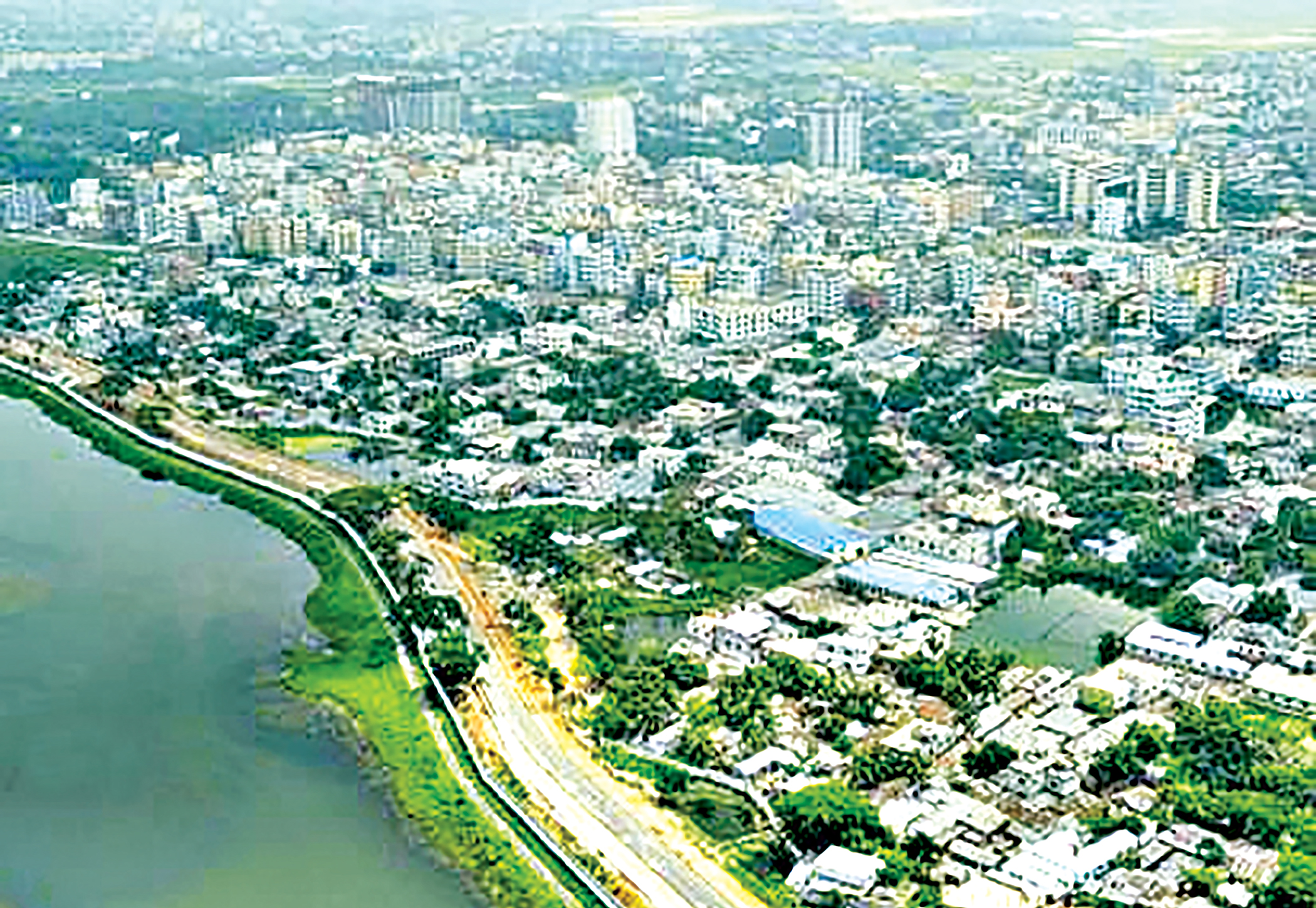
TDS: You emphasise the idea of “good density,” which contrasts with the common perception of Dhaka’s overwhelming overpopulation as a barrier to modern amenities and the main cause of the city’s chaotic nature. Could you elaborate on this perspective?
AM: Conventional wisdom holds that high population density is a burden and the root cause of many social, economic, and political problems. I argue that density becomes a burden and a paralysing problem only if it is not managed well or distributed equitably with a fair allocation of resources. Walking around Dhaka, density surely feels overwhelming, maddening, and claustrophobic—and this is because we have not been proactive or creative in managing it. What we face is not “density,” but rather gadagadi—a phenomenon of people living in extreme congestion which poses a threat to public health.
In contrast, “good density” is a form of tactical urbanism that addresses the problem of overcrowding. In other words, good density presents a mixed-use urban lifestyle, one that ensures people live in compact and affordable housing units with easy, walkable access to the basic services they need, such as schools, healthcare, work, markets, outdoor public spaces, and parks—all within comfortable walking distance. When I say, “good density,” I actually mean “good society density.” Managing population density well presents the opportunities for creating a good society.
It is a given that our cities will always be high-density because of our country’s land-to-population ratio. We simply have too many people on a relatively small piece of land. For context, about 70 million people live in the UK’s total area of 250,000 km², whereas 180 million live in Bangladesh’s 150,000 km². In Thailand, 72 million people occupy over 500,000 km². Bangladesh’s density is comparable to half the U.S. population living in just the state of Iowa. Our cities will always be dense, so imagining low- or mid-density cities with picturesque parks will remain a perpetual false dream.
The question we must ask is: why have we not been able to harness our density dividend? Several policy failures are to blame. One of them is both philosophical and tactical: the uncritical acceptance of a historical Western fear of population density, rooted in the urban pathologies of 19th-century industrial cities such as London, Manchester, and New York. Describing the wretched urban conditions in mid-19th-century Manchester—nicknamed “Cottonpolis”—in The Condition of the Working Class in England (1845), Friedrich Engels portrayed the modern fear of unhygienic urban density. Modern urban planning as a discipline internalised this 19th-century fear, which we inherited when planning our own cities at the tail end of the 20th century.
What we failed to account for are the late-20th-century South Asian urban realities: the inevitability of rural-to-urban migration, ultra-dense conurbations, the informal economy and settlements, and the looming threat of climate change. Urban policymakers, planning communities, and local governments have generally treated population density as a burden—a problem to be solved—rather than as an opportunity to create a new type of urban lifestyle marked by compact living, economic dynamism, a low-carbon footprint, resilient environmental adaptation, and walkable neighbourhoods.
TDS: Instead of pursuing democratic and inclusive development across the city, we increasingly see fortification through gated communities, while private enterprises and government facilities remain concentrated in affluent areas. Yet Dhaka still struggles to become a truly liveable city. Why is that?
AM: In an ideal world, good urban planning promotes democratic growth and inclusive development, meaning the interests of all city dwellers are prioritised as part of a general social contract, which is then spatialised through land-use instruments such as the Detailed Area Plan (DAP). Unfortunately, however, we have knowingly or unknowingly accepted planning as an elitist tool to produce cities “of the privileged, by the privileged, for the privileged.”
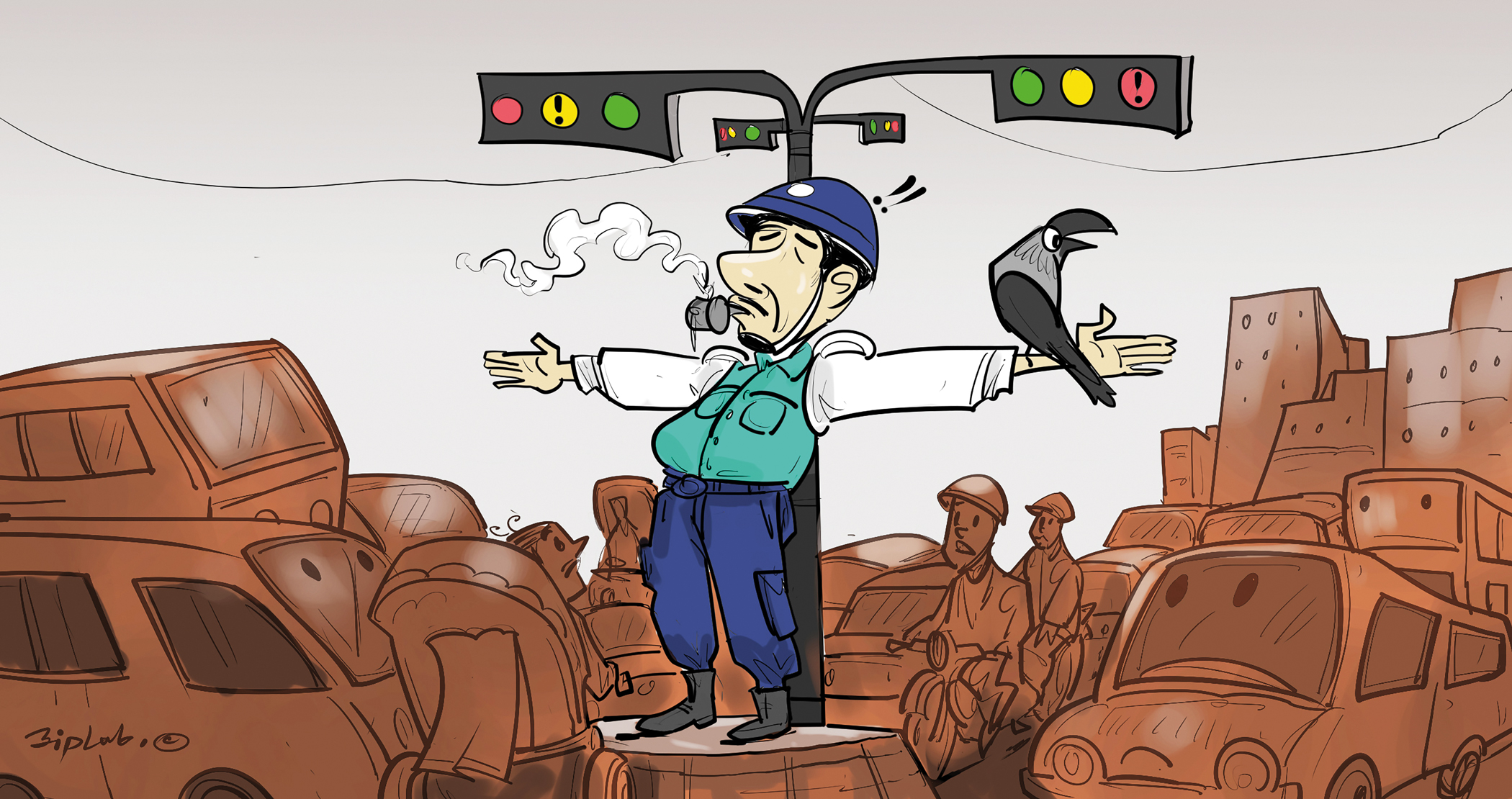
One way to understand this discriminatory practice is through our approach to footpaths. We are reluctant to invest in them as soft infrastructure that benefits the majority of daily commuters. Yet we are often eager to invest in flyovers, whether or not they are the best and most affordable mobility option for the city. Flyovers are costly and serve only a small portion of daily motorised movements, yet they are celebrated as triumphant political symbols that drive our vision of development.
The sad truth is that our urban development model presents a highly pixelated landscape of unevenly distributed privilege. While the parks in Gulshan boast walkways, cafés, libraries, and basketball courts, 37 of Dhaka’s 129 wards have neither a park nor a playground. So, when you say, “we increasingly see fortification through gated communities, while private enterprises and government facilities remain concentrated in affluent areas,” we should not be surprised. The problem is that we fail to recognise how misguided we are in packaging this gross spatial injustice as progress.
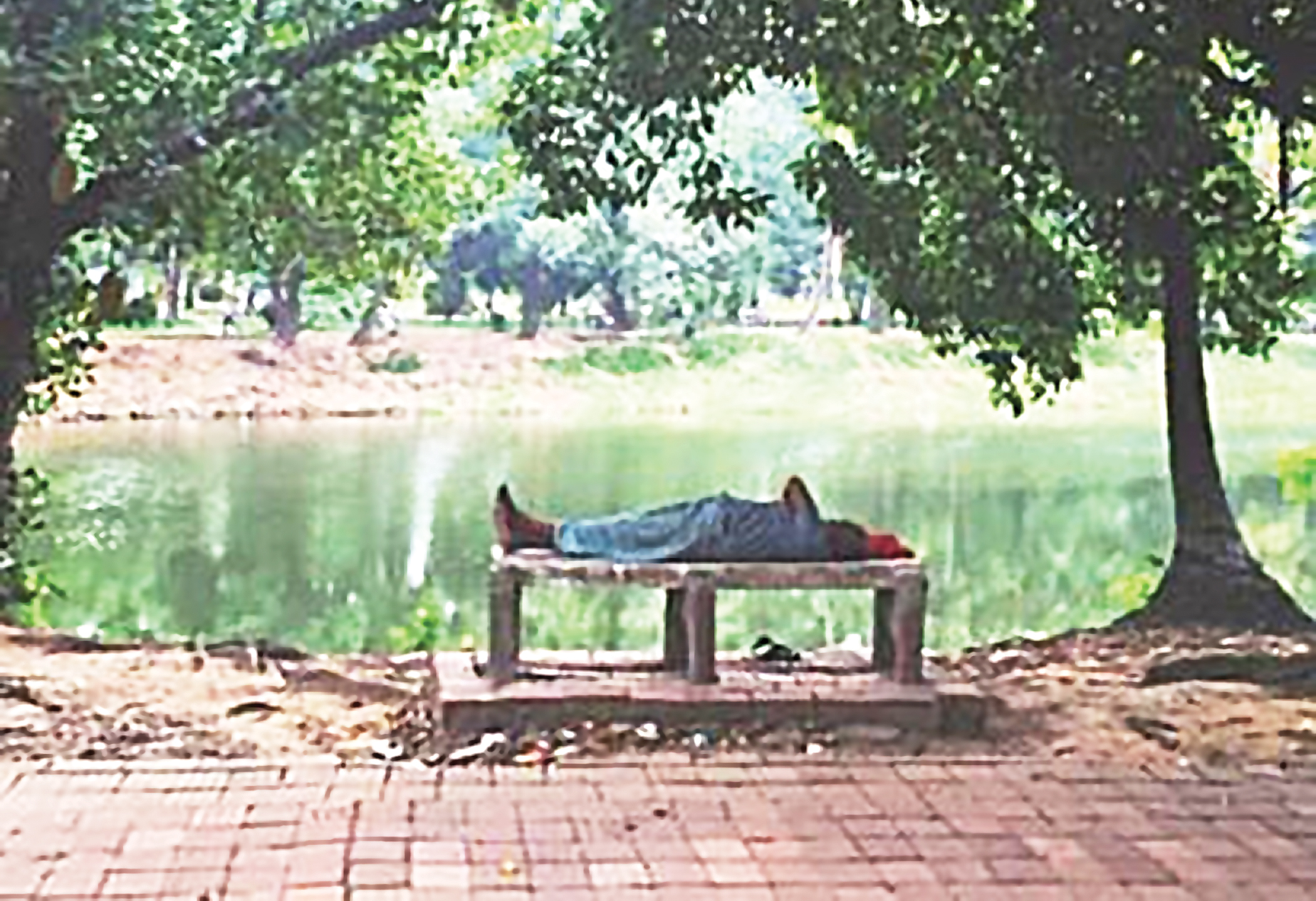
TDS: Could you elaborate on the idea of urban justice in the context of Dhaka, especially considering the decline of parks, footpaths, and public spaces for walking, playing, and recreation — and, most importantly, the lack of adequate public transport?
AM: While “justice” is a complex political concept—whose justice or injustice we are talking about, or what the ultimate goal of justice is, as Aristotle would demand—we can narrow it down to a working model for our cities. By urban justice, I mean several things: using resources at our disposal in ways that benefit the majority of the city’s population; managing population density to democratise access to services such as healthcare, education, and transportation; protecting the city’s environmental DNA to ensure long-term sustainability, particularly in the era of climate change, for the benefit of present and future generations; and creating urban spatialities that nurture democratic values, civic awareness, and respect for the rule of law among city dwellers. Achieving these goals will, of course, require sincere collaboration among all stakeholders.
TDS: Given that much of the city’s infrastructure — both planned and largely unplanned — has become deeply entrenched and may seem irreversible, how can we prevent tragedies such as the recent Milestone School fire or building collapses or fire incidents, and mitigate such massive losses?
AM: The Milestone School tragedy was heartbreaking. Even though it felt like a bolt from the blue, it was, unfortunately, inevitable. It resulted from unchecked greed to extract profit from every square inch of city land, a blatant failure to adhere to commonsense land-use policy (why place a school in the flight path zone, knowing well the danger of crashes and the air pollution from jet fuel emissions?), and the air force’s disregard for public safety. Someone in the administration should have anticipated this tragedy and acted to prevent it. That didn’t happen. Planning should be pre-emptive rather than reactive. We keep repeating mistakes that cost lives. We can begin to prevent tragedies like this by holding those in charge accountable, enforcing safe land-use policies, and depoliticising the enforcement of law.
TDS: Decentralisation has long been discussed but rarely implemented effectively to ease the burden on Dhaka. With the added challenges of climate change, how can Dhaka maintain its surrounding rivers sustainably and ensure the capital remains liveable in the future?
AM: Decentralisation has become a political problem with no immediate or formulaic solutions. It is a policy challenge for both the executive and legislative branches of government, as well as for local governments and planning communities. We have reduced “decentralisation” to a feel-good slogan, while Dhaka has grown into a colossal primate city, disproportionately larger than the next three major cities combined. By allowing Dhaka’s unchecked expansion to consume the rivers and wetlands that sustain it, we are not only damaging Dhaka itself but also diminishing the potential of other cities across the country.
To decentralise the capital, we must first recognise that mid-sized cities represent our new urban frontier. A resilient and adaptable urban development policy for these cities is not only essential to reducing pressure on Dhaka but also offers an effective and equitable model of economic growth for the entire nation. Several incentives support this approach. First, high living costs are encouraging residents of the capital to relocate to smaller cities in search of a more affordable lifestyle. Second, the growing economies of mid-sized cities are fostering opportunity-rich start-up ecosystems. Third, these cities help narrow the urban–rural and agriculture–industry divides, creating a range of hybrid forms of work for their labour force. Fourth, because mid-sized cities have not yet reached a frenzied stage of development, their entrepreneurial classes have the opportunity to shape climate-resilient, human-centric, economically vibrant, and inclusive cities.
It is time to be proactive. Safeguarding Dhaka’s rivers and wetlands will require a new generation of context-specific urban policies, greater environmental literacy, depoliticised enforcement of environmental laws, and, ultimately, a degree of soul-searching about the kinds of cities we aspire to build for the greater good of society.
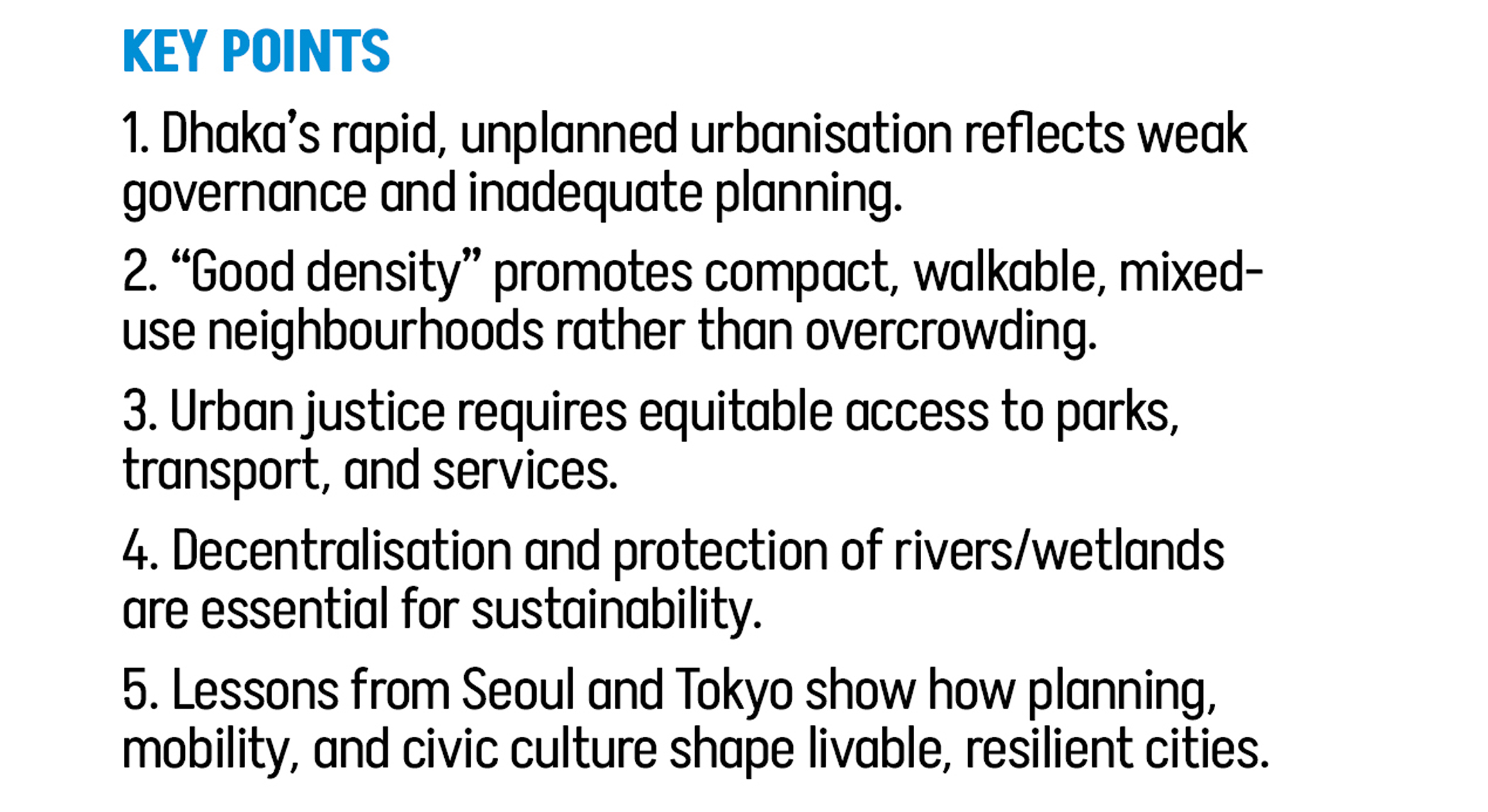
TDS: Could you share examples of locally developed solutions, or lessons from other cities around the world, that might help address Dhaka’s urban problems?
AM: The best solution to Dhaka’s problems is to cure ourselves of excessive Dhaka-centrism in our national thinking. We need to start imagining a future beyond Dhaka.
One of the most instructive cases for Dhaka is Seoul, a city I have had the opportunity to visit and study. Like Dhaka, it is a primate city, but since the 1970s the South Korean government has developed satellite towns around it to ease population pressure on the capital. These new towns, located 20–30 miles from Seoul, are connected by highways, subway extensions, and later by high-speed rail. Regional development policies also prohibited the excessive concentration of industry in Seoul. Furthermore, the establishment of Sejong Administrative City, 120 kilometres south of Seoul and home to many government ministries and agencies, as an ambitious decentralisation project has eased pressure on the capital and spurred growth in the Chungcheong region.
Why can’t we pursue commonsense solutions, such as relocating several government ministries to other cities and reducing the burden on the capital? What is stopping us?
There is another city from which we can learn much: Tokyo. If you are there, the first thing you notice is that public transport is everywhere and widely used. The system crisscrosses the city so thoroughly that owning a car becomes unnecessary. This culture of devaluing car ownership helps make dense cities like Tokyo both sustainable and liveable. Some of Tokyo’s 23 wards—Shinjuku and Toshima, for example—have a population density of more than 20,000 people per square kilometre. Despite this, they offer a vibrant mix of housing, shopping, restaurants, businesses, parks, and culture.
Tokyo’s streets and subways are always full of people. While riding the subway in Tokyo, I recalled the words of Gustavo Petro, president of Colombia since 2022: “A developed country is not a place where the poor have cars. It’s where the rich use public transportation.” Despite its enormous population, Tokyo doesn’t feel claustrophobic. The reasons are population management, efficient mobility options, equitable distribution of amenities, and a culture of self-discipline as a philosophy of urban life. This last point is the most important. For a city to function well, its people must believe in the collective good. Good cities and good people shape each other.
The interview was taken by Priyam Paul.
Adnan Zillur Morshed is an architect, architectural historian, urbanist, and columnist. He teaches at the Catholic University of America in Washington, DC. He can be reached at morshed@cua.edu.
Send your articles for Slow Reads to slowreads@thedailystar.net. Check out our submission guidelines for details.
From 'wasteland' to Bhasanchar: Bangladesh’s ongoing experiment in governing uncertain land
Why Bangladesh's schools need financial autonomy
What the water knows: The unmaking of Bangladesh's haors

Who writes the history of the July Uprising?
How violence against women is normalised in Bangladesh's chars

Why Bangladesh must invest in community-led early childhood education
The moral architecture of Bangladesh’s parliament

Why Bangladesh innovates but rarely builds global companies
Beyond groundwater: Rethinking Barind's water crisis