How AI became an authority in our classrooms
A few months ago, something small happened at home that stayed with me.
My young son had recently discovered what he calls “Gemini Aunty” on my phone. One morning, when neither my wife nor I could persuade him to wake up for school, I tried something different. I asked the AI to speak to him.
A calm voice responded in Bangla, gently telling him that good children wake up on time and prepare for school.
He listened immediately.
What struck me was not just that it worked, but how quickly authority shifted. A child who resisted his parents responded to a machine without hesitation.
That moment raised a question that extends far beyond the home: when AI speaks, what makes us listen?
Across classrooms in Bangladesh, AI is already becoming part of everyday educational practice. Teachers are using it to prepare lessons, generate materials, and manage workloads more efficiently. For many, it is proving to be a valuable support.
But alongside this growing use, a quieter pattern is also emerging.
In Bangladesh, discussions around AI in education often focus on access and adoption. But readiness is not only about whether tools are available. It is about whether educators and institutions are prepared to engage with these tools critically and contextually.
Some educators engage with AI thoughtfully. They adapt its outputs, question its suggestions, and reshape it according to their students’ needs. For them, AI becomes a starting point for thinking.
Others use it differently. Content is generated and used with minimal reflection, treated as ready-made answers rather than something to be examined or questioned. In these cases, AI begins to take on a different role, not just as a tool, but as a source of authority.
This distinction matters.
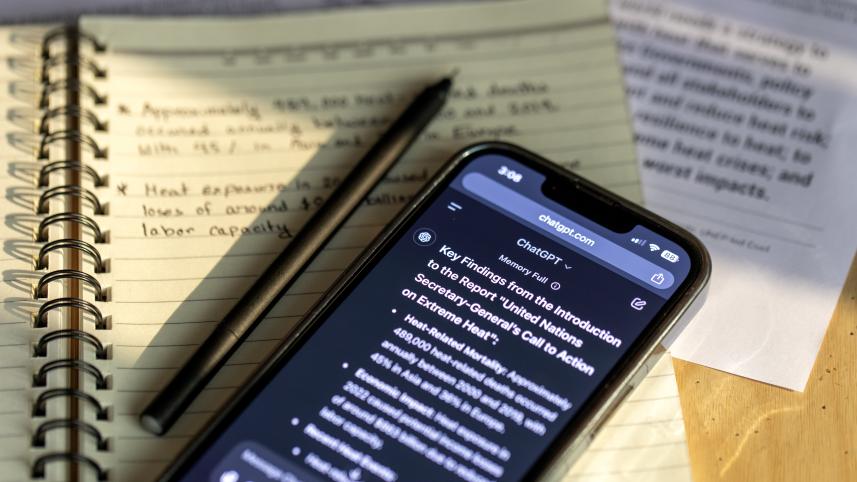
AI does not simply provide information. It presents it in ways that feel immediate, fluent, and convincing. Its responses often sound complete, even when they are partial or contextually limited. This can create a subtle shift in how knowledge is received. Instead of asking whether something is accurate or appropriate, we may begin by assuming that it is.
In conversations with educators across Bangladesh, this shift is becoming visible. Some teachers describe AI as an essential support that enhances their work. Others express concern that it is increasingly being treated as a “magic solution,” producing answers without requiring much interpretation or adaptation.
This raises a deeper question about readiness.
In Bangladesh, discussions around AI in education often focus on access and adoption. But readiness is not only about whether tools are available. It is about whether educators and institutions are prepared to engage with these tools critically and contextually.
Without that readiness, AI risks being used in ways that reduce professional judgment rather than strengthen it. Lessons may become less responsive to local contexts. Students may rely on answers without questioning how they were generated. Over time, this can shape how learning itself is experienced.
At the same time, avoiding AI is not a realistic option. It is already embedded in how information is accessed and shared.
The challenge, then, is not whether AI should be present in education, but how it is approached.
AI can support teaching and learning in meaningful ways. It can reduce administrative burdens, provide new resources, and open new avenues for exploring ideas. But this potential depends on how it is used.

It requires seeing AI not as an unquestioned authority, but as something to be engaged with. It requires asking where its responses come from, what they leave out, and how they apply to specific contexts. It also requires maintaining the habit of questioning, even when answers are readily available.
This places responsibility not only on individual teachers, but on the system as a whole. Educators need opportunities to build the skills required to work with AI thoughtfully. Institutions need to create space for reflection, not just adoption. And policy conversations need to move beyond whether AI should be used, towards how it shapes thinking and learning.
AI is already speaking in our classrooms, our homes, and our daily work.
The real question is whether we are still thinking.
Shamresh Saha is a senior manager at the British Council. This article was developed through the #NextGenEdu Learning Cohort, a platform for reflection and dialogue on AI and education in Bangladesh.
Send your articles for Slow Reads to slowreads@thedailystar.net. Check out our submission guidelines for details.

Dhaka accidentally built the city planners now want. Can we make it liveable?

Can Bangladesh produce its own knowledge?

How we are killing Dhaka

Can Bangladesh afford not to invest in Bhola’s gas?

Bangladesh’s renewable policy: Still too little but not too late

Prabhat Patnaik speaks / Why the Global South must rethink export-led growth

Bhotekoshi flood: Another warning from the Himalayas. Are we listening?

Renewing the Ganges Water Sharing Treaty: What should Bangladesh do?

What it really costs to live in Dhaka