Why Bangladesh’s children are in school but not learning
Sub-Saharan Africa and South Asia are the only regions where the majority of young teenage children cannot read, and the majority will probably not achieve literacy as adults. The consequences extend far beyond the education sector. At a time when artificial intelligence, automation, and other technological advances are reshaping labour markets, and countries are seeking to build knowledge-based economies, Bangladesh has a workforce in which more than half lack functional literacy and numeracy.
Bangladesh has struggled for nearly five decades to secure foundational literacy and numeracy for all children. Successive governments have made progress, but not enough to justify complacency. For the new government, this is both an urgent challenge and an opportunity to reassess existing plans and learn systematically from past policy and implementation failures.
The only country in South Asia with universal foundational learning is Sri Lanka. Despite its political conflicts, it has made education a central national development priority for a century.
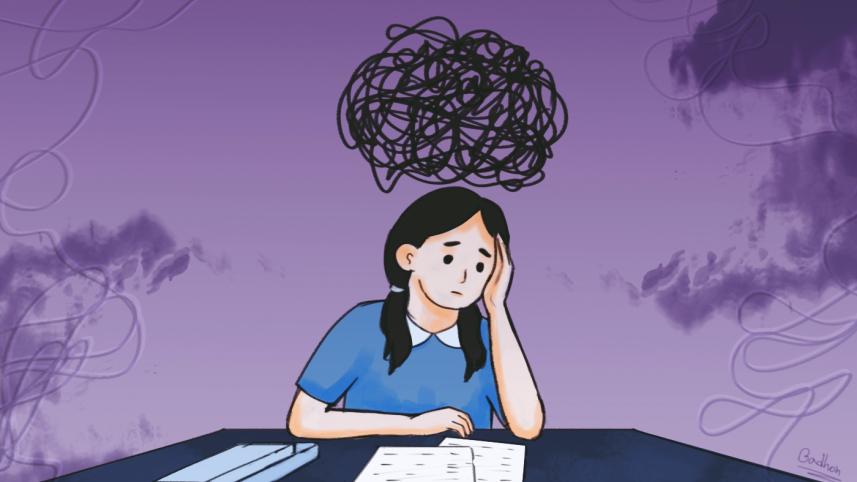
Completion of the primary cycle for all children was the UN's second Millennium Development Goal (MDG2). 2015 was the target date. In South Asia, by 2015, nearly all children were in school, but most could not read. The sequel is the UN's fourth Sustainable Development Goal (SDG4), with 2030 as the target date: "By 2030, ensure that all girls and boys complete free, equitable, and quality primary and secondary education leading to relevant and effective learning outcomes." In South Asia, the target will not be realised in 2030, just as it was not in 2015.
What is basic literacy?
In the 2010s, Jim Yong Kim, a Korean physician and head of the World Bank, vented his frustration in a major World Bank report: "What is important, and what generates a real return on investment, is learning and acquiring skills. This is what truly builds human capital … in many countries and communities, learning isn't happening. Schooling without learning is a terrible waste of precious resources and of human potential."
Frustrated by endless debates over the definition, the World Bank in the 2010s "cut the Gordian knot" by defining learning poverty as children aged 10–14 who are unable to read a 100-word story at approximately Grade 2 level fluently. The definition of basic literacy is implicit: children in the relevant age cohort (10–14) minus those suffering from learning poverty (see Box 1).
Using this definition, the World Bank published basic literacy rates for regions: 40% in South Asia and 14% in Sub-Saharan Africa, as well as for 78 individual countries. The basic literacy rate in Sri Lanka is 85% (= 100% [all Sri Lankan children aged 10–14] minus 15% [Sri Lankan children aged 10–14 unable to read a 100-word story]). The basic literacy rate in India is 44% (= 100% minus 56%); the rate in Bangladesh is 42% (= 100% minus 58%); the rate in Pakistan is 23% (= 100% minus 77%). Data are unavailable for Nepal.
The World Bank's learning poverty statistic is an assessment of the inability to read, at a basic grade 2 level, among national cohorts of children aged 10–14. The basic grade 2 literacy rate in a country is defined as 100% minus the learning poverty rate. In this age cohort, students are expected to be in an upper primary grade or to have completed the primary cycle. The learning poverty rate is defined as the sum of two subsets:
|
Parents want their children to learn
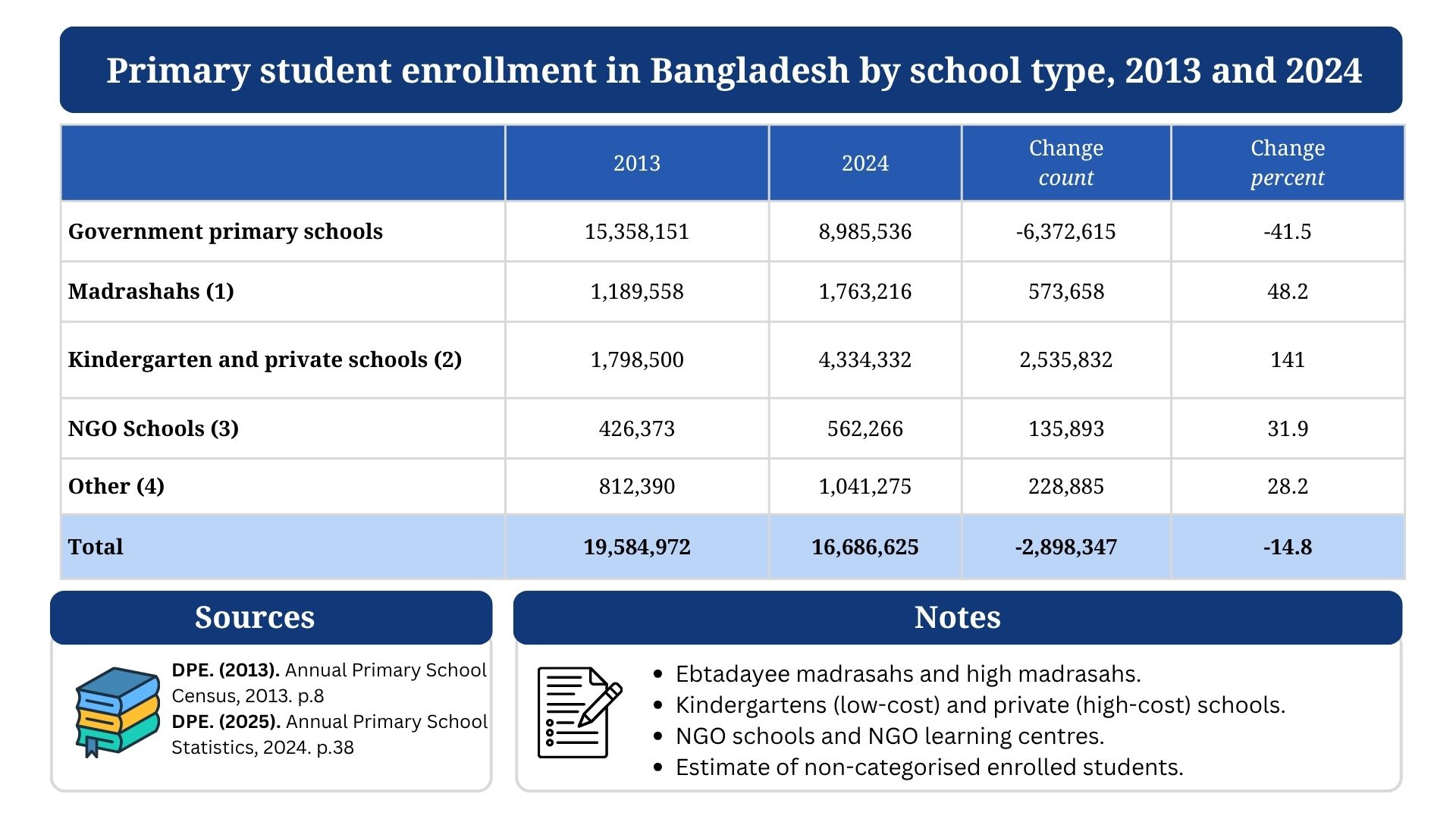
From 2013 to 2024, enrolment in Bangladesh's government primary schools declined dramatically, by 40%! The number of families with sufficient income to pay student fees in either kindergarten (low-cost) or private (high-cost) schools has more than doubled. Enrolment in madrasahs and NGO schools has also increased substantially.
Why have parents in South Asia abandoned government primary schools?
Sri Lanka experienced a civil war for over three decades, from 1980 to 2009. It faces educational challenges in teaching students to learn both Sinhalese and Tamil. As defined by the World Bank, Sri Lanka has nonetheless sustained a low level of learning poverty, which implies a near-universal basic literacy rate. However, in the three large-population countries of India, Pakistan, and Bangladesh, the World Bank concludes that the majority of children aged 10–14 cannot read at the basic level and are therefore experiencing high levels of learning poverty.
In both Dhaka and Delhi, the central governments provide a second source of evidence on students' ability to read in government primary schools: the National Student Assessment (NSA) in Bangladesh and the Rashtriya Sarvekshan (PARAKH) in India. Both countries conduct large-scale, in-school random-sample assessments using similar protocols, based on grade and curriculum, which evaluate students' ability to read and do basic arithmetic in grade 3 and the final year of primary school, grade 5.
The protocols classify results into one of four categories: "below basic", "basic", "proficient", and "advanced". The first two categories are deemed undesirable; the third and fourth are deemed desirable. In both India and Bangladesh, the average grade 5 results in government schools are consistently at the undesirable "basic" level. In other words, only a minority of students in government schools are in the desirable categories.
The third source of evidence for children in rural India comes from the large, biennial, at-home ASER surveys of children organised by Pratham, an NGO. The ASER reading protocol is simple: can students read a 100-word story at a basic grade 2 level fluently? Since 2012, the surveys have consistently found average grade 5 results in government schools below 50%. Admittedly, in three states—Kerala, Himachal Pradesh, and Punjab—the majority of grade 5 students in government primary schools can consistently read at least a basic 100-word story. This is not the case in the other 25 Indian states.

The crisis has no single cause; rather, it reflects five interconnected historical, institutional, fiscal, and governance obstacles that repeatedly prevent government primary schools from converting schooling into learning.
The burden of history
In India, high-caste Hindus ensure that their children acquire literacy at an early age. When India became an independent country in 1947, the Brahmin majority among government officials in Delhi emphasised secondary and tertiary education, not primary education. Since the Bangladesh Liberation War in 1971, the Department of Primary Education (DPE) in Dhaka has followed much of the inadequate education strategy adopted in Delhi.
Weak teacher training and a lack of a professional culture among teachers
In both India and Bangladesh, most government primary school teachers receive degrees from teacher training centres, but they do not consider themselves professionals committed to teaching students the ability to read and do basic arithmetic. In both countries, teachers are civil servants with salaries based on negotiations between teachers' associations and governments, with few incentives linked to learning outcomes. Governments and teachers' associations (at the state level in India and centrally in Bangladesh) bargain over teachers' remuneration and working conditions; they do not concern themselves with students' learning outcomes.
Corruption
In South Asian countries, there are many forms of government corruption. For example, printers may leak examination questions; companies may pay baksheesh for contracts to publish school textbooks; teachers may take paid leave in order to campaign on behalf of the governing political party. Probably the most important dimension of corruption is teachers paying to transfer from a remote school to a more desirable one.
Weak taxing effort
South Asian governments do not spend enough to offer remuneration that would attract young people into teaching as a profession. These governments justify low levels of taxation and low budgets for government primary schools because teachers are treated as low-level civil servants, with few professional expectations.
Lack of ‘coherent’ management of government primary schools
Many developing countries in East and Southeast Asia have taken seriously the creation of coherent relationships among the institutions necessary for an effective school system. With the exception of Sri Lanka, education management in South Asia is incoherent.
| Institutions | Coherent system activities that promote student learning | System-failing activities that block student learning |
| Ruling political party |
|
|
| Teachers’ associations |
|
|
| School principals |
|
|
| Education ministry officials, national and regional |
|
|
| Employers |
|
|
| Suppliers of educational inputs (e.g., textbooks, school buildings) |
|
|
| Non-government schools (private, NGO and religious) |
|
|
| International donors |
|
|
Source: Adapted from Table O.2 in World Bank (2018, p. 14).
Realising universal ‘basic literacy’ during the primary education cycle—and, hopefully, more advanced reading ability—is crucial for achieving higher incomes and stronger economic growth in the next generation. There are numerous obstacles to student learning in government primary schools, and addressing them will not be easy. The advantage of the new government elected in February is its clean blackboard; it is not responsible for the errors of the past. The challenge now is to translate that fresh start into sustained reforms that finally ensure every child leaves primary school able to read, write, and do basic arithmetic.
John Richards is a Canadian economist at Simon Fraser University, Vancouver. He has undertaken volunteer teaching and research in Bangladesh. He can be contacted at jrichard@sfu.ca
Shahidul Islam is an education policy and planning expert currently based in Canada. He can be contacted at shahidul.islam@utoronto.ca
Send your articles for Slow Reads to slowreads@thedailystar.net. Check out our submission guidelines for details.

What kind of doctors does Bangladesh need?
Why aren’t we talking about the health risks of battery rickshaws?
What six South Asian economists taught the world about development
Can Dhaka’s Pink Bus break a four-decade pattern?

Kazi Khalid Ashraf & Adnan Zillur Morshed on Dhaka's Future / What kind of city do we really want?
Is Bangladesh’s garment industry ready for the next shock?
Can pink buses make travels safer for women?

Chained majesties: The plight of captive elephants in Bangladesh

Why Bangladesh needs mandatory warning labels on packaged foods