


Servants of an algorithm: May Day and the fight for the South Asian digital working class

Nusrat wakes up with a start at 3:15 am in her room in Mirpur. She has already missed the 2:00 pm Toronto deadline. Dazed and groggy, she rushes to open her laptop, which is still lying precariously beside her pillow, her recent university certificate in graphics design hanging in a well-laminated frame on the wall. She had been working through the night. She must have dozed off again while working on the 'project': a branding package for her "client", a Canadian real estate firm. It would have cost the client three thousand dollars to get the service from a studio in Toronto. Nusrat will receive, after the "platform" that connects her with the Canadian firm takes a 20% cut, around $77. Nusrat, like other "crowd workers", the terminology reveals how platform-owners view workers like her — has learnt the hard way: do not complain; do not ask for a review; do not ask for an extension; do not contest the algorithm's judgment. As it is, there is no 'manager' to whom she can launch a complaint. She is managed by an algorithm that decides whether to give her a 'good review', a bad review, or a 'no review'. In either case, this will determine her "ranking" in the reserve army of crowd workers in Bangladesh, India, Pakistan, Cambodia, Nepal, and beyond. The mechanism of employment? An algorithm. Her work is adjudicated by and dictated by the algorithm. It is performed for an algorithm.
Nusrat's story is not an isolated account. She is a composite of hundreds of thousands of spatially segregated workers who actively produce surplus value for global capital while living in precarious conditions of employment. This workforce, often euphemistically buried under 'gig work', 'flexible work', or other cosy categories, is among the most exploited and least protected in the world. Mainstream economics, of course, can get away with these euphemisms. But a concrete examination of the conditions of the global digital working class reveals a different story altogether. In the Conditions of the Global Digital Working Class, I theorised platform labour as the emergent form of globalised class exploitation in the 21st century. As a political economist, I became interested in the series of investigative accounts by journalists like Casey Newton, who revealed chilling accounts of "bodies in seats" and the darkest secrets of platform-based labour performed for rich corporations in the global North. My research led me to a surprising conclusion: the 19th-century account of the conditions of the working class in England by Frederick Engels, Karl Marx's best friend and co-author, was far more useful in developing a political-economic understanding of the conditions of the contemporary digital working class than my colleagues who were studying "labour economics" at mainstream economics departments using advanced calculus. Engels' account leads us to the four modes of labour exploitation in the Digital Factory.

The four modes of the digital factory and the hidden abode of production
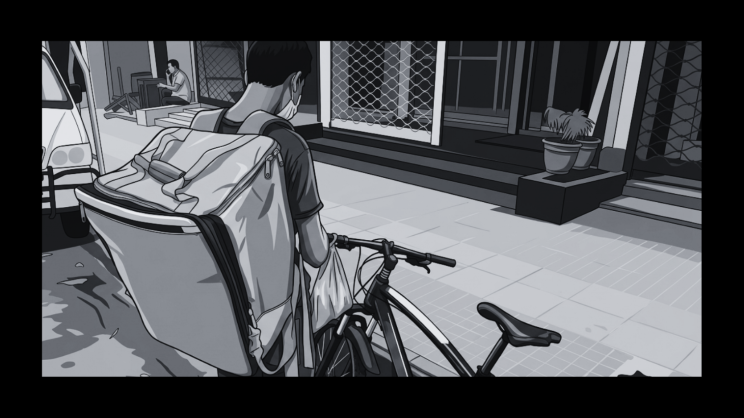
Four distinct, but interrelated, modes of labour jointly shaped the 'digital factory'. The first one, and I alluded to this above, is what I call platform-site labour. The idea is simple: workers use their own internet connection, electricity, and means of production (computers, software) to perform productive labour on a digital platform. Amazon's Mechanical Turk is an example of such a platform. Another option is what can be called platform-mediated labour. The Pathao rider in Dhaka, the Rapido driver in Chennai, and the Uber delivery person in Karachi fall in this category. In this case, as in the previous case, the worker absorbs all the costs and risks of production and ownership — the motorcycle, the fuel cost, insurance against accidents, depreciation — and the platform receives a cut, a rent or subsumed payment, for the service of 'connecting' the worker with the consumer.
These workers will be classified in official documents and contracts as "independent contractors", a lofty legal fiction created with the precise aim of mystifying the social relation as it is, and more importantly, stripped of collective bargaining rights, minimum wage, or health insurance protections, or any other mechanisms of grievance mediation that are available to "employed workers". A third possibility is what can be called 'training' or 'micro-training' labour. Increasingly, platforms like Clickworker, Remotasks, and Amazon Mechanical Turk, to name a few, 'subcontract' hundreds of thousands of South Asian workers — who are more likely to be women, so there is a gendered class exploitative angle to the entire story — to perform 'labelling' and cognitive labour that enables and trains algorithms for artificial intelligence. These modes of labour include 'flagging', 'moderation', 'training recommendations', 'labelling images and audio', and numerous other training tasks that require subjective human intervention.

Finally, a fourth mode is best understood as platform skill-captured labour: a freelancer on Upwork, a software developer for Toptal, or a graphics designer for 99designs, who has spent labour and money to invest in a craft or skill that typically requires a university degree, now finds herself in the precarious position of being unemployed and educated. The platform acts as an intermediary between the 'skill-provider' and the 'client' and charges a commission for this service.
What is common to all four modes is: 1) the medium of product production platform; 2) the mode of product delivery, that is, the mechanism through which the completed task is delivered to the client; 3) the management and quality assessment of the product. All three nodes of governance are performed, controlled, and dictated by an algorithm. It is the dystopia that Marx had envisioned in his analysis of capital on machines in capitalist conditions of production, in which he had speculated how a giant "automaton" (his words) can centralise the entire cognitive knowledge of humans as a species, and command and execute its control from a core infrastructural apparatus (the platform), to extract surplus value from the global working class.
These modes of labour are piece-rated, asynchronously performed by spatially segregated workers, and deliberately atomised and algorithmically managed. "Crowd workers" compete in a global reserve army, where Bangladeshi annotators bid against Cambodian transcribers and Kenyan and Nigerian data labellers, in a race to the bottom engineered by platform capitalists in the Global North. It is a global-scale feudal tribute that has led to the bizarre and befuddling valuations of the Mega 7 corporations — Meta, Amazon, Microsoft, Nvidia, Apple, Google, and Netflix — and the exorbitant profit margins of their platforms.
South Asia: The world's digital colony of crowdworkers
The Oxford Internet Institute's Online Labour Observatory provides the most comprehensive tracking system for global platform work. This dataset reveals some striking facts about South Asian workers in the global digital factory system. India supplies more than a fourth of all online 'gig' labour, Bangladesh supplies 15%, and Pakistan contributes roughly 12% to the global gig worker army. Jointly, the Subcontinent economies account for over half of the global online labour force. To get a better sense of the differentiation at the global scale, the United States — where most platform-based capitalists are located — contributes barely 5% to the global supply.
Is this a coincidence? Political economy suggests otherwise. This is a structural signature of a new form of digital colonial extraction system, in which South Asians provide the labour and the tribute (subsumed payments and rents); Silicon Valley, Seattle, and Toronto collect the rent.
Platform capitalists figured out that surplus extraction can be best achieved in conditions of greater worker helplessness.
But why the bizarre geographic distribution of labour? To answer this, we must understand the relationship between the conditions of work and how the algorithm allocates tasks to minimise the 'operating expenses' of the platform, or, in other words, to maximise the rate of profit on platform investments. Platform capitalists figured out that surplus extraction can be best achieved in conditions of greater worker helplessness. In other words, the more precarious and helpless a worker finds themself, the more likely they will be willing to deal with the miserable conditions of life imposed upon the servants of the algorithm. The Oxford Internet Institute provides an empirical window into this reality by rating platforms worldwide across five dimensions: fair pay, fair conditions, fair contracts, fair management, and fair representation.
The findings for South Asia reveal the dismal state of affairs that platform capitalists can get away with in these economies: India's top-rated platforms like Big Basket, Swiggy, Urban Company, and Zomato get an average score of 'six' in these ratings; Bangladesh's Sheba a five; in Pakistan, every single platform — Bykea, Careem, Foodpanda, and Uber — scores zero. Capitalists understand that profits are inversely related to operating costs, and that operating costs, in turn, can be significantly reduced if workers are made to accept lower wages and worse working conditions. The platform capitalists benefit from the divisions along national lines: the labour can be performed anywhere; the algorithm reminds the worker.
A South Asian digital workers alliance: Towards a regional minimum wage
It follows then that the problem is transnational; the solution cannot be otherwise. This is the strategic insight that May Day demands we apply to the digital economy. The 'gig' workers of Dhaka are no longer immune to the working conditions of micro-taskers in Lahore and freelancers in Bengaluru. The global circuit of capital and the 'vast automaton' of technological developments under contemporary capitalism confront the South Asian digital working class with a simple yet provocative question: Is a South Asian Digital Workers' Alliance possible? If so, what would it look like?
First, this would require a regional digital minimum wage framework. The existing SAARC institutional apparatus, despite its political failures, originally conceptualised a framework for jointly mediating global and regional labour standards by South Asian workers and suppliers. This concept should, in the digital age, be extended to the idea of a minimum regional wage; not a 'uniform' wage across the three economies, but a minimum floor calibrated to an index of purchasing power parities across the three economies. In the absence of such a union or alliance, platform capitalists can push the wages and living conditions of crowd workers to the bare minimum. Clearly, this approach will only benefit core capitalists, and the returns from productive digital labour will not be distributed to workers or governments in these economies.

Second, workers across the three economies can develop 'worker-owned' platform cooperatives. While the gig economy is dominated by a handful of rich capitalists in the Global North at the present juncture, it is conceivable that an institutional apparatus that facilitates worker's unions and alliances across regional borders, also propels workers in these economies to form worker's owned platform cooperatives: a system in which the workers who perform the labour on the platforms are, at once, the joint owners of the surpluses produced on these platforms.
Finally, this will require cross-border digital labour organising. It would be belabouring the obvious to reiterate that the existing 'trade union' framework of organising South Asian labour has failed to incorporate and embed crowd workers into its domain. Gig work is still 'culturally' viewed, even by left-leaning parties, as being distinct from 'industrial' and 'agricultural' labourers who 'actually produce things'. This 'manual-labour' fetishisation of work and productive social relations impedes our imaginations for progressive transformation. It is time to rethink and reimagine a union of the digital working class across national borders.
Shahram Azhar is an Associate Professor of Economics at Bucknell University.
Send your articles for Slow Reads to slowreads@thedailystar.net. Check out our submission guidelines for details.