What six South Asian economists taught the world about development

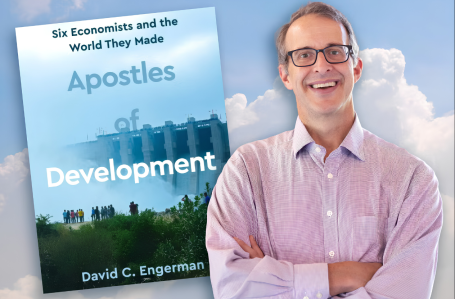
In conversation with David C. Engerman, Leitner International Interdisciplinary Professor at Yale University, about his new book, Apostles of Development: Six Economists and the World They Made.
The Daily Star (TDS): How did you develop the intellectual framework for your new book, Apostles of Development, which focuses on six prominent South Asian economists?
David C. Engerman (DCE): My first article dealing with development in India actually dates back to 2003, when I used various American sources (all conveniently located in the Boston area, where I was then living) to write about American efforts to influence Indian planning. I dove more deeply into Indian history when I wrote The Price of Aid: The Economic Cold War in India (2018), which used a wealth of archival materials from India, the USSR, and the United States to reinterpret flows of policy ideas in international development. From there, it was but a small leap to following those ideas through the work of a number of economists. I began work on what became Apostles of Development when I was looking to write a history of international development through a group of Global South economists. I went through a few possible permutations, but ultimately a conversation with a friend and colleague led me to the extraordinary group of South Asians who entered the famous Economics Tripos at Cambridge.
TDS: Given South Asia’s shared yet contested history of Partition, during which at least three of the economists in your book experienced violence and displacement, how do you think these early experiences shaped their later trajectories as economists, thinkers or planners?
DCE: It’s hard to say. In his poignant and powerful memoir, Rehman Sobhan recounts remaining aloof from contemporary events, including even the Partition. Amartya Sen was similarly insulated from some — but not all — of the Partition’s effects, though it interposed an international boundary between his ancestral home in Dhaka and his life in West Bengal. That said, his sense of the severe limits facing the poor was honed by an experience with a badly injured Muslim man who entered his home in Dhaka during World War II. As for Mahbub ul Haq, it’s harder to say, not least because I never had the chance to speak with him. His family fled Jammu amid increasing communal violence there — but I don’t see much evidence that the experience affected his economic thinking. Manmohan Singh’s family was buffeted by the Partition; he had been born and raised in a small village in what would become Pakistan, so, like many Sikhs, he fled to India. But it was a harrowing time for his family, some of whom were lost to the violence. Singh’s daughter put it well in her joint biography of her parents: to her, 1947 was the year of independence — but to her parents, it was the year of Partition. That said, I’m not sure I find any trace of that harrowing experience in Singh’s economic ideas.
The Apostles’ experiences in Cambridge taught them many things but did not — in spite of the efforts of some of the teachers — turn them into partisans for one or another school of thought. Most were broadly Keynesian in approach, though none interpreted Keynes as radically as their instructor Joan Robinson. They learned a number of important economic lessons while at Cambridge: that economics was not a canon but an argument, and that economics (and especially what later came to be development economics) was a field in which theoretical innovation came through the effort to address key problems of the day.
TDS: How did their education in economics at Cambridge shape their intellectual development? Which economists or schools of thought had the greatest influence on their ideas and approaches?
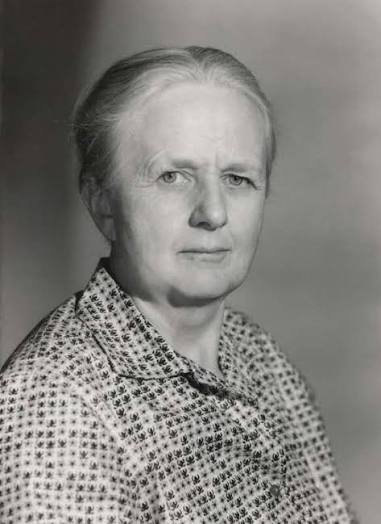
DCE: The Apostles’ experiences in Cambridge taught them many things but did not — in spite of the efforts of some of the teachers — turn them into partisans for one or another school of thought. Most were broadly Keynesian in approach, though none interpreted Keynes as radically as their instructor Joan Robinson. They learned a number of important economic lessons while at Cambridge: that economics was not a canon but an argument, and that economics (and especially what later came to be development economics) was a field in which theoretical innovation came through the effort to address key problems of the day. All six Apostles credit Joan Robinson in one way or another; she was certainly a larger-than-life figure at Cambridge in the 1950s — and the only female instructor on the Economics Faculty in those days. Yet it’s hard to identify what exactly the Apostles — who, after all, disagreed profoundly in their economic ideas — learned from Robinson… or from her colleagues.
TDS: The post-independence decades in South Asia were marked by hope, experimentation and disillusionment over development, as countries experienced limited land reforms, fragile democracy, military rule and a gradual shift from state-led to more market-oriented economies. How did these changes influence the ideas and intellectual evolution of these economists, and how, in turn, did their thinking shape South Asia’s economic transformation?
DCE: That’s a big question — the intellectual and economic history of South Asia over five or more decades! I think there was a great deal of optimism as the Apostles began their education in economics; colonialism was gone, the chance to make a new nation fell to them and their cohort, and they believed they could really make a difference.
All six engaged with contemporary economic questions in their home countries, though Amartya Sen did so less than the others. Their ideas evolved as new problems arose; indeed, new theories and practices emerged in response to those problems. Sobhan favoured government ownership of manufacturing plants in newly independent Bangladesh, for instance, not only because it accorded with his political vision but also because much of Bangladesh’s manufacturing sector had been abandoned by West Pakistani owners. Manmohan Singh had long believed that trade could be an engine of growth, but over the course of the 1970s and 1980s began to argue for broader liberalisation — which he enacted only in 1991.
TDS: Could you elaborate on the distinctive ideas developed by each of these economists, both in theory and practice? For instance, what shaped Amartya Sen’s broader understanding of development, Mahbub ul Haq’s focus on “basic needs”, Rehman Sobhan’s emphasis on reducing inequality, and Jagdish Bhagwati’s prioritisation of economic growth before redistribution? How did these often competing ideas interact with and influence one another?
DCE: All six were concerned with the rising inequality across South Asia in the 1960s. The question of how to end poverty was a complicated one, with some arguing that growth had to come first, others promoting specific pro-poor policies, up to and including redistribution. Haq, always a clever wordsmith, argued against the latter: without growth, he quipped, we can “only redistribute poverty.”
Haq justified inequality — both between rich and poor and between West and East Pakistan — as unavoidable; Sobhan argued strenuously against both positions. Bhagwati came to the conclusion that inequality was relatively stable through the process of development — so the best solution was to grow out of poverty. Sen began to focus on the economic as well as the non-economic determinants and impacts of poverty.
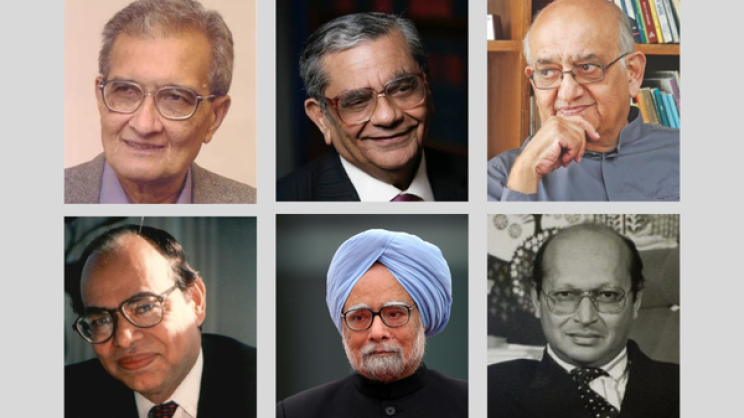
But for a roll call of core ideas, I’d say (proceeding in alphabetical order) that Jagdish Bhagwati did impressive work on the political economy of trade, and on the possibilities but also challenges to development via international trade. Haq will undoubtedly be best remembered for his formulation of the Human Development Index and the accompanying Human Development Report — an effort to devise a simple way to measure development outcomes like health and education. Lal Jayawardena, while he was directing the World Institute for Development Economics Research, led and contributed to an impressive but ultimately unsuccessful challenge to Structural Adjustment. Amartya Sen’s contributions are many: the notions of “entitlements” and “capabilities” helped open up, as Abhijit Banerjee put it, “new space” for development economics. Manmohan Singh was a masterful bureaucrat who spent decades working on making adjustments, generally towards trade and liberalisation even before 1991. And Rehman Sobhan, besides his work with Sheikh Mujibur Rahman in the struggle for independence and in steering Bangladesh’s post-liberation economy, has served as a constant reminder of the need to pursue not just economic growth but economic justice. Both Singh and Sobhan professed “inclusive development”, though I’m not sure that they had the same thing in mind.
Sen and Sobhan have been especially influential in insisting that we pay attention to the poorest members of society and formulate policies and ideas that can improve their conditions. Times have changed dramatically since the Apostles went to Cambridge in the 1950s — but those commitments have remained steadfast.
TDS: How would you assess Rehman Sobhan’s contributions as an economist, particularly his work on poverty and inequality and his engagement with institutions and public policy?
DCE: I spoke with almost 100 people when working on this book, asking them about the Apostles’ ideas, interests, commitments, and the like. Maybe five or ten people I spoke with knew all six Apostles professionally, one of whom told me that Sobhan was “probably the most moral” of the six. While he travelled frequently overseas, he was committed to his country more fiercely than the others — in fact, he had the chance to help bring Bangladesh into being. He was in official government service for not much more than three years of his professional life (on the Planning Commission just after liberation, and then briefly in the Shahabuddin interregnum in 1991). But he remained a forceful and persistent voice for economic and social justice over the remainder of his long career. Indeed, when he and I participated in a BIDS seminar in early October, he reminded the audience, particularly its younger members, how much work remains to be done in the pursuit of justice.
TDS: Finally, what do you see as the lasting contributions of these economists to economic thought and practice, both in South Asia and globally? How might their ideas continue to influence future generations of economists in a changing global context?
DCE: Some of the important legacies of the Apostles were tangible institutions that carry forward their ideas: the annual Human Development Report (Haq and Sen), Pratichi (Sen and Sobhan), the Centre for Policy Dialogue (Sobhan), the UN University’s World Institute for Development Economics Research (Lal Jayawardena), and the Journal of International Economics (Bhagwati). While Sobhan didn’t create the Bangladesh Institute for Development Studies (BIDS), he spent a term as Director-General, working tirelessly to ensure its future and its autonomy.
Yet many of the Apostles’ most important legacies were intangible. In the policy realm, Manmohan Singh’s efforts as Finance Minister in 1991 (together with his Prime Minister, P. V. Narasimha Rao) set India on a new course. His decade as Prime Minister, starting in 2004, saw a raft of new economic rights: to employment, to food, and to information.
Both Bhagwati and Sen left their largest legacies in their intellectual work. In a series of pathbreaking articles, Bhagwati shaped a generation of trade economists. Sen’s innovative and influential work in social choice theory and welfare economics shaped those fields and won him the Nobel Prize. But he also contributed to rethinking some basic terms too often taken for granted: “justice”, “equality”, and “development”, among others.
Sen and Sobhan have been especially influential in insisting that we pay attention to the poorest members of society and formulate policies and ideas that can improve their conditions. Times have changed dramatically since the Apostles went to Cambridge in the 1950s — but those commitments have remained steadfast.
The interview was taken by Priyam Paul.
Send your articles for Slow Reads to slowreads@thedailystar.net. Check out our submission guidelines for details.

Can Dhaka’s Pink Bus break a four-decade pattern?
Kazi Khalid Ashraf & Adnan Zillur Morshed on Dhaka's Future / What kind of city do we really want?
Is Bangladesh’s garment industry ready for the next shock?

Can pink buses make travels safer for women?

Chained majesties: The plight of captive elephants in Bangladesh

Why Bangladesh needs mandatory warning labels on packaged foods

Is Bangladesh going the wrong way on AI?
Bangladesh and the question of indigenous peoples

The invisible crisis: Why Bangladesh must wake up to its data vulnerability