Bangladesh’s FDI puzzle: Why human capital, not red tape, is the real constraint

Bangladesh and Vietnam started from strikingly similar places. Both emerged from war and partition in the 1970s. Both turned to export-oriented growth in the 1980s. Both built their early industrial strategies around cheap, disciplined labour and access to Western markets. Four decades later, the gap between them is stark: in 2024, according to UNCTAD data, Vietnam attracted $20.17 billion in foreign direct investment, while Bangladesh drew just $1.27 billion — a fifteen-to-twenty-fold difference in a single year. The gap has only widened since: Vietnam’s Ministry of Planning and Investment reported inflows climbing to $27.62 billion in 2025, while Bangladesh remains stuck below the $2 billion mark.
Bangladesh has cheap labour, a large domestic market, and a giant neighbour, India, next door. Yet it remains largely on the sidelines of global capital flows. The reasons are structural, and the most important one — a workforce that lacks the skills to attract anything beyond low-value manufacturing — is also the hardest to fix.
An export success built without foreign capital
Bangladesh’s garment industry accounts for more than 80 percent of its exports, but foreign multinationals barely own any of it. The industry traces back to a single 1978 joint venture between a Bangladeshi entrepreneur and the South Korean conglomerate Daewoo, which trained about 130 Bangladeshi workers in garment production and export logistics. Within a year, most of those trained workers had left to start their own competing firms. As garment manufacturing requires relatively modest capital and no advanced technology, these new firms stayed locally owned. Today, only about 5 percent of Bangladesh’s textile and garment factories are foreign-owned.
Vietnam’s electronics sector is the mirror image. Vietnam allowed full foreign ownership starting in 1987 and aggressively courted anchor investors like Samsung, whose Vietnam operations grew from a $670 million plant in 2008 into a $17–18 billion investment within a decade and now account for more than a quarter of Vietnam’s total exports. Foreign firms control the overwhelming majority of Vietnam’s high-tech exports, and even after fifteen years, domestic Vietnamese firms have largely failed to break into the core supply chain.
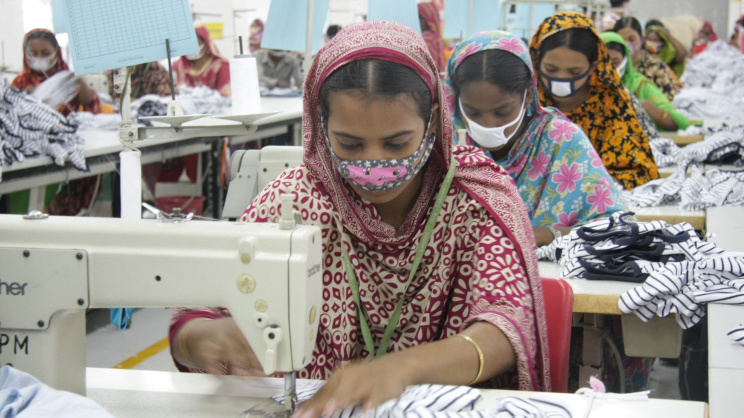
Bangladesh’s export success, in other words, is a domestic capitalism story. Vietnam’s is a foreign investment story. Only one of these produces the kind of deep, technology-intensive FDI that reshapes an economy’s long-run trajectory — and the reason comes down largely to what each country’s workforce can actually do.
The central constraint: Human capital
This is the factor that most explains why Bangladesh and Vietnam diverged, and it is not a policy problem that a quick reform can solve.
According to the World Bank, only about 4 percent of Bangladesh’s workforce has education beyond the secondary level, and national assessments find that only a quarter to a little under half of students in grades five through eight actually master basic literacy, numeracy, and English. Vietnam, by contrast, has a 96 percent literacy rate, and tertiary enrolment rose from just 3 percent in 1995 to roughly 30 percent by 2019 — a tenfold increase in one generation, the product of a government that made mass literacy a founding national priority as early as 1945.
But literacy is only the floor. The more precise and more damning measure is what economists call economic complexity: whether a society possesses the specialised, often tacit knowledge — engineering expertise, quality control, supply-chain coordination, technical management — needed to produce sophisticated goods; and whether all those different specialists can actually work together smoothly so that their separate pieces of know-how add up to a finished, working product. Harvard’s Growth Lab, which tracks this through its Economic Complexity Index, names Bangladesh explicitly as a country that has failed to diversify its know-how and faces low growth prospects, while identifying Vietnam as one of the developing economies making the fastest strides in complexity — and the Growth Lab projects Vietnam to lead the world in per capita growth over the coming decade.
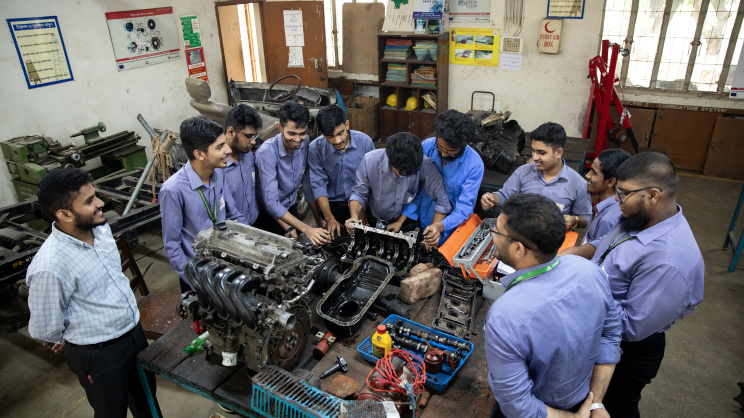
This complexity gap shows up concretely, not just statistically. Bangladesh’s technical and vocational training system suffers from a persistent mismatch between what is taught and what employers need. As one recent TVET graduate put it, the curriculum leaned heavily on rote memorisation, leaving little room for the hands-on skills employers actually wanted. Vietnam has its own skills shortages, but it faces a different kind of problem: universities are pushing hard into fields like semiconductor engineering and artificial intelligence. And shortages there largely reflect an economy generating sophisticated jobs faster than the education system can churn out graduates. One country is struggling to make its training relevant, while the other is trying to keep up with a fast-moving, increasingly complex economy.
Not all FDI is interchangeable. Investment researchers distinguish ‘efficiency-seeking’ FDI, which chases low costs and needs only modest skills, from higher-value FDI that requires a genuinely skilled, technologically absorptive workforce. Garment factories fall into the first category; semiconductor and electronics plants fall into the second. A country’s human capital — in this fuller, complexity-inclusive sense — effectively sets a ceiling on which category of investment it can attract, regardless of tax incentives or labour costs.
This matters because not all FDI is interchangeable. Investment researchers distinguish ‘efficiency-seeking’ FDI, which chases low costs and needs only modest skills, from higher-value FDI that requires a genuinely skilled, technologically absorptive workforce. Garment factories fall into the first category; semiconductor and electronics plants fall into the second. A country’s human capital — in this fuller, complexity-inclusive sense — effectively sets a ceiling on which category of investment it can attract, regardless of tax incentives or labour costs.
This is also, paradoxically, why Bangladesh succeeded in garments in the first place. Sewing is a skill transferable within months — which is exactly why Daewoo’s trained workers could walk out and become competitors almost immediately. The same low-skill barrier that allowed Bangladesh’s industry to become domestically owned so quickly is now the barrier that keeps the country locked into low-value manufacturing. It is unable to attract the kind of investment that pushed Vietnam into higher-value production. Closing this gap is not a matter of a few reform initiatives; it requires the kind of sustained, multi-decade investment in education quality that Vietnam made starting from its founding, not something a government can build within a single budget cycle.

A compounding factor: Ease of doing business
A second, more fixable gap involves the basic mechanics of running a business. In the last globally comparable rankings, Bangladesh ranked 168th out of 190 countries on the World Bank’s Ease of Doing Business Index; Vietnam ranked 70th. The successor B-READY index and Transparency International’s corruption rankings tell a similar story — Bangladesh trails specifically on public services, contract enforcement, and corruption.
This matters more for countries like Bangladesh and Vietnam than for advanced economies. For the United States or Japan, other advantages — market size, technology, deep capital markets — are large enough that regulatory friction barely factors into an investment decision. But in many areas, Bangladesh and Vietnam are often competing for the same type of investment — a garment factory that could plausibly land in either country, or in Cambodia or Pakistan. In that competition, contract enforcement speed and bureaucratic friction become the actual tiebreakers. Setting up a food-processing factory in Bangladesh currently requires a dozen separate approvals from national and local agencies — a level of friction with real, measurable consequences for where investment goes.
A third factor: Proximity to capital, not just proximity to markets
Geography is often treated as a fixed advantage or disadvantage, but what matters is not simply how close a country sits to a large neighbour — it is whether that neighbour has surplus capital looking for somewhere to go. Research on outward investment from Asia’s capital-surplus economies finds that this capital is unusually sensitive to distance, flowing disproportionately to nearby, lower-income destinations rather than spreading globally in the way Western investment does. The mechanism is straightforward: a Japanese or Korean firm investing nearby can draw on decades of accumulated regional supply-chain knowledge and existing trading relationships in a way it cannot when investing somewhere distant and unfamiliar.
Vietnam sits inside exactly the neighbourhood where this matters. Its largest investors — Singapore, Japan, South Korea, China, Hong Kong — are precisely the economies that have spent decades running current account surpluses and exporting those savings into nearby, low-cost production platforms. Vietnam is not just conveniently located near component suppliers; it is conveniently located near the capital itself.
Bangladesh’s geography does not offer the same advantage. India, its one truly close large neighbour, is not a capital-surplus economy — it is a net capital importer competing for the same global FDI pool that Bangladesh is chasing, not a source of outward-seeking savings. The one plausible capital-surplus region within reach, via the Indian Ocean and a large diaspora of migrant workers, is the Gulf, whose sovereign wealth funds now manage trillions of dollars. But that capital overwhelmingly bypasses developing Asia, flowing instead towards the United States, Europe, and larger Asian economies. Bangladesh’s geography, in short, places it near a market but not near a reservoir of investable capital — a distinction that matters more than raw physical proximity alone.
What Bangladesh is doing — and what it can and cannot fix
Of these three factors, only two are within Bangladesh’s control. Geography and the location of the world’s capital-surplus economies are fixed; human capital and the business environment are not, and Bangladesh is making a real effort on the latter. The Bangladesh Investment Development Authority has expanded a digital One-Stop Service platform to consolidate approvals, and proposed reforms include a ‘negative list’ model that would let most sectors proceed through simple digital registration, along with legal protections shielding investment terms from political interference. Ninety-seven special economic zones have been approved, and extended tax holidays now apply to automated manufacturing, AI infrastructure, and green energy. The urgency is real: Bangladesh graduates from Least Developed Country status in November 2029, phasing out trade preferences that have long supported the garment sector.
Bangladesh’s experience is a useful corrective to a common assumption in development economics and among international development finance institutions: that improving the ease of doing business is the master key to attracting foreign investment. The data show that it matters — but it is necessary, not sufficient. A country can streamline every permit and still find itself competing only for the same low-value investment it has always attracted if its workforce cannot accomplish more.
These reforms target exactly the components that the empirical literature identifies as significant for FDI in developing economies — contract enforcement, tax administration, and permitting speed. If implemented well, they should meaningfully improve Bangladesh’s business environment and increase its competitiveness within the categories of investment it already attracts: garments, light manufacturing, and domestic-market-oriented services.
But this is precisely the limit of what institutional reform can do. Streamlined permitting and digital registration address friction — they make it easier to do the kind of business Bangladesh already does. They do nothing to address the structural constraint of a workforce that cannot staff more sophisticated industries. A frictionless approval process still cannot conjure up a semiconductor-ready labour force. Until Bangladesh makes the kind of sustained, decades-long investment in education quality that transformed Vietnam’s workforce, the country’s underlying human capital gap will keep it competing only for the same category of low-value manufacturing it has always attracted — no matter how efficient its bureaucracy becomes. Ease-of-doing-business reform can raise the ceiling on how much of that investment Bangladesh captures. It cannot raise the ceiling on what kind of investment it can attract.
The broader lesson
Bangladesh’s experience is a useful corrective to a common assumption in development economics and among international development finance institutions: that improving the ease of doing business is the master key to attracting foreign investment. The data show that it matters — but it is necessary, not sufficient. A country can streamline every permit and still find itself competing only for the same low-value investment it has always attracted if its workforce cannot accomplish more.
Vietnam’s transformation rested on a foundation Bangladesh has yet to build: a sustained national commitment to education dating back to its founding, paired with policies that let multinational investors make decade-long bets on a workforce capable of executing them — all reinforced by the accident of sitting next to Asia’s capital-surplus economies rather than a capital-importing one. Bangladesh’s current reforms are addressing the parts of the problem that respond to legislation and digitisation. The deeper structural constraints — human capital most of all, with geography close behind — will keep shaping the country’s FDI trajectory for a long time to come, unless education becomes the subject of the same sustained national priority that Vietnam gave it two generations ago.
Dr M.G. Quibria is an economist and public policy commentator whose work explores trade, development, governance, and democratic change in Bangladesh and beyond. He can be reached at mgquibria.morgan@gmail.com.
Send your articles for Slow Reads to slowreads@thedailystar.net. Check out our submission guidelines for details.
Will the Saudi Arabia-Turkiye-Pakistan Makkah Agreement create a new regional security order?

Why Bangladesh needs a regional strategy beyond SAARC
Why every protest matters: Lessons from Bangladesh, India and Nepal
Malaysia and Bangladesh want solutions. Is Myanmar ready for Rohingya return?

Michigan primary: How standing up to Israeli genocide could win Democrats Congress in November
Hormuz 2.0? The Six Degree Channel and Bangladesh's maritime security

South Asia’s new space race / How satellites are transforming conflict between India and Pakistan

Is there any hope for Gaza?
How Bangladesh's SEACO plan could strengthen trade across the Muslim world