Dhaka’s diplomatic balancing in the Middle East

Dhaka’s recent diplomatic manoeuvring over the escalating Middle East conflict reflects a careful balancing of competing priorities. After military strikes by the United States and Israel on Iranian territory, Bangladesh responded twice.
Neither statement mentioned the United States or Israel by name.
That omission matters.
The statement called for “maximum restraint,” stressing regional stability and the safety of Bangladeshi nationals.
The second said the government was “deeply saddened” by the targeted assassination of Iran’s Supreme Leader and described it as a “violation of international law.” Together, the two statements reveal a calibrated response — cautious in attribution, firmer in legal framing.
The multiple cross-border strikes placed sovereignty at the centre of this crisis. Such actions immediately raise questions of territorial integrity and legality under the United Nations Charter. While many governments framed their responses explicitly around sovereignty, Bangladesh’s initial statement did so only in general terms.
The stronger legal language appeared in the follow-up communication. This sequencing suggests deliberation rather than contradiction — an attempt to manage risk first, then clarify principle.
Diplomatic language carries layers of meaning. Naming an aggressor is one approach. Affirming sovereignty without directly assigning responsibility is another. Calling for restraint without reference to specific actors is the most cautious option. Bangladesh initially chose that cautious path. Yet the second statement showed that Dhaka was prepared to invoke clearer legal standards when it deemed necessary.
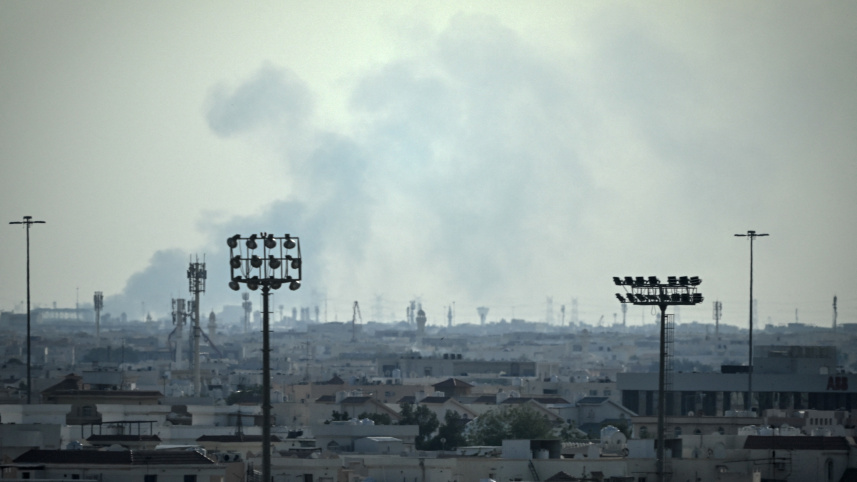
A new government in Dhaka must navigate layered expectations at home and abroad. Public sentiment in a Muslim-majority country is closely attuned to developments in the Middle East. At the same time, Bangladesh’s economy is deeply connected to Western markets, labour destinations in the Gulf and international financial institutions. Remittances from the Middle East remain a vital economic pillar. Diplomatic language perceived as overly confrontational could carry economic or political consequences. In this context, caution is not hesitation; it is strategic calculation.
Across South Asia, responses reflected similar considerations. India expressed concern and urged restraint without sharply condemning either side. Sri Lanka emphasised sovereignty while maintaining balance. Nepal adopted neutral language focused on de-escalation. Pakistan, shaped by geographic proximity to Iran and domestic political dynamics, took a more direct position criticising the strikes.
The varied responses illustrate that South Asian governments weighed their own strategic exposures before choosing their words. Bangladesh’s approach fits within this broader pattern of cautious calibration rather than standing apart from it.
The wider Muslim world also responded in diverse ways. Within the Organisation of Islamic Cooperation (OIC), some member states described the strikes as violations of sovereignty and international law, while others prioritised restraint and stability.
Statements from the Gulf Cooperation Council (GCC) similarly focused on preventing escalation and preserving regional security. These differences show that even among Muslim-majority countries, responses were shaped by national interests as much as shared identity. Bangladesh’s measured language therefore falls within a broad spectrum of diplomatic reactions.
Yet the episode raises a deeper question about the interests of smaller states. For small countries like Bangladesh, sovereignty is not merely a legal principle; it is a practical safeguard. In an international system shaped by unequal power, respect for territorial integrity offers smaller states a degree of protection. When cross-border force becomes normalised or ambiguously addressed, that protection weakens for all. Consistently affirming sovereignty is therefore not about aligning with one party or another. It is about reinforcing the rules that smaller states rely on for their own security and stability.
The cornerstone of Bangladesh’s foreign policy, “friendship towards all, malice towards none,” has long prioritised non-interference and territorial integrity. During President Ziaur Rahman’s tenure, this approach was recalibrated toward multi-vector engagement while retaining a strong emphasis on sovereignty. That legacy suggests neutrality grounded in law rather than neutrality grounded solely in caution. Clear articulation of principle can coexist with diplomatic restraint.
The fast-evolving conflict context also underscores the importance of preparedness in diplomatic communication. In moments of crisis, international responses are scrutinised instantly. Developing structured response frameworks — combining restraint, legal principle and protection of nationals — would enable Bangladesh to speak with both clarity and consistency from the outset.
Measured diplomacy need not mean muted principle; it can mean disciplined articulation. Ultimately, Dhaka’s approach achieved its immediate objectives: avoiding entanglement, safeguarding citizens and preserving strategic flexibility. Yet diplomacy is not only about managing risk; it is also about signalling values. In crises involving deliberate cross-border force, sovereignty remains central to the international order. Clear and steady articulation of that principle strengthens neutrality rather than undermines it.
In an increasingly polarised world, smaller states protect their strategic space not through silence, but through calm and consistent affirmation of the rules that protect them.
For Bangladesh, the challenge is not choosing between restraint and principle; it is ensuring that restraint is anchored in principle. As an engaged participant in Global South diplomacy, Bangladesh strengthens its credibility when restraint is matched with steady affirmation of international law.
Badrul Hassan is a development and humanitarian professional. He can be reached at badrulsocial@gmail.com.
Send your articles for Slow Reads to slowreads@thedailystar.net. Check out our submission guidelines for details.

What Nepal’s flood devastation means for Bangladesh, India and China
Five reasons why Bangladesh shouldn’t join the Mecca Pact
Why Gaza peace deals keep falling apart

Rohingya genocide: Will the ICJ verdict bring justice?

Should Bangladesh join the Mecca Pact?

Documenting Rohingya history / Rohingya repatriation needs more than diplomacy

Nine years on, Rohingya refugees need more than shelter
Myanmar’s partial Rohingya repatriation plan: Another attempt to mislead Bangladesh?

Is Trump’s Gaza peace plan falling apart?