Life along a dying Teesta

The Teesta, once the vibrant pulse of northern Bangladesh, is fighting for survival. Where strong currents once promised prosperity, the river has largely withered into a narrow, knee-deep stream or vast, barren sandbars. This ecological collapse has plunged millions living along its banks—farmers, fishermen, and labourers—into deep uncertainty.
Flowing 115 kilometres through 13 upazilas in Lalmonirhat, Kurigram, Nilphamari, Rangpur, and Gaibandha, the river now hosts 123 riverine islands, or chars, home to nearly 500,000 people. For these residents, the riverbed is no longer a waterway but a daily obstacle, requiring long treks across scorching sand to reach the mainland.
Sekendar Ali (70) a farmer from Char Kalmati in Lalmonirhat, remembers when the river sustained multiple harvests a year. “The Teesta’s water used to be our lifeline,” he said. “Now, during the dry season, we don’t get enough water for irrigation. It was once a blessing, but now it has become a curse. It overflows during the monsoon, causing floods and erosion, then dries up when we need it most.”
Residents along the Teesta say that reduced water flow is not only affecting agriculture and livelihoods but also threatening the entire ecosystem. The disrupted natural flow is reducing fish breeding, destroying aquatic habitats, and lowering groundwater levels. If this continues, parts of northern Bangladesh could gradually face desertification.
The economic toll is widespread. Fazal Mia (65) a farmer from Aditmari, says the lack of water has forced a costly reliance on groundwater. “My 20 bighas of land are in the riverbed, covered with sand. We cannot cultivate properly,” he said. “The dried-up Teesta has made our lives miserable. If it survives, our agriculture and livelihoods survive too.”
For those who relied on the river for transport, the reality is equally bleak. Abdar Ali (60) a boatman from Kurigram, is now effectively unemployed. “People cross the river on foot. Boats are no longer needed,” he said. “Hundreds of boatmen have left the profession. We can only earn for four or five months a year; for the rest of the time, our boats sit tied to the bank.”
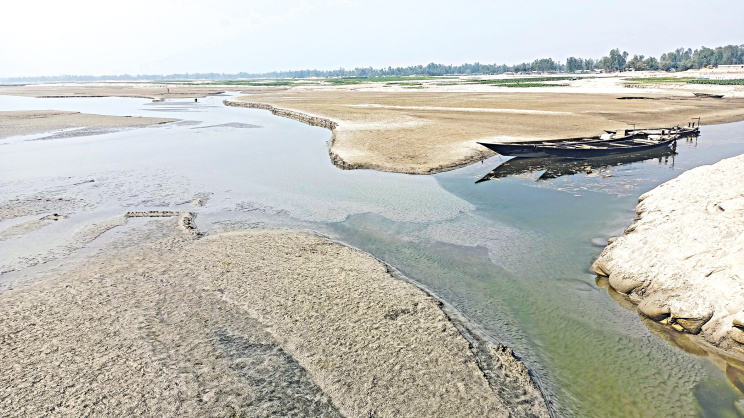
Fishermen face a similar decline. Nirmal Chandra Das (50) from Rangpur, notes that the iconic bairali fish, once a local staple, is nearing extinction. “We used to catch 10–12 kg of fish daily. Now we don’t even get half a kilo,” he said. With 25 fishing villages along the banks struggling, many families have abandoned their ancestral trade for day labour.
The Bangladesh Water Development Board attributes this to massive sedimentation. Roughly 20 million tonnes of silt accumulate annually from upstream. Without regular dredging, the riverbed has risen, destroying its capacity to hold water.
Amitav Chowdhury, Executive Engineer of the Dalia Water Development Board, confirmed the dire state of the river. “In the dry season, the Teesta turns into a dead canal with several channels, none carrying sufficient water,” he said. “Dredging is urgently needed to restore a single, functional channel. Downstream of the barrage, there is hardly any water because all 44 gates remain closed during the dry season.”
The environmental impact extends beyond immediate livelihoods. Residents warn that the loss of natural flow is lowering groundwater levels and threatening to turn northern Bangladesh into a desert.
SM Shafiqul Islam, president of the ‘Save the River, Save Teesta’ movement, warned that the river is on the brink of death. “People have been protesting for years, but apart from promises, no real action has been taken,” he said. He argued that by dredging the river and narrowing its width from the current 6–9 kilometres back to 1 km, vast tracts of land could be reclaimed and the river restored.
Hope now rests on the proposed “Teesta River Management and Restoration Project”, or the Teesta Master Plan. Sarfaraz Banda, Chief Engineer of the Water Development Board’s Rangpur Division, said the plan includes dredging 115 kilometres of the river, embankment construction, and the recovery of 171 square kilometres of land. “If implemented, employment will increase, and agricultural land will be restored,” he said, though he noted that the project remains a high-level government matter.
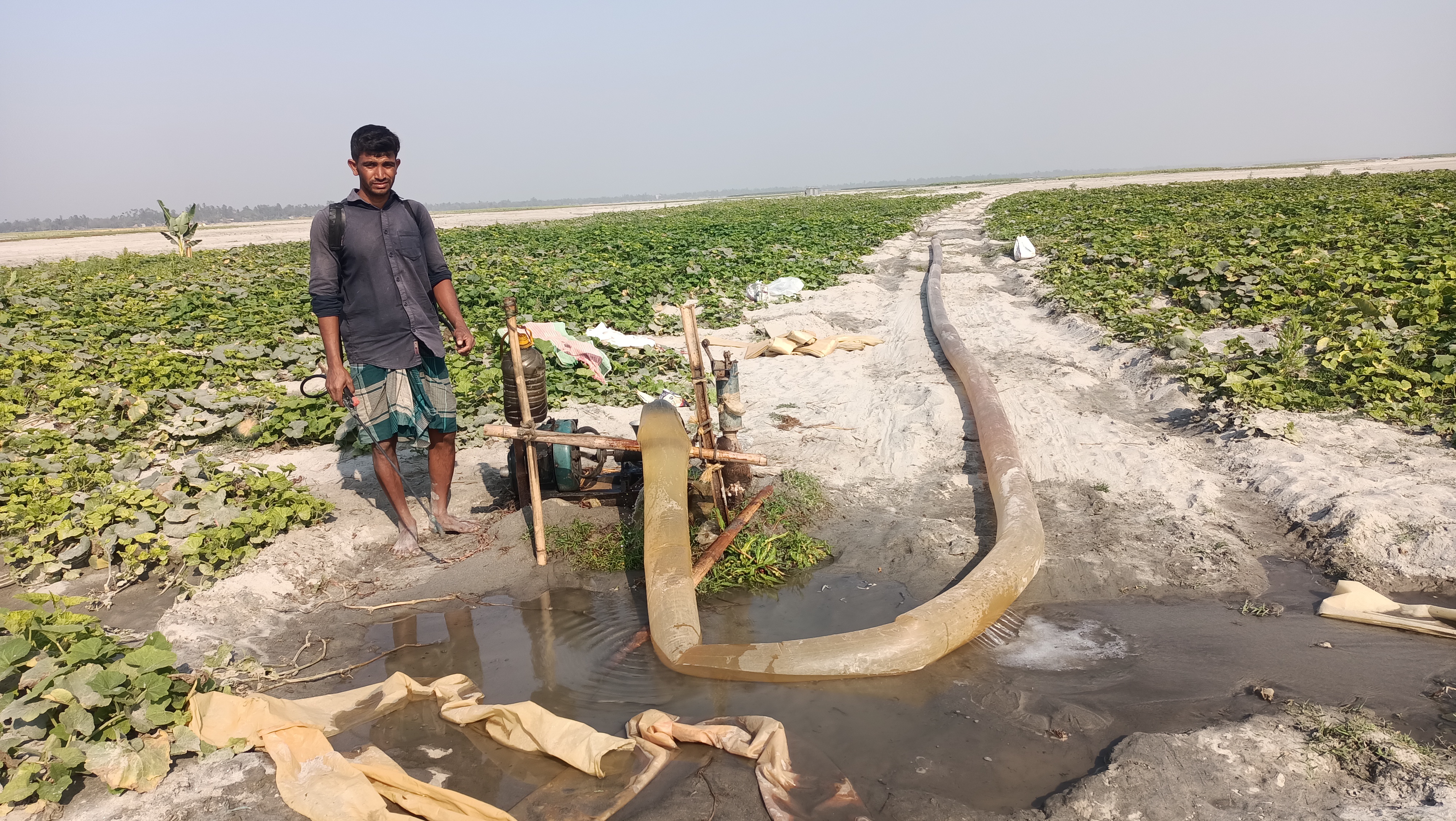
Experts argue that infrastructure alone is insufficient. Dr Tuhin Wadud, a professor at Begum Rokeya University and director of ‘Riverine People’, stressed that a fair water-sharing agreement with India is very important. “Infrastructure development is not enough, ensuring the natural flow of water is.” he said.
Residents along the Teesta shoal held a series of protests last year, including human chains, sit-ins, and torch processions, to demand the implementation of the Teesta Master Plan. Led by Asadul Habib Dulu, then the chief coordinator of the Teesta River Protection Movement and now the Minister for Disaster Management and Relief, the demonstrators even spent nights on riverine chars to voice their demands.
During these protests, representatives from the interim government’s water resources ministry and PowerChina met with activists to exchange views. Although the interim government initially pledged to begin the project in January 2026, the deadline passed without action. The water resources adviser later clarified that the plan is under further review and will be left for the elected government to implement.
Disaster Management and Relief Minister Asadul Habib Dulu, who led the Teesta River Protection Movement, insists the current government is committed to the project. “The Teesta is the lifeline of nearly two crore people,” he said. “The crisis of the Teesta is the crisis of an entire region. I have briefed the Prime Minister in detail about the master plan. Our government has started working on it.”
For those living on the shifting sands of the chars, the wait continues. As Didarul Islam, a farmer from Kaunia, put it: “Our demand is simple—there should be water in the river, crops in the fields, and boats on the water. We want life to return to normal.”
S Dilip Roy is a journalist at The Daily Star.
Send your articles for Slow Reads to slowreads@thedailystar.net. Check out our submission guidelines for details.

More than refugees: How Rohingya youth are reclaiming their story
Behind every cup / The mental toll on women tea workers
From Shyamnagar to Kurigram: Women work, but where is the income?
Waiting for April: The other side of migration in the Sundarbans
Where have Bangladesh’s hilsa gone?

Lead poisoning in Bangladesh: A crisis ignored for too long
Who recycles Bangladesh’s garment waste?
Bangladesh running out of options on Rohingya crisis: Is there a way out?
Construction of the Sugandha-Kalatoli beach road / A grave threat to Cox’s Bazar’s sand dunes