


Dual demands of Shamim’s No. 6 role
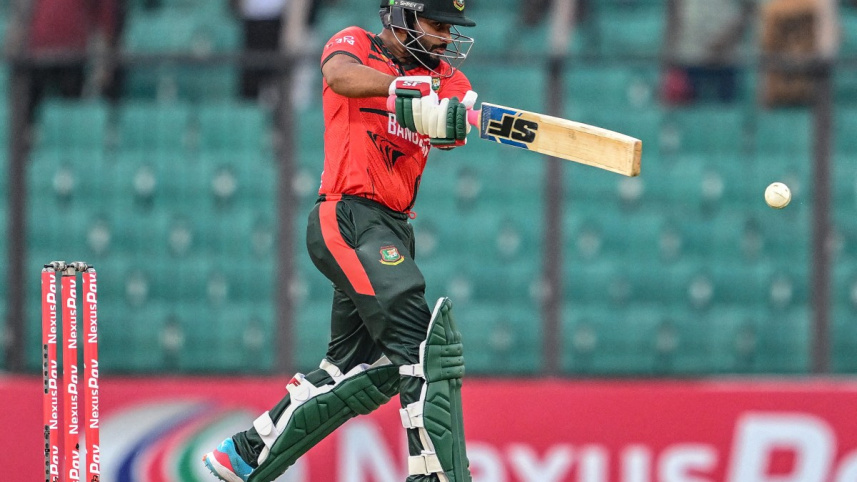
Players like Shamim Hossain are a rarity in Bangladesh cricket. He comes in at number six in T20Is, a position that in itself is a thorn in the country’s overall cricketing culture. Why? Because no one seemed able to hold down the position for long until Shamim came along.
At Mirpur Academy Ground last month, ahead of the ongoing New Zealand series, Shamim spent over an hour facing throwdowns. Strangely enough, instead of rehearsing the all-out hitting his role demands, he focused on basics: playing straight in the V. He relayed that it was not only because it was early days in his preparations after a gap.

“Yes [just beginning preparations], but when I will actually bat in matches, this is how I should begin, in a V. Only in the last two-three overs do I experiment with my side shots, so I’m preparing accordingly,” Shamim had told this reporter.
When it was pointed out that it was not the norm for him, he laughed. “I try most of the time because sometimes you have to play slow if early wickets fall… and this routine comes from experience.”
Asked how difficult this adjustment was, he remarked, “Everything is easy if you want [but] it’s a little tough for me. Actually, for those who go and hit, it’s difficult for them. The more control I have, the better it will be for me.”
There were subtle tweaks too. His stance was straighter during that session, his bat coming down more directly rather than from the slip-cordon angle. But he downplayed it: “It just comes from practice… not much of a change.”
In the last two years, Shamim has featured in all 29 T20Is the Tigers played. He has appeared at number six the second-most times (18) over the last five years, surpassing Mahmudullah Riyad, who has 17 appearances in that position. Going down that list, Jaker Ali (18), Afif Hossain (18) and Nurul Hasan Sohan (19) also have a similar number of appearances at six, and two of those three are out of the T20I side while Sohan is still looking for game time. In this bunch, Shamim boasts the highest strike-rate (135.44).
The reason Shamim needed these routines was to find more continuity. In his last 10 innings, Shamim only faced more than 20 deliveries thrice and fewer than 10 on five occasions. Yet the demand remains immediate impact, as seen in the first T20I where his 13-ball 31 contributed to a convincing six-wicket win.
“I adjust my stance myself, what feels comfortable… not because of the bowler,” he said, citing South Africa great AB de Villiers as an influence for his straighter setup. Asked if he stands at an angle when playing behind the wicket, he said: “Yes, that’s when I can do that.”
The bouncer he dispatched over the wicket-keeper’s head for six in the first T20I came from the angular stance, in just the third delivery he faced -- a rare trait in Bangladesh cricket for a volatile position.
“We don’t have many players here [for six],” chief selector Habibul Bashar told The Daily Star yesterday. “This position makes the difference between winning and losing and for those who bat in these positions, they need to bat at 130 -140 strike-rate, as is the case in other countries. It’s the reality [of facing less deliveries] and those who bat there has to accept it. If Shamim can continue like this, even though it may not happen regularly, it will be big for us.
“I think Shamim is capable of playing V as well because a day would come when in a one-day there is lots of time and he has to bat differently. He has that ability and it’s all about the mindset. He has that special skill and if he understands that it will be big for the team,” added the former Bangladesh captain.
For now, Shamim’s game carries that duality -- control and chaos -- shaped to meet the demands of a role where time is scarce but impact is everything.
 For all latest news, follow The Daily Star's Google News channel.
Comments