


Faruque, Bulbul pressured, Tamim spared: Cricketers' BPL double standards?

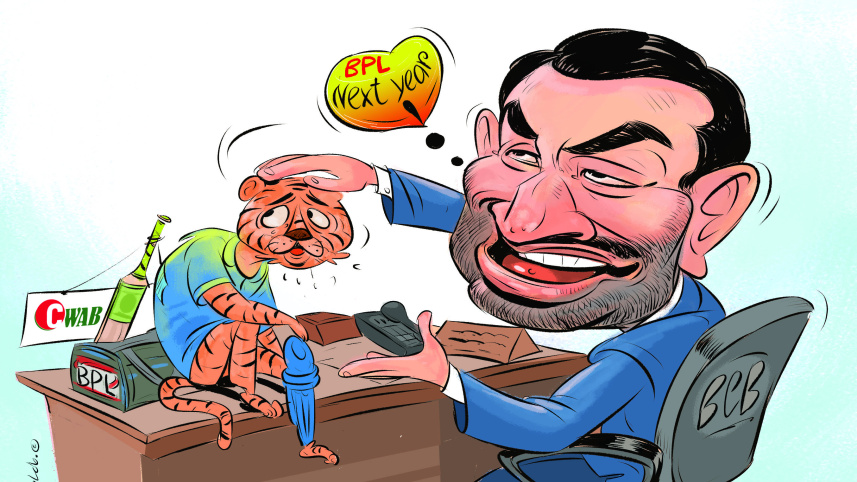
Expect the unexpected. This has become something of an unofficial motto of the Bangladesh Cricket Board (BCB). From U-turns and limping logic to claims of “following a process” that contradicts the process itself, little can surprise us anymore.
Take the case of Cricketers Welfare Association of Bangladesh (CWAB), an association supposedly formed to protect players’ interests but which has now found itself in the spotlight.

One can be perplexed by the token resistance shown by CWAB members before ultimately accepting BCB president Tamim Iqbal’s decision to put a stop to the Bangladesh Premier League (BPL) this year.
These are the same players who, albeit not under the CWAB banner but under Tamim’s leadership, were desperate for the BPL to go ahead during the tenures of former BCB presidents Faruque Ahmed and Aminul Islam Bulbul.
A group of players led by Tamim met Faruque barely a month after he assumed the presidency in the aftermath of the July uprising and pleaded with him not to put the BPL on hold.
The players were even willing to compromise on their earnings to ensure the tournament took place. Despite the tumultuous state of the country and the BCB following the 2024 uprising, they were not particularly keen on giving Faruque much time to organise a BPL -- one he had hoped to deliver without controversy.
Tamim has cited similar circumstances, before seemingly putting the tournament on hold this time.
The irony is obvious: why was Faruque put under such pressure then, while Tamim is facing nothing close to the same level of resistance now?
Players have always argued how important the BPL is for their livelihood. Even Mushfiqur Rahim said that “it would be difficult for us [players] to provide for our families” without BPL back in 2024.
So, if the livelihoods of players -- even for someone as established as Mushfiqur -- are affected by the BPL not taking place, why is CWAB nodding along with a decision that seemingly does little to protect the players’ interests?
The following BPL edition brought another former captain into the BCB hot seat. Bulbul, an ardent critic of the BPL and its dubious reputation, eventually had to yield as well.
After being elected directly into the presidency following a period of running the BCB without a full board, Bulbul found himself heading the BPL Governing Council. What followed was perhaps the worst edition since the tournament’s inception in 2012.
Players staged protests and boycotted matches after M. Najmul Islam publicly disrespected a senior player, Tamim, controversially labelling the former captain an “Indian agent” and asking players to return the millions spent on them.
This time, however, there will be no BPL. Nor will there be an alternative tournament.
The cricketers had asked for a separate competition in its place, but that too was turned down by Tamim.
“The board told us they are making a model which will benefit 180-200 cricketers in the long term, not just 50-60 cricketers. So we are keeping faith in the board’s plan,” CWAB president Mohammad Mithun told reporters after meeting Tamim on Tuesday.
So, how are the players, now under the CWAB umbrella, suddenly so willing to trust the board’s plans?
They kept Faruque and Bulbul on the ropes and made sure the BPL went ahead. Why, then, the preferential treatment towards another former captain, Tamim?
CWAB is meant to have the bargaining power to secure favourable outcomes for players. Yet it has hardly lived up to that purpose.
Even when players staged the biggest protest in the country’s cricketing history in 2019, demanding better benefits and facilities, they chose not to do so under the CWAB banner. It is supposed to be an independent platform through which players can make their voices heard, but it has seemingly always worked in alignment with the establishment. As things stand, it seems it is no different this time.
 For all latest news, follow The Daily Star's Google News channel.
 It is no secret that the latest CWAB committee was formed with Tamim’s blessings. Perhaps that goes some way towards explaining the lack of resistance to his decision on the BPL.
Around 133 cricketers currently enjoy the safety net of regular BCB salaries through contracts: 28 centrally contracted players and 105 with first-class contracts. But a much larger ecosystem remains dependent on tournament opportunities and match earnings.
In the absence of the BPL, the board instead offered compensation through the National Cricket League T20, with increased match fees. But it is hardly expected to make up for what many could have earned from a franchise-based BPL.
After successive editions of the Dhaka Premier League, where players have struggled to command what they once earned, the disappearance of another major payday cannot simply be brushed aside.
Tamim, meanwhile, has remained steadfast: no BPL without a complete overhaul.
The tournament has indeed been plagued by controversies ranging from financial irregularities and fixing concerns to non-payment of players. Despite all that, it remains the country’s most lucrative platform for players seeking exposure and a major payday.
There is another layer of irony to Tamim’s reluctance. The same presidents whom Tamim and the players pressured into staging the BPL eventually paid a heavy price for it.
Faruque’s eventual ouster from the BCB was linked, among other things, to the poor organisation of the tournament. Bulbul, too, faced the heat after presiding over an edition that put Bangladesh cricket’s reputation in serious jeopardy.
Perhaps Tamim, wiser from their experiences, has chosen to eliminate the possibility of BPL’s shortcomings becoming fault lines in his own leadership.
It also does not answer the question facing the players. If they could put immense pressure on two reluctant BCB presidents to organise the BPL when circumstances were arguably far more difficult, why has their resistance suddenly become so accommodating when one of their own, and their former leader, is the man saying no?
CWAB’s job is not to protect Tamim from criticism; it is to protect players’ interests. The players’ acceptance now raises a simple but uncomfortable question: does CWAB’s resistance depend on who is sitting in the president’s chair?
Comments