


‘Success might have come sooner if I had a set batting position’

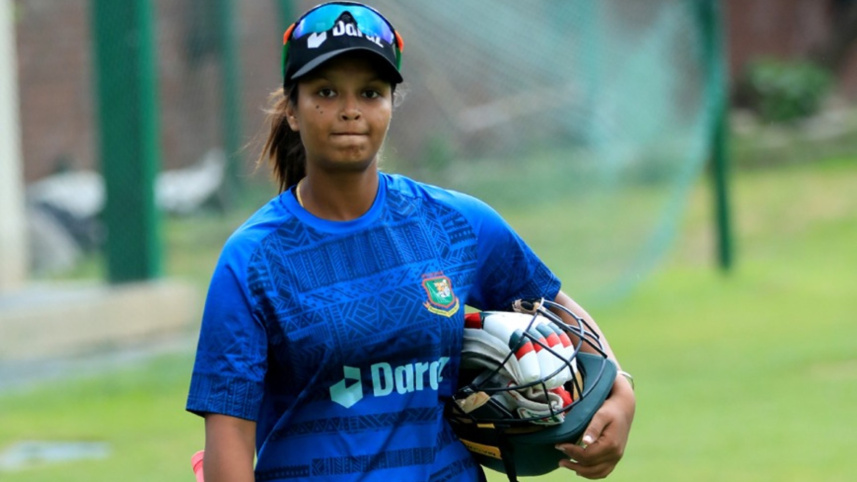
Sobhana Mostary has emerged as one of the most consistent performers for the women’s team across both white-ball formats in recent times, banishing early struggles and criticisms. The 24-year-old is now eager to carry her form into the upcoming T20 World Cup. In an interview with The Daily Star’s Samsul Arefin Khan, she spoke about the team’s preparation, her personal transformation, and Bangladesh’s ambitions for the tournament. Excerpts of the interview are as follows:
The Daily Star (DS): You are heading to the T20 World Cup knowing that the majority of the teams you’ll face are somewhat familiar. Could you tell us about your overall preparation?

Sobhana Mostary (SM): We will play in England for the first time, which brings a unique excitement. We understand that the weather and the wicket will behave differently there. We have practised on wickets similar to those during our last two practice matches. I believe the tri-nation series in Scotland will be a great opportunity to acclimatise.
DS: In the last 50-over World Cup, we faced setbacks in several nail-biting matches where it felt like we needed more preparation. Do you think preparation this time is enough to rectify previous mistakes?
SM: We had preparation but lacked match practice. This time, we played against Sri Lanka. The tri-series is in a country near England, which makes for very good preparation. Playing the Netherlands and Scotland in their own conditions is a great opportunity for us.
DS: How do you view your own transformation as a batter and the challenge of delivering for the team
SM: I believe it is necessary to feel important to the team, a realisation that came to me quite late. Previously, when there were many senior players, I didn’t feel that same level of demand on myself and would often get out playing casual shots. I also faced a lack of experience and was shuffled across many positions – opening, middle order, and number three. I believe if I had been fixed in one position earlier, my success might have come sooner.
DS: Was there a specific turning point where you started seeing yourself differently?
SM: For me, being dropped from the team during the last Asia Cup T20 in Sri Lanka [in 2024] was a major turning point. It made me realise what I needed to improve upon. Another turning point was the T20 World Cup in the UAE. There was a lot of controversy surrounding me before that trip, and my mindset wasn’t strong. The first match against Scotland, where I scored 36, was crucial for my comeback. I then scored 44 against England and 38 against South Africa, placing myself among the top ten run-getters.
DS: What are the team’s strengths and weaknesses?
SM: Our batting is both a point of concern and a potential strength. If we can put runs on the board, our bowlers can play without pressure. Regarding our pace bowling, we can’t change it overnight. My personal observation is that we rely heavily on our spinners. A specific weakness is chasing; we failed to chase in our last three T20s against Sri Lanka. Success will depend on how well our batters can handle those chasing situations.
DS: We often struggle with chasing and quick batting collapses. Is the team working on handling that pressure?
SM: Batting collapse is a major concern. Those of us carrying the team constantly discuss who should play at what time. We are practising specific scenarios, such as how to play from the 11th to the 17th over. This has been a focus in our recent practice sessions.
DS: What are the team and individual targets for this World Cup?
SM: The team consensus is that we want to win three matches. We have beaten teams like the Netherlands and Pakistan, and even South Africa. If we maintain the desire to win, we can succeed. We shouldn’t let ourselves get mentally down by thinking of them as higher-ranked teams.
DS: You will be in Scotland during Eid. How does celebrating with the team compare to being with your family?
SM: When we celebrate Eid together, we try to support one another. We have our own fun, programmes, and buy new dresses. We might even have a practice on Eid day, so we will try to celebrate Eid after the practice session with special food and gifts.
DS: What is your family saying about your absence during Eid?
SM: My mother’s main concern is always whether I am playing well and staying fit. Since I have been away many times, she is used to it now.
 For all latest news, follow The Daily Star's Google News channel.
Comments