


Win brings relief but exposes conservative mindset

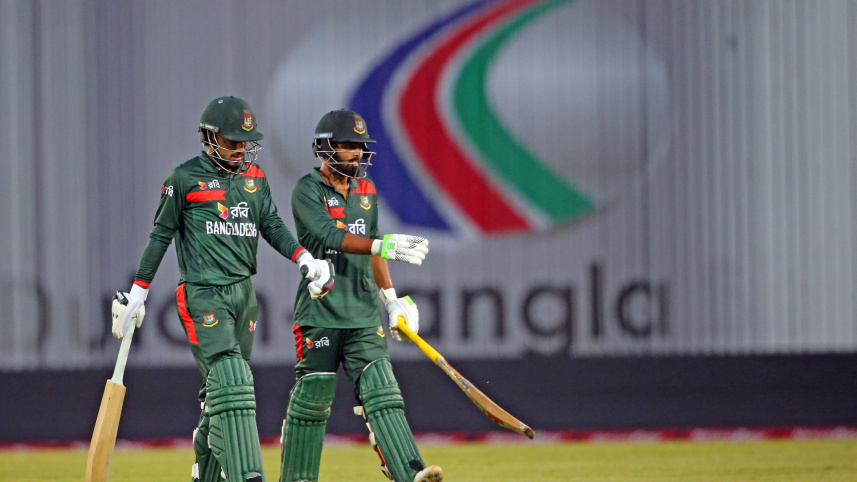
Bangladesh’s 11-run victory over Pakistan in the series-deciding third ODI on Sunday brought much-needed relief, helping them climb to ninth in the ODI rankings, but even in victory, the team’s conservative batting approach raised concerns.
Sent to bat, Bangladesh appeared well on course for a big total. However, poor execution towards the latter stages meant they finished with 290 for five, once again falling short of 300 -- a familiar pattern in ODIs for the Tigers in recent years.

Openers Tanzid Hasan Tamim and Saif Hassan gave an ideal start with a 105-run stand. Tanzid went onto score a run-a-ball 107 -- his maiden ODI century and at the time of his dismissal, Bangladesh were well placed at 194 for three in the 37th over and looked well placed to cross the 300-run mark comfortably.
However, after his departure, Bangladesh added only 96 runs from the remaining 82 deliveries.
More concerningly, they managed just 39 runs in the final five overs despite having seven wickets in hand and two set batters -- Litton Das and Tawhid Hridoy -- at the crease. During that period, they struck only two boundaries.
Litton scored a sluggish 41 off 51 balls with one four and a six, while Hridoy remained unbeaten on 48 from 44 deliveries with four boundaries, further exposing Bangladesh’s lack of firepower in the death overs.
Afif Hossain, recalled to the side after 15 months, also had the opportunity to accelerate late in the innings but managed only five runs from eight balls after arriving in the 47th over.
A similar situation had unfolded during Bangladesh’s home ODI series against the West Indies in last October. In the third ODI, a blistering 176-run opening stand between Saif Hassan and Soumya Sarkar had set the platform for a big total, yet, Bangladesh ended up with 296 for eight, failing to capitalise in the latter stages.
These failures are indicative of a conservative approach, which could be sensed from what captain Mehidy Hasan Miraz had said at the toss of the third ODI against Pakistan.
“I think 260 is a very good score in these conditions because we have a very good bowling attack,” said the skipper.
This assessment might have been justified on the typical slow and low surfaces at Mirpur’s Sher-e-Bangla National Cricket Stadium, but the wickets for the Pakistan series were noticeably different, offering genuine pace and bounce which allowed batters to play their shots freely.
In that context, Miraz’s target of 260 reflected a conservative and outdated mindset.
ODI cricket has evolved with the influence of T20 cricket, as totals exceeding 350 or even 400 are no longer rare.
Since the 2023 ICC World Cup in India, teams have scored 300 or more 69 times in ODIs, including three scores above 400 and 19 above 350.
In contrast, Bangladesh have crossed the 300-run mark only once during this period in 25 matches -- posting 321 for five against the West Indies in Basseterre in 2024 in a losing cause.
These statistics underline Bangladesh’s continued struggle to adapt to the evolving demands of modern 50-over cricket.
The hosts nearly paid the price for their cautious approach in the third ODI against Pakistan.
Even after reducing Pakistan to 82 for five, the match went down to the last over owing to a fighting century from Salman Agha and a late surge from captain Shaheen Shah Afridi, which nearly snatched the match away from the hosts.
Rishad Hossain held his nerves in the final over defending just 14 runs to seal the win but the match once again highlighted that Bangladesh’s ODI mindset is in need of a rethink.
 For all latest news, follow The Daily Star's Google News channel.
Comments