


BFF's high-profile coach hunt

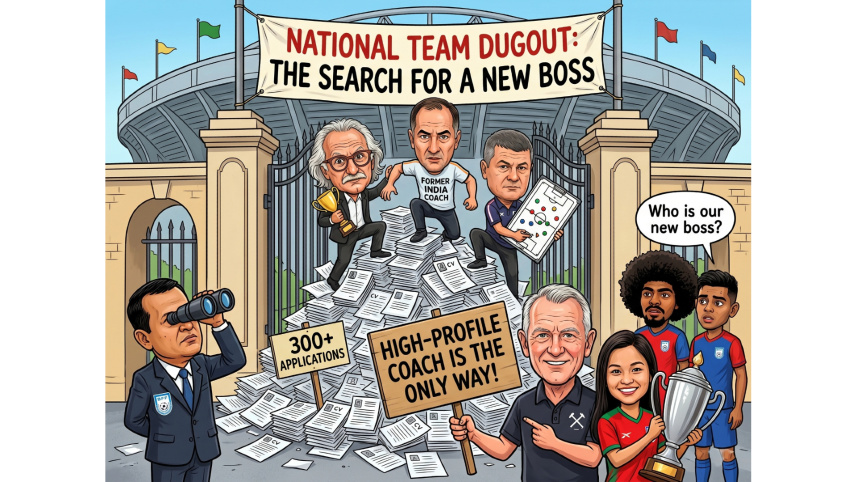
Bangladesh football stands at the foothills of a new beginning. The chapter of Javier Cabrera has come to a close, leaving behind a dugout that is now almost a blank canvas. Yet, for a country languishing near the bottom of the FIFA rankings, master tacticians from across the world are eager to leave their mark.
Around 270 applications have already been submitted for the role of national team head coach. Alongside that, more than 100 applications have come in for age-group teams, and another 30-plus for the position of goalkeeping coach.

Such overwhelming interest from world-class coaches is apparently astonishing. But beneath that surprise lies a quiet shift. The arrival of expatriate stars like Hamza Choudhury and Shamit Shome has sparked a sense of renaissance in red and green.
At this critical juncture, one thing is clear. There is no alternative to appointing a high-profile coach.
Cabrera, despite holding a UEFA Pro Licence, had limited exposure at the highest level. As a result, even with players shaped in European systems joining the squad, that pedigree failed to translate consistently onto the pitch.
A contrasting picture can be seen in the women’s team. Under the guidance of Peter Butler, the entire landscape has changed. Armed with rich experience, including his playing days at West Ham United, Butler ushered in a new awakening. The women’s team and their age-level understudies are no longer confined to SAFF dominance but competing confidently on the Asian Cup stage.
Butler’s success serves as a clear reminder that the men’s team, too, needs an experienced, high-profile tactician, especially a manager capable of understanding players raised in Europe and America while building chemistry with local talent.
While the list of names circulating on social media is eye-catching, the Bangladesh Football Federation has not disclosed any specific candidates, though it confirmed to The Daily Star that several coaches with national team experience have applied. Among the prominent names being linked are Petar Segrt, who led the Maldives to SAFF glory, and India’s two-time SAFF-winning former coach Igor Stimac. Also in the mix are former Bashundhara Kings coach Valeriu Tita and Germany’s experienced Antoine Hey. Names such as Miodrag Radulovic and Didier Olle-Nicolle, along with other European tacticians, are also believed to be on the federation’s radar.
High-profile coaches often operate differently. They are not confined to conventional training routines; instead, they function as modern-day managers. Their approach is rooted in science and data – from GPS tracking and sports science to psychological development and meticulous video analysis of opponents.
Such coaches rarely come alone. They demand a full support structure aligned with their philosophy – tactical analysts, fitness trainers, nutritionists, and goalkeeping coaches working in unison. In the dressing room, they expect complete authority, free from administrative interference.
The federation, meanwhile, appears aligned with entrusting their faith in someone who can construct a seamless structure from grassroots to the national team.
“We want someone who can plan across the entire structure, from grassroots to Under-23 and the national team,” Technical Committee chairman Kamrul Hasan Hilton told The Daily Star.
“Ideally, we are looking for a coach who has developed teams from a young level and delivered results at national, AFC or World Cup stages.”
Ultimately, the psychological boost a heavyweight coach brings to a dressing room, especially when managing players like Hamza and Shamit, is irreplaceable. With that, players can buy into the idea of chasing bigger targets more wholeheartedly, not just SAFF supremacy, but success on the AFC stage and beyond.
In the coming days, the selection committee will trim the list down to a shortlist of 25 to 30 candidates.
“No coach can change everything overnight; he must be given at least two to three years to build a group capable of representing the country for the next eight to ten years,” player- turned-coach Alfaz Ahmed believes.
Who will emerge as the high-profile architect to break the shackles of stagnation in the men’s team?
 For all latest news, follow The Daily Star's Google News channel.
Comments