


Changing of the guard: Premier League to begin with record nine new managers
The Premier League has never been afraid of change. Players come and go, fortunes rise and fall, owners rewrite club identities almost overnight. Yet for nearly four decades there was always a familiar figure standing in one of English football's biggest technical areas.
English football seemed to have revolved around towering personalities who built dynasties rather than simply teams.

Sir Alex Ferguson built Manchester United into an empire. Arsene Wenger changed the way English football thought about nutrition, sports science and preparation. Jose Mourinho brought tactical cynicism and psychological warfare to the league. Jurgen Klopp restored Liverpool through relentless intensity, while Pep Guardiola elevated possession-based football into an art form.
Between them, they collected 26 of the Premier League's 34 titles.
Their influence, however, stretched far beyond silverware. They became the constants in an increasingly unpredictable league, shaping generations of footballers, rivalries and tactical trends.
That era has now quietly come to an end.
When the Premier League kicks off its 2026-27 campaign later this month, none of those five iconic figures will occupy a dugout. For the first time since the 1985-86 season, England's top flight will begin without Ferguson, Wenger, Mourinho, Klopp or Guardiola patrolling the technical area.
It is perhaps fitting that their collective departure coincides with another landmark.
A record nine clubs are set to begin the season under new permanent managers, the highest number ever at the start of the top-flight campaign and a reminder of just how dramatically football's appetite for patience has diminished.
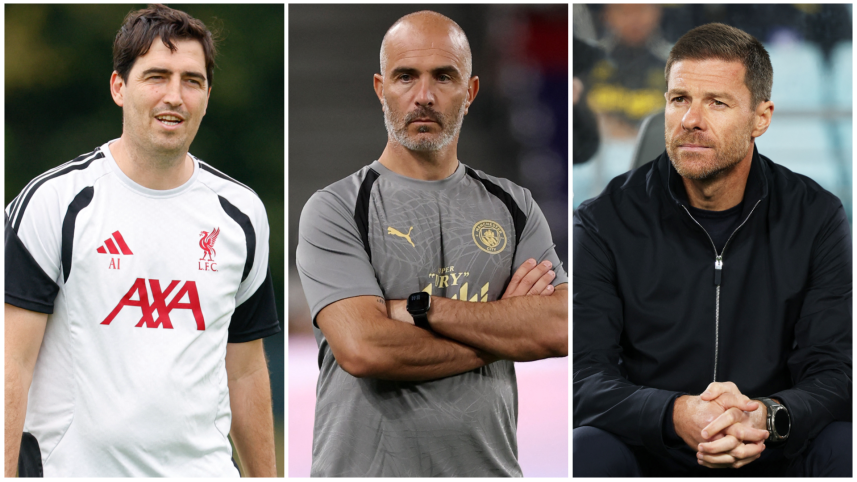
Liverpool have handed the reins to Andoni Iraola after dismissing Arne Slot. Manchester City responded to Guardiola's departure by appointing Enzo Maresca, entrusting the Italian with succeeding arguably the most influential coach of the Premier League era.
Chelsea, meanwhile, have once again pressed the reset button. After Liam Rosenior's short-lived tenure ended in disappointment, the Blues have turned to former Real Madrid boss Xabi Alonso in the hope that one of Europe's brightest young coaches can restore them to the summit of English football.
Elsewhere, Bournemouth appointed Marco Rose following Iraola's departure, while Nottingham Forest moved for Oliver Glasner after parting company with Vitor Pereira.
Crystal Palace quickly replaced Glasner with Pierre Sage after the Austrian left at the end of his contract. Fulham looked towards another former Real Madrid figure by appointing Alvaro Arbeloa after Marco Silva's exit, while Ipswich Town chose Gary O'Neil following Kieran McKenna's resignation.
Newcastle United are also expected to complete the appointment of Matthias Jaissle after Eddie Howe stepped down, taking the total number of clubs beginning the campaign under new permanent management to nine.
Never before has the Premier League entered a season amid such widespread change. The previous record came ahead of the 2016-17 campaign when eight clubs unveiled new managers. That summer ultimately proved transformative. Guardiola arrived at Manchester City, Antonio Conte took charge of Chelsea and immediately guided the Blues to the Premier League title in his very first season.
Before that, seven clubs changed managers before the 1995-96 season, while six did so prior to the 2012-13 campaign.
Yet this latest wave feels different. Those earlier summers represented isolated periods of change. This one feels more like the culmination of a gradual shift, where long-term projects have steadily given way to short-term solutions and immediate results.
Perhaps nowhere illustrates that changing landscape better than the identity of the Premier League's longest-serving manager today.
Not long ago, surviving six or seven years in the dugout barely warranted discussion. Today, it makes you the elder statesman of the division.
For instance Mikel Arteta. The Spaniard only took charge of Arsenal in December 2019, yet fewer than seven years later he already occupies that position. In an era once dominated by Ferguson, Wenger and later Guardiola, such longevity would barely have warranted a mention.
 For all latest news, follow The Daily Star's Google News channel.
 Across Europe's top five leagues, only Atletico Madrid's Diego Simeone has been in charge of his current club longer. The Argentine has led the Spanish giants since December 2011, a remarkable feat in modern football where patience has become an increasingly rare commodity.
The contrast within England is even more striking. Aston Villa's Unai Emery and Leeds United's Daniel Farke are among only a handful of managers who have remained with their clubs for more than three seasons. Sunderland's Regis Le Bris, appointed only in July 2024, is already the fourth longest-serving manager in the division.
Manchester United offer perhaps the clearest illustration of football's revolving door. Michael Carrick only became the club's permanent manager in May after initially taking charge on an interim basis in January. Yet only 10 Premier League managers have been in their jobs longer. He is already United's seventh permanent manager since Sir Alex Ferguson walked away in 2013.
Tottenham's Roberto De Zerbi, appointed as recently as March, is only one place behind Carrick in the longevity rankings.
The managerial merry-go-round, however, did not suddenly begin this summer. The 2025-26 Premier League season alone produced 11 managerial changes, with Nottingham Forest appointing multiple coaches during the campaign. Tottenham also changed head coach twice, while Chelsea altered direction before the season had even finished.
The average tenure of a Premier League manager now stands at around 20 months.
The irony, of course, is that frequent change offers no guarantee of improvement. Several clubs continued to struggle despite replacing managers during the 2025-26 campaign. Forest remained trapped in instability despite multiple appointments, while Tottenham and Chelsea discovered that changing the man in the dugout rarely fixes deeper structural issues overnight.
Others, however, enjoyed an immediate bounce.
Carrick averaged 2.6 points per game across his opening five matches as Manchester United manager, while Liam Rosenior produced an identical return after taking charge of Chelsea. Yet football has a habit of exposing short-term optimism. Rosenior won only one of his final eight Premier League matches before eventually losing his job.
History offers little encouragement to those expecting every managerial appointment to transform a club overnight.
Since the Premier League's inception in 1992, only six managers have lifted the title in their very first season in charge.
Jose Mourinho set the benchmark by guiding Chelsea to the crown in 2004-05 before Carlo Ancelotti repeated the feat with the same club five years later. Manuel Pellegrini delivered Manchester City's title in 2013-14, Claudio Ranieri authored Leicester City's greatest sporting fairytale in 2015-16, Antonio Conte conquered England during his first campaign with Chelsea in 2016-17, while Arne Slot most recently joined that exclusive list by steering Liverpool to the championship in 2024-25.
Those examples, however, remain exceptions which is precisely why the coming season feels so fascinating.
Nine clubs have chosen to begin again. Some have gambled on proven winners, others on rising tactical minds, while several have simply searched for a fresh voice after disappointing campaigns.
Whether this unprecedented managerial reset produces a new golden generation of coaches or merely fuels another cycle of dismissals remains to be seen.
One thing, however, is already certain. The Premier League that begins this month bears little resemblance to the one Ferguson, Wenger, Mourinho, Klopp and Guardiola once ruled. The era of managerial dynasties has quietly given way to an age of relentless turnover, where even six years in the same dugout now feels like a lifetime.
Comments