


Why changing Rab's name or repackaging it is not enough

In 1829, blue uniforms were chosen for the first British metropolitan police, established by Sir Robert Peel, to distinguish them from the British military, whose uniforms were red. The force was also prohibited from carrying firearms so as not to alienate the public. The first of the nine Policing Principles formulated by Peel, widely regarded as the father of modern policing, states that the primary purpose of the police is “to prevent crime and disorder, as an alternative to their repression by military force and severity of legal punishment.”
In the United States, the Posse Comitatus Act of 1878 imposed restrictions on the use of the federal military forces for domestic law enforcement, except in extraordinary circumstances.

Over the past two centuries, however, much has changed. According to criminologist and police militarisation expert Peter B Kraska, the once clear distinction between the roles of the military and the police has gradually become blurred. Governments around the world have redefined the concept of national security by merging external threats with internal security challenges. Under the banners of the “war on terror” and the “war on drugs,” police forces have become increasingly militarised. According to Kraska, police militarisation is a process through which civilian police increasingly adopt the material, cultural, organisational and operational methods of the military.
This is dangerous for several reasons. The primary responsibility of the military is to defend the state against external enemies. The police, by contrast, are responsible for ensuring public safety, upholding the rule of law, investigating crimes, and maintaining public order while protecting constitutional rights. Consequently, the two institutions differ fundamentally in their training, methods of operation, and use-of-force doctrines. Military personnel are trained to defeat—and, when necessary, kill—the enemy through the application of maximum force. Police officers, on the other hand, are trained to enforce the law using the minimum force necessary, to protect citizens’ rights as far as possible, and to bring suspects before the courts rather than eliminate them. Moreover, as military personnel operate under a separate command structure, it is also more difficult to ensure effective civilian oversight and accountability. As a result, those who abuse their authority may remain beyond the reach of ordinary civilian justice and accountability mechanisms.
In countries with strong democratic institutions, these risks may be contained through effective civilian control and independent accountability mechanisms. But in countries where democratic accountability is weak, hybrid security forces composed of military and police personnel can easily become instruments of abuse of power and human rights violations. Bangladesh’s Rapid Action Battalion (Rab) is a clear example of such cases.
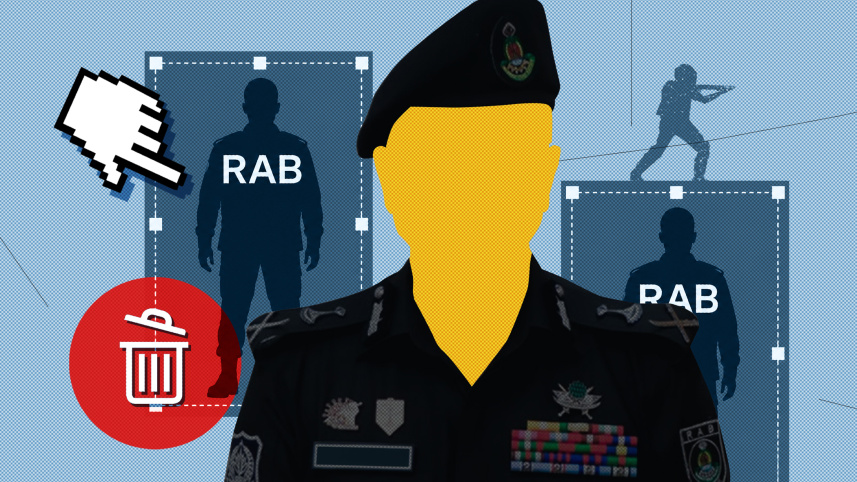
Rab was established in 2004 as an elite force comprising personnel seconded from the Army, Navy, Air Force, Police and other law enforcement agencies. Its declared objective was to combat terrorism and organised crime. In reality, however, this paramilitary force became involved in “crossfire” killings, enforced disappearances, torture and other serious human rights violations.
One of the main reasons behind Rab’s record of human rights violations lies in its organisational structure. In a country like Bangladesh, where democratic accountability is weak, assigning military personnel to civilian law enforcement inevitably creates the conditions for such abuses. As long as military personnel are deployed for extended periods in routine policing, such outcomes are very likely. That is why the United Nations, along with domestic and international human rights organisations, has called not for reforming Rab but for abolishing it altogether and strengthening the civilian police through proper training.
Human Rights Watch has long called for the abolition of Rab. In its 2011 report, “Crossfire”, the organisation explained why abolition is necessary: “At present RAB is drawn from personnel from the police and the military who return to their units once they have served their term with RAB. This practice has been widely criticized for giving soldiers civilian law enforcement tasks and expecting them to operate under a different framework and code of conduct without adequate training, leading to predictable abuses. It is also likely that the abusive practices of RAB are then introduced into other forces, such as the police. The constant shuffling between the different forces makes it difficult to keep track of those responsible for violations for vetting purposes.”
Following the 2024 July Mass Uprising, the Commission of Inquiry on Enforced Disappearances recommended that Rab be dismantled. Explaining the reason, the commission wrote: “RAB has been at the centre of the system of enforced disappearance, torture, and extrajudicial killing described in this report. Its legal mandate, operational culture, and chain of command have proved resistant to reform. The force should therefore be wound up as an institution, with transitional arrangements that protect evidence and enable prosecutions.”
The Office of the United Nations High Commissioner for Human Rights (OHCHR), in its fact-finding report on human rights violations committed in Bangladesh between July 1 and August 15, 2024, also recommended abolishing Rab. The report criticised the militarisation of policing in Bangladesh, stating that such paramilitary forces are more likely to resort to lethal force and commit serious human rights violations during security operations. Regarding Rab, it observed: “Although nominally directed by a police official, a seconded Army colonel has controlled RAB operations. Over the course of two decades, RAB established a legacy of extrajudicial killings, enforced disappearances, torture and other serious violations targeting criminal suspects, opposition politicians, civil society figures and state officials seen as disloyal.”
Despite these strong recommendations, the BNP-led government is reluctant to abolish Rab. Instead, according to a recent report, it intends merely to change the force’s name while retaining most of its existing structure. To that end, the Ministry of Home Affairs has initiated the process of drafting a new law. The draft law, like the existing one, continues to allow personnel to be recruited on secondment from the armed forces and other law enforcement agencies. Yet Rab’s problem does not lie in its name; it lies in the use of military personnel to carry out civilian policing.
Ironically, the BNP repeatedly called for Rab’s abolition when it was in opposition. In May 2014, then opposition leader and former Prime Minister Khaleda Zia demanded that Rab be disbanded. She said: “Rab is now involved in enforced disappearances, killings and abductions. There is no longer any need for a force that kills people. Therefore, I demand that it be abolished.”
In the same month, BNP’s then Senior Vice-Chairman and current Prime Minister Tarique Rahman also called for Rab’s abolition. Launching a signature campaign titled “Disband Rab” in London, he said: “The people no longer have the slightest confidence in Rab. Its abolition has now become a public demand.”
The BNP continued to make the same demand on various occasions. After the July Mass Uprising, in December 2024, the party recommended to the Police Reform Commission that Rab be abolished, citing allegations of human rights violations and extrajudicial killings. At a press conference, the current Acting President Hafiz Uddin Ahmad, who was then a member of BNP’s standing committee and head of the party’s police administration reform commission, said: “We think Rab has been condemned so much internationally, and it has turned out to be a monster within the country. Most of the extrajudicial killings, enforced disappearances and murders were carried out by the Rab. That is why we recommended its disbanding.”
More than two decades of Rab’s history show that, regardless of which party has been in power, the force has served mostly as an unaccountable death squad for the government of the day. This has been possible not because of its name or uniform, but because of its paramilitary organisational structure.
Therefore, simply renaming Rab or reorganising it under a new banner, while retaining the same type of paramilitary structure, will leave intact the risk of human rights violations committed in the name of combating terrorism and crime. The BNP once recognised this reality and demanded Rab’s abolition. If it abandons that position now that it’s in government, a legitimate question will arise: does it genuinely want to end the human rights abuses associated with Rab, or does it intend to preserve the same coercive force so that it can be used against political opponents in the future?
If Bangladesh is to fulfil the aspirations of the July Mass Uprising and implement the recommendations of the United Nations as well as domestic and international human rights bodies, there is no alternative to disbanding Rab and building a professional, accountable and people-oriented civilian police service.
Kallol Mustafa is an engineer and writer who focuses on power, energy, environment, and development economics. He can be reached at kallol_mustafa@yahoo.com.
Views expressed in this article are the author's own.
Follow The Daily Star Opinion on Facebook for the latest opinions, commentaries, and analyses by experts and professionals. To contribute your article or letter to The Daily Star Opinion, see our guidelines for submission.
 For all latest news, follow The Daily Star's Google News channel.
Comments