


Immortality washed away in the rain of Bern
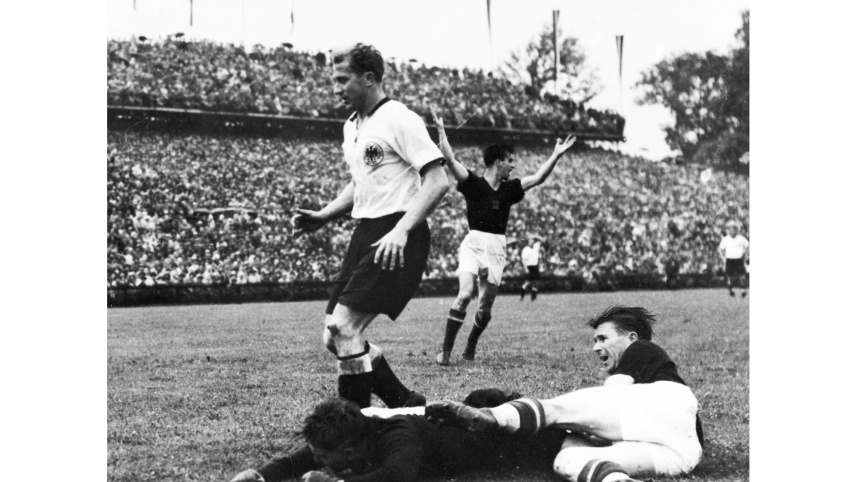
In the early 1950s, across Europe’s green carpets, Hungary were not merely a football team. They were devoted practitioners of the art of football. The eleven men on the field seemed to move according to the sheet music of an invisible orchestra. The world knew them as the “Magic Magyars.” When the ball was at their feet, it felt as though a master poet was arranging his finest verses.
The chief architect of that magical symphony was Ferenc Puskas, known as the “Galloping Major.” Beneath his modest frame and heavy build lay a supernatural force. Each strike of his left foot resembled a perfect geometric design, effortlessly finding the corners of the goal. Across Europe, people bowed before this Magyar prince with a strange mixture of awe and reverence.
 For all latest news, follow The Daily Star's Google News channel.
 When Hungary arrived in Switzerland for the 1954 FIFA World Cup, they were nearly invincible. For four straight years they had not lost an international match. In that period they had stunned the world by defeating England 6–3 on English soil. They came to the World Cup with a single purpose -- immortality. And almost everyone in the football world believed that the trophy would ultimately travel to Budapest.
In the group stage, Hungary played football like a raging storm. A 9–0 demolition of South Korea was followed by an 8–3 victory over West Germany. Opponents seemed merely present on the pitch; control of the matches rested entirely with Hungary. Puskas was scoring, creating, leading his team forward with such confidence that it seemed as though the World Cup trophy was already in his hands.
Yet it was against that very German side that the beginning of an unseen tragedy occurred. At one stage of the match, a fierce tackle from German defender Werner Liebrich sent Puskas crashing to the ground. His ankle suffered a serious injury. The game continued on the field, but for Hungary time seemed to stop. Puskas was carried off, pain etched across his face, while an uneasy anxiety spread among the spectators.
Doctors said the chances of his return in the tournament were slim. Still, Hungary advanced even without him. They beat Brazil in a thrilling encounter, then overcame Uruguay to reach the final. Yet across the entire nation one question lingered. Would Puskas return?
In the end, he did. Ignoring the limitations of his body, embracing the pain. Because for a captain, sometimes responsibility, dreams, and the call of history become greater than the body itself.
July 5, 1954.
Clouds gathered over the city of Bern that day. On the day of the final, rain fell relentlessly. The pitch of Wankdorf Stadium had turned heavy with mud. Yet on that field stood the strongest team in the world, before them the final door to immortality.
The beginning of the match felt like a mesmerizing illusion. When the referee’s whistle sounded, the first ten minutes suggested that injury had placed no shackles on Puskás’s magical feet. In the 6th minute, with that same injured and pain-stricken left foot, he sent the ball into the net. The silence of the stadium shattered under the roar of Hungarian celebration. Just two minutes later, a goal from Zoltan Czibor made it 2–0.
It felt as if the nectar of immortality was already touching Puskás’s lips. Even with injury, he seemed like an invincible god of football.
But football sometimes writes stories stranger than human imagination.
The heavy rain of Bern and the muddy pitch slowly began to swallow Hungary’s artistic football. Before ten minutes had passed, goals from Max Morlock and Helmut Rahn brought the score level at 2–2 before halftime.
Suddenly the picture of the match changed. Hungary’s one-sided dominance disappeared. The contest became a battle fought on equal terms.
As time passed, the rain intensified. The players’ jerseys grew heavier. The mud on the pitch slowed every run. And as for Puskas, the swollen muscles in his leg had begun to revolt. With every step he felt a piercing agony, as if thousands of sharp needles were stabbing his ankle. Still he ran, clenching his teeth, chasing an elusive dream.
As the match neared its end, the score remained 2–2. Hungary attacked, but fortune seemed to slip past them. Then, in the 84th minute, German forward Helmut Rahn received the ball. He created a little space and struck.
The ball hit the net.
Puskás felt as if someone had torn his heart out. 3–2.
One side of the stadium erupted in celebration, while on the other a heavy silence descended. The Hungarian players could hardly believe what had happened.
Then came one final flicker of hope. From a perfectly weighted pass by a teammate, Puskas received the ball. Forgetting all pain, he deceived the German defense and sent the ball into the net! For a fleeting moment it felt as though immortality had returned to his grasp. For a fleeting moment it seemed the story might not yet be over.
But before the celebrations could erupt, his eyes caught the raised flag of the linesman.
Offside.
Puskas stood still. In his eyes there was a gaze where exhaustion, disbelief, and a deep helplessness blended together. It was as though he understood that this match would not return.
Moments later the referee blew the final whistle. West Germany were world champions, and for Hungary it became the lament of a lost dream.
Puskas?
He stood at one end of the field, hands on his hips, soaked in rain and mud. There were no tears in his eyes, only a dense, unfathomable emptiness. Those eyes that moments earlier had searched for the goal like a hungry eagle were now filled with all the helplessness in the world. The physical pain of injury was trivial to him then; before his eyes, slipping forever through his own fingers, the World Cup had vanished, and with it the chance of an entire generation to become immortal.
In that still, silent gaze lay an endless regret and disbelief. Standing there in his mud-stained jersey and rain-drenched body, Puskas that day seemed like a tragic hero from a play of William Shakespeare.
History would remember it as the Miracle of Bern.
Comments