


Argentina's 24-pass orchestra

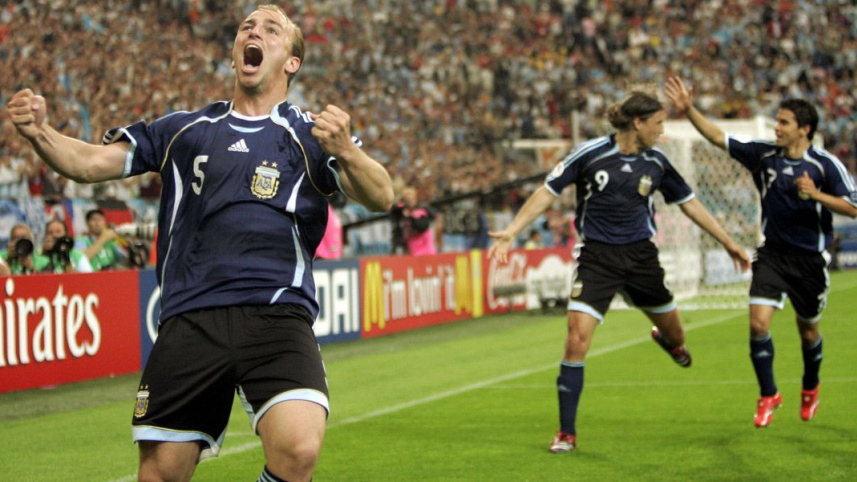
Gelsenkirchen, Germany. June 16, 2006.
It could have been just another ordinary afternoon. But on that day, on that stretch of green, 11 men in sky blue and white stepped onto the pitch not merely as footballers, but as artists with a shared canvas.

The opponents were Serbia and Montenegro. The clock had ticked to 31 minutes. And then, time seemed to pause.
What followed was not just a goal, it was a composition.
From deep within their own half, Argentina began a move devoid of urgency, free of brute force. There was no rush to overwhelm, no primal desire to dominate. Instead, there was calm, an almost meditative rhythm. The ball moved like a living thing, gliding from foot to foot with delicate precision.
Javier Mascherano, Roberto Ayala, Juan Pablo Sorin, each touch seemed preordained, as if bound by an invisible thread. This was not mere passing; it was conversation, a silent language spoken across the grass.
At the heart of it all stood Juan Roman Riquelme, the conductor of this symphony. With every touch, he dictated tempo and direction, the ball responding like a disciplined apprentice. Serbian players chased shadows, their pursuit increasingly futile, as Argentina sculpted patterns -- triangles, quadrilaterals -- across every inch of the pitch.
The passes kept coming. One, two, ten, fifteen…
Fifty-four seconds stretched into an eternity.
And then, without warning, the gentle river turned into a crashing wave.
The move surged forward. Maxi Rodríguez found Javier Saviola, whose deft touch guided the ball into the path of Esteban Cambiasso.
Cambiasso knew he could not finish this alone. Inside the box stood Hernan Crespo, tightly marked, with barely space to turn. Cambiasso released the ball to him in a split second.
What happened next belonged to a different realm.
Crespo, as if seeing beyond the limits of his own vision, produced a backheel of sublime intuition, an artist’s final stroke. The ball returned, perfectly weighted, into Cambiasso’s path. Serbia’s defence, once structured and alert, was now undone, reduced to spectators in a moment of pure brilliance.
There was no hesitation now.
The ball met Cambiasso’s left foot. A powerful strike followed. Goalkeeper Dragoslav Jevric could only watch as the ball traced its path into the net.
Twenty-four passes. Nine different players.
For a fleeting second, the crowd forgot to breathe. Then came the eruption.
Cambiasso ran with arms outstretched, like a conductor acknowledging applause after a flawless symphony.
The beauty of the goal lay not in individual brilliance, but in its collective soul. There was no single hero, no solitary flash of genius. Instead, there was patience, understanding, and unwavering trust.
 For all latest news, follow The Daily Star's Google News channel.
 It remains a timeless reminder: sometimes, the greatest magic in football is created when no one tries to be the magician alone.
Comments