


Brehme’s penalty: The moment Maradona’s Argentina fell silent

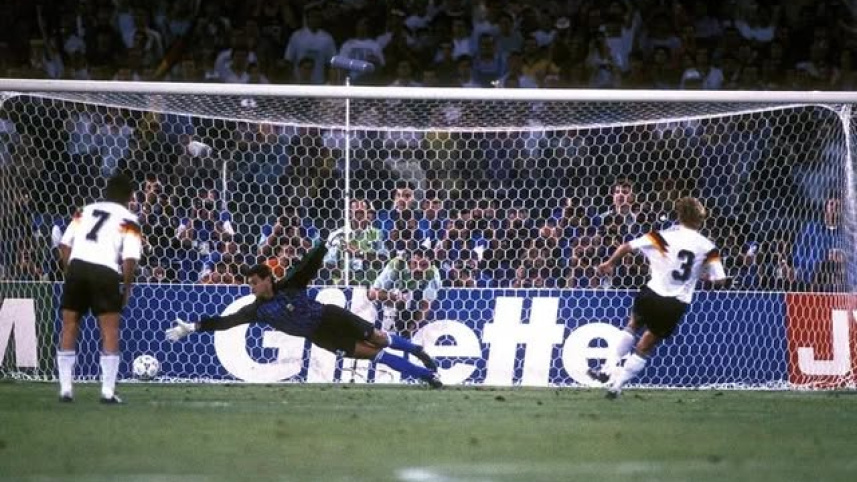
That night in Rome, the moon was out, but there was no light. Beneath the vast galleries of Stadio Olimpico, the night slowly sank into a gloom as if the world itself already knew that a king would soon fall. Just as the air grows heavy before every tragedy, it felt that way that night. The smell of fatigue lingered on the grass, mingling with the crowd’s screams of fear, and there stood Diego Maradona in the midfield, looking utterly alone.
Completely alone.

Four years earlier, under the Mexican sun, he had danced with the ball at his feet like a magician. But in Rome in the final of the 1990 FIFA World Cup against West Germany, he appeared like a wounded emperor. The relentless pressure, kicks, tugs, and pushes of the German defenders seemed to have gradually pulled him down into the realm of mortals. His legs no longer moved as they once did; his body was weary. Yet the fire of determination still burned in his eyes. Maradona knew that legends never fully surrender. They break, but they do not crumble.
Argentina, too, was a weary army that day. Gone was the dazzling beauty of 1986, gone the free-flowing rhythm. They played with teeth clenched, as if each player wanted to defend the last wall with his own chest. Across the field stood a cold, merciless, mechanical German team, a team that believed in discipline more than emotion.
And as time ticked by, it seemed the night might somehow pass. Perhaps extra time. Perhaps a tiebreaker. Perhaps some last-minute miracle.
Because when Maradona is on the field, people want to believe in miracles until the final whistle.
Then came that whistle.
85th minute.
Rudi Voller fell in the box.
The referee awarded a penalty.
In that instant, it felt as though someone had suddenly sucked all the air from Argentina’s chest. The sky seemed lower. Maradona watched from afar. His eyes held a disbelief beyond words. It was as if he thought: could it really end this way?
The Argentine players swarmed the referee. Protests, screams, frantic hand gestures. But some doors in history, once opened, never close.
The ball was placed for the penalty.
And the stadium fell into sudden silence.
That silence was terrifying.
It felt as though someone had stolen every sound from the city of Rome. Thousands of people, yet no noise. Only one man walking slowly toward the ball.
Andreas Brehme.
Left-handed, left-footed. A defender. He wasn’t supposed to be here. But he was walking. Calm face, head held high, eyes forward.
In the German dugout, a small drama was unfolding. Lothar Matthaus, the team captain, the best player at that moment, the regular penalty taker, had changed his boots. The wet pitch had made his old shoes slippery. He lacked the courage to take the penalty with the new boots. He shook his head. No.
Then Brehme had the courage.
 For all latest news, follow The Daily Star's Google News channel.
 He was no celebrated footballer. No magician, no poet. Just a man history usually overlooks. Yet that day, history had decided that its harshest sentence would be written by his foot.
Brehme placed the ball. His face betrayed no emotion. Neither excitement nor fear. As if he could not comprehend that within a few seconds, an entire nation’s heart would be shattered.
Yet, strangely, this left-footed man chose to strike with his right. To take a shot with his weaker foot under the deathly pressure of a World Cup final was not courage -- it bordered on madness.
Still, there was a strange logic in that madness.
Argentina’s goalkeeper, Sergio Goycochea, had become the god of penalties in the tournament. He had saved his team in shootouts against Yugoslavia in the quarterfinal and Italy in the semifinal. Now he stood on the line, arms spread, mentally ready to swallow Brehme whole. Argentina’s last hope.
Goycochea knew Brehme would shoot with his left. Brehme knew that Goycochea knew. So in that moment, he overturned everything -- his habits, his instincts, his natural tendencies.
Then Brehme ran.
A short run-up.
One shot.
A cold, perfect, merciless strike with his right foot.
The ball hit the net as if it were not a goal, but the sound of a dagger piercing a heart.
Goycochea leapt toward the corner, but history’s hand was faster.
And at that moment, Maradona’s world fell apart.
He stood frozen in midfield, eyes empty. An emptiness unlike ordinary defeat. As if someone had taken not just the World Cup, but a part of his soul. He knew there was no turning back.
After the final whistle, the tears came.
One of football’s proudest men was crying. Head down. Eyes hidden. Like a child.
Yet those tears were not his alone. They carried the heartbreak of all Argentina. In Buenos Aires that night, people sat silently in the streets. No shouting, no riots. Only a deep, inert grief. A grief that spoke without words.
Maradona later said that night was the heaviest of his life. He had not just lost -- he had fought. Throughout the tournament, carrying his team on a broken body and weary legs, hiding injuries, giving everything. Yet one man lifted his right foot and shattered all of that sacrifice. In a single instant. From 12 yards away.
Yes, the camera was fixed on him. Millions watched. Even gods would have faltered.
The Argentine players sank to the ground. Some bowed their heads, some stared blankly. All the strength seemed to have left their bodies. They looked like an army defeated in battle.
And in the distance, the Germans celebrated.
Brehme stood at the center of that celebration. Perhaps even he did not know that he had not just scored a goal. He had killed a dream.
He had written the final line of Maradona’s last World Cup final epic.
With a single strike of his right foot.
And the sound of that strike still echoes through Argentina’s longest, quietest tears in football history.
Comments