


Curacao hasn't slept since we qualified: Chong
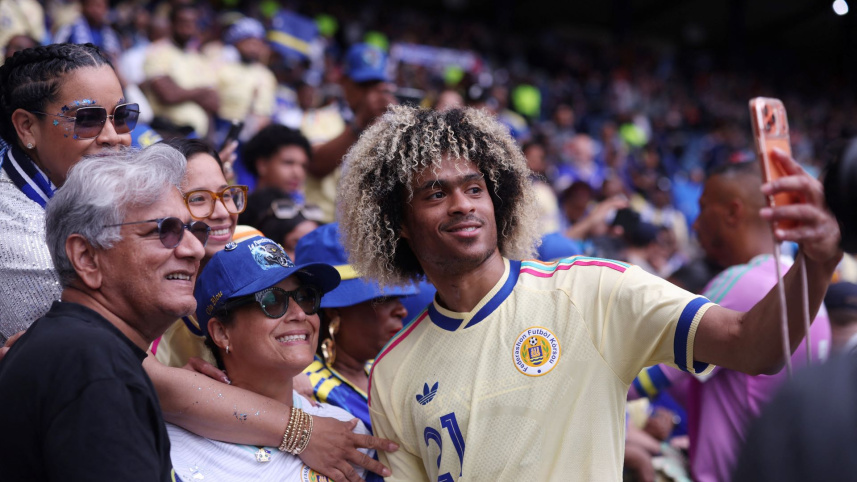
When Curacao line up to face Germany in their FIFA World Cup 2026 opener on 14 June in Houston, it will be a special moment for all the players from the Caribbean side. For Tahith Chong, it will have extra significance as the lone Curacao-born player on the squad.
The 26-year-old winger spent much of his youth on the island before moving to the Netherlands to further his football career. At international level, his start came in the Dutch youth national teams, but when it came time to make a call on his senior team career, it was Curacao that came to the fore.

Chong debuted with The Blue Wave in 2025 with a bang, helping them qualify for their first World Cup. Now, he will have a chance to show the world what his homeland is all about on and off the pitch as Curacao prepare to take on Côte d'Ivoire, Ecuador and Germany in Group E of the global showpiece.
Why did you choose Curacao?
It just felt like home. I go back every summer (and for) every holiday I have as well. I go back home and it just feels like going back home. That's how Curacao always felt. When that opportunity came, you go where it feels like home.
What was it like to finally play in Curacao?
I was born there and when I was a kid I played in Curacao before I moved to Holland. Where we stay with the national team when we go back to Curacao is literally opposite the school I went to when I was like six or seven. It was my first start – I'd already made my debut in Trinidad. For a lot of the family, it was the first time seeing me live in person, so it was pretty cool.
What did it mean to you to have your grandma see you play for the first time?
(My) grandma was 96, so (she'd) seen me a lot of times on TV and stuff, but at her age it was obviously different to travel. When I had that home game, it was amazing for her to come and watch and see (me) in person. I went to see her after the game as well. She passed away two months after, so thinking about that [brings back] fond memories.
What is your earliest memory of watching the World Cup?
The first time I watched football was the 2006 World Cup. My dad played a bit in Curaçao and then he lived a few years in Holland. When he was playing in Curacao, he always used to tell me: "Come and watch the games. Come along." I was like: "I don't really like that sport. I think it's a stupid sport." Then came the 2006 World Cup and I watched it. It was the final with Italy against France with (Zinedine) Zidane doing the head-butt. I was for France in the final – I don't know why – and I cried. After that game I [said] to my dad: "'I want to go (and) play football". To think now 20 years later that I'm potentially on the brink to go and play for Curacao where it all started at a World Cup is obviously amazing.
What does Curacao represent to you?
With us being at the World Cup, we can represent Curacao, and hopefully people find out a bit more about Curacao and our history. I think a lot of people don't know Curacao. I live in England, and Curacao is not that well-known in England. I really hope we represent the country in a good way and give a tiny bit of a history lesson about Curacao as a people and a country.
How would you describe the identity from inside the group?
Everyone gets along. It's a culture we've built with everything we do. It's all about the team and not individuals or anything like that. When you come here, you feel like you're coming home, you feel like you're accepted into the family, which is something (that is) obviously unique.
What will it feel like to play in that first World Cup match?
It will be a dream come true, not just for me but for the whole group, considering we’re the smallest nation ever, and all the boys having had different paths to get to where we are. It's been a long process. I've recently joined up, but you've got our captain Leandro Bacuna, and Eloy Room, our keeper, they've been coming here for 10+ years, so you can imagine what they're feeling.
As the only native of Curacao on the team, how have your countrymen reacted to reaching the World Cup?
I don't think the island has slept yet. I think it’s been five months now [since qualifying]. With the World Cup, the people enjoy it and the atmosphere is crazy down there. Normally, you’ve got people that are Brazil fans, Argentina fans, but obviously this year, with us playing as well, it's going to be different. Everybody is going to be for Curacao, so it's going to be super cool to see.
What does it mean to you that Curacao qualified?
 For all latest news, follow The Daily Star's Google News channel.
 It probably hasn't completely [sunk] in for me yet that Curacao is going to the World Cup. It has with my dad, though, for a long time. Every time we speak, every time we call, he always says: "World Cup... Curacao are going to the World Cup." So, I think it's definitely [sunk] in for him.
What will it take for Curacao to become a World Cup regular?
I think it starts with youth. If you can develop them young – four, five – you can start building some infrastructure for them to grow as players. I still think Europe helps a lot, because Europe lives and breathes football. They have all the facilities and everything that you eventually need to get to that next level. But, who knows, in 20-30 years, Curacao might have these facilities and then you're having a completely different conversation.
I think you can compare it a bit to baseball, because baseball is very big in Curacao and we have a lot of MLB [Major League Baseball] players. For them, it's been a process to get to that level, and hopefully, Curacao football can get there as well. We have so much talent in Curacao, not only in football or baseball but all kinds of different sports. If we can help the infrastructure, I think Curacao might have a bright future.
Comments