


Howard the human wall

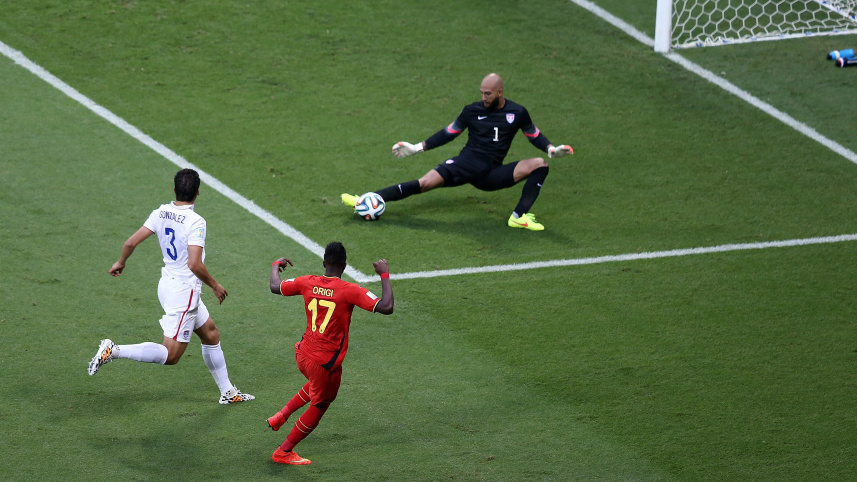
War, too, has its rhythm. Sometimes fast, sometimes slow, sometimes a breath-stopping surge of tension. But there are some battles where rhythm ceases to exist -- where there is only relentless attack and an unyielding resistance in response.
That afternoon, football seemed to lose all sense of rhythm, and standing alone against it was USA goalkeeper Tim Howard. It became difficult to tell whether he was a man or a wall.

The date was July 1, 2014.
At the Arena Fonte Nova in Salvador, Brazil, the stage was set for an unequal war. On one side stood Belgium’s golden generation -- Eden Hazard, Kevin De Bruyne, Vincent Kompany -- players whose feet carried the magical rhythm of football. On the other side was the USA, armed with little more than an unbreakable spirit. Yet, the tens of thousands in the stands had no inkling of the epic tragedy that was about to be written on that green stage.
From the referee’s first whistle, it was a one-sided onslaught. Belgium’s attack shaped the battlefield at will. From inside the box, from distance, from the right flank and the left -- waves of strikes came crashing toward the American camp. With precise, almost geometric passing and blistering pace, the USA defense looked like a worn-out sailboat caught in a violent storm.
The first big shot came suddenly. A powerful strike from distance -- its trajectory perfect, its force undeniable. It should have been a goal. But Howard’s hands were faster than time itself. He leapt, pushed the ball away, as if it were no threat at all. In that single moment, it became clear -- this day would be different.
What followed was an endless tale of attack. Hazard surged down the left, his dribbling leaving defenders scattered. De Bruyne orchestrated from midfield, threading passes like a chess master arranging pieces. And up front was Romelu Lukaku -- a blend of power and pace, capable of breaking the deadlock at any moment.
Each attack told a different story. Low shots, headers, sudden volleys -- every ball that flew toward goal seemed to plead, “Let me in.” But every time, that plea was denied by one man.
Howard’s body was no longer just a body -- it had become a machine of astonishing reflexes. He seemed to know the ball’s destination before it arrived. Diving right to fingertip it away, stretching left to block with his legs, calmly denying close-range shots -- each save redefined the very meaning of the impossible.
At first, the crowd applauded. Then they fell silent in disbelief. The commentator’s voice echoed with astonishment: “Another save! Howard again!” It felt as though the entire stadium was asking the same question -- how many times can one man do this?
As time went on, the battle grew deeply personal. It was no longer just a World Cup knockout match; it had become a war between a goalkeeper and an entire attacking force. After each save, there was more sharpness in his eyes, more defiance -- as if he were challenging himself: “Can you do more?”
Ninety minutes passed. The scoreline remained unchanged, as though Howard had frozen time itself.
But football, in the end, is a game created by humans. Even miracles grow weary.
In extra time, the wall finally cracked. After relentless pressure, Kevin De Bruyne found the net. Then Romelu Lukaku struck. Against his power, resistance could no longer hold. The scoreline shifted, and reality returned.
Yet even then, there was no sign of collapse in Howard’s eyes. He rose again, prepared himself once more -- as if the battle was not yet over. Because his fight was never about the result; it was about surpassing his own limits.
The final whistle blew. The scoreboard recorded one story, but in the hearts of people, another was written.
Sixteen saves. Just a number -- but within it lies countless moments, countless breathless scenes, and countless acts of defying the impossible.
 For all latest news, follow The Daily Star's Google News channel.
Comments