


Klose: The goal machine who left his mark of greatness with quiet steps
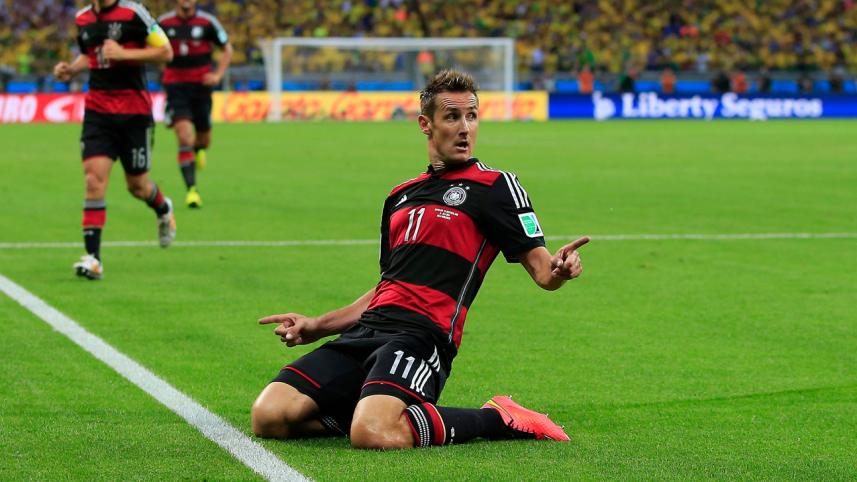
The Estadio Mineirao in Belo Horizonte was stunned into silence. In the stands, thousands of Brazil supporters wore expressions of disbelief and despair; the weight of the hush was palpable. The scoreline was equally unfathomable. It was on that night, during Germany’s 7-1 demolition in the 2014 World Cup semi-final, that Miroslav Klose ascended to the summit of footballing history.
After the goalkeeper parried his initial strike, Klose coolly slotted home the rebound. In doing so, he surpassed the Brazilian legend Ronaldo to become the World Cup’s all-time leading scorer with 16 goals.

The moment was explosive, yet the celebration was devoid of any grand theatricality. It was as if it were merely business as usual: score the goal, contribute to the team, and quietly return to his station. Klose’s entire career followed this blueprint -- understated and restrained, yet ruthlessly clinical.
Klose once remarked, "Scoring goals is much like fishing. In both, you must be patient, wait for the precise moment, and then execute with a perfect blend of power and composure."
Born in Poland, his early childhood was spent there before he moved to Germany with his family at the age of eight. Growing up as an immigrant involved navigating the challenges of a new language and culture. His path to professional football was anything but conventional. Instead of a prestigious academy, he began at a local club, and as a young man, he even trained as a carpenter. Remarkably, at the age of 21, he was still playing in the fifth tier of German football. Where many would have seen their dreams fade, his ascent was only just beginning.
Through a combination of merit and fortune, his breakthrough came when he was scouted by Kaiserslautern. This led to his Bundesliga debut and, following a series of impressive displays, a swift call-up to the national side. He scored on his international debut in 2001 and never looked back. While he represented illustrious clubs such as Werder Bremen, Bayern Munich, and Lazio, the World Cup remained his true stage.
Klose burst onto the scene at the 2002 World Cup like a whirlwind. He netted a hat-trick in the opening match against Saudi Arabia -- all three goals coming from headers. Finishing the tournament with five goals, he played a pivotal role in guiding Germany to the final. Though the trophy eluded them following a defeat to Brazil, it was clear that this striker was built for the grandest occasions.
Yet, Klose never allowed himself to be bigger than the game. "I have always adhered to certain values because many young people are watching me.
“For me, it’s only natural. I’ve won Fair Play awards, but that is simply my nature, my character. I am who I am -- there is no need to pretend to be someone else."
The humble Klose did, however, have one flamboyant streak: his trademark celebration. The "Salto" -- a perfect front-flip -- became his calling card. But that was the extent of it. A goal, a moment of joy, and then a calm return to his hunt, lurking like a predator.
The 2006 tournament took place on German soil, and in familiar surroundings, Klose appeared even more refined. He bagged a brace in the opening match and maintained consistent form throughout. With five goals, he claimed the Golden Boot. Although Germany finished third, he was the spearhead of that campaign.
By the 2010 World Cup, Klose was 32. Many assumed his era was drawing to a close. But Klose had a habit of awakening whenever a World Cup arrived. He scored against England and celebrated a brace against Argentina, proving his mettle in high-stakes matches. Once again, Germany finished third, and Klose moved within touching distance of history with another four goals.
By 2014, Klose was no longer just a veteran; he had become a living legend. He equalled Ronaldo’s record of 15 goals against Ghana, and that historic semi-final goal against Brazil finally set him apart at the top. The goal itself -- clinical finishing at the second attempt after the initial save -- was a masterclass in positioning and nerves of steel.
Beyond becoming the greatest goalscorer in World Cup history, Klose finally tasted the ultimate glory, healing the wounds of three previous near-misses. He retired from international football as a world champion in his very last match -- the fulfillment of every footballer’s greatest dream.
He noted, "Team success was always above everything else for me, and it remains so."
Klose was never a dazzling dribbler, nor was he the type to tear through defences with individual flair. His strength lay elsewhere -- in his impeccable movement inside the box and his ability to seize a half-chance. He didn't need raw pace or flashiness to evade his markers; he relied on timing and footballing intelligence. Furthermore, his aerial prowess remained one of his most formidable weapons.
Klose thus stands as a rare character who demonstrated that greatness does not always require the limelight. Sometimes, it is achieved quietly, by standing in the right place at the right time and doing one's job to perfection.
 For all latest news, follow The Daily Star's Google News channel.
Comments