


From leather to chip: The historic evolution of the World Cup ball
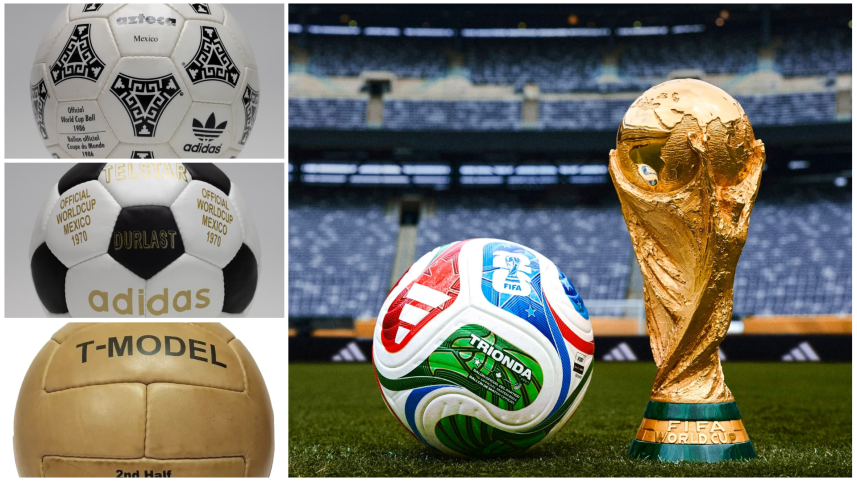
Alongside the history of the FIFA World Cup, one of its most inseparable elements -- the football itself -- has evolved in step. The balls have undergone revolutionary changes, each reflecting a new era of the game. From the heavy, hand-stitched leather balls of 1930 to today’s high-tech spheres made from synthetic, durable materials, the transformation has been remarkable.
Key innovations along this journey include the introduction of the ‘Adidas Telstar’ in 1970 for better visibility on television, the use of ‘thermal bonding’ technology in 2006 to create seamless balls, and, more recently, AI-driven data systems to assist referees in making precise decisions.

Let’s take a closer look at the footballs used throughout the history of the FIFA World Cup.
The era of heavy leather (1930–1966)
Rough, unpredictable, and a true test of physical endurance -- early World Cup balls were exactly that. Balls used in the first tournaments, such as the ‘T-Model’ in 1930, were made from thick cowhide leather. Inside, a bladder was secured using heavy cotton laces.
On rainy days, these leather balls would absorb water and nearly double in weight. As a result, heading the wet, heavy ball often led to concussions or serious injuries for players.
However, evolution brought innovation. The 1962 ‘Mr. Crack’ ball marked a major breakthrough, becoming the first to use a latex valve (made from natural rubber), which helped maintain its shape for longer.
Balls used in this era:
1930 (Uruguay): Tiento (first half of the final) & T-Model (second half)
1934 (Italy): Federale 102
1938 (France): Allen
1950 (Brazil): Superball Duplo T (first ball without external laces)
1954 (Switzerland): Swiss World Champion
1958 (Sweden): Top Star
1962 (Chile): Mr. Crack
1966 (England): Challenge 4-Star
Telstar and the visibility revolution (1970–1982)
The iconic look of modern football was born in this era.
1970 marked a turning point, as Adidas became the official supplier for the first time. Before that, host nations were responsible for producing match balls. The German multinational, renowned for sportswear and equipment, introduced the famous ‘Telstar’ -- a 32-panel black-and-white ball.
The name came from “Television Star,” designed specifically so viewers could clearly track the ball on black-and-white TV screens. The black pentagonal patterns against white panels enhanced visibility.
Although still made of leather, the balls began using ‘Durlast’ coating, making them water-resistant. In 1974, the ‘Telstar Durlast’ added polyurethane coating to prevent water absorption. Then, in 1978, the ‘Tango’ introduced a 20-panel triad design, which became so iconic that it influenced ball design for the next two decades.
Balls used in this era:
1970 (Mexico): Telstar
1974 (West Germany): Telstar Durlast
1978 (Argentina): Tango
1982 (Spain): Tango Espana
The synthetic era (1986–2002)
Faster, lighter, and more consistent.
The 1986 ‘Azteca’ became the first fully synthetic World Cup ball. Replacing leather with polyurethane made it completely waterproof and improved shape retention.
In 1994, the ‘Questra’ introduced a layer of polystyrene foam, giving the ball a softer touch while significantly increasing speed.
This era also marked the end of the traditional black-and-white dominance. The 1998 ‘Tricolore’ became the first colored World Cup ball, inspired by the French flag with red, white, and blue designs. Then, in 2002, the ‘Fevernova’ broke away entirely from traditional aesthetics, featuring vibrant triangular patterns inspired by Asian culture.
Balls used in this era:
1986 (Mexico): Azteca
1990 (Italy): Etrusco Unico
1994 (USA): Questra
1998 (France): Tricolore
2002 (South Korea & Japan): Fevernova
 For all latest news, follow The Daily Star's Google News channel.
The digital and aerodynamic era (2006-Present)
A touch of aerospace engineering on the green pitch.
With the 2006 ‘Teamgeist’, Adidas introduced a groundbreaking technology -- thermal bonding -- replacing traditional stitching. This created a perfectly smooth surface, making the ball’s flight more predictable.
Later designs, such as the 2014 ‘Brazuca’ and the 2018 ‘Telstar 18’, reduced the number of panels from 32 to just six, significantly improving aerodynamic stability.
The 2022 ‘Al Rihla’ was a true game-changer. Used in the Qatar World Cup, it -- along with the upcoming 2026 ‘Trionda’ -- features a 500 Hz inertial measurement unit (IMU) sensor. This chip tracks every touch of the ball 500 times per second.
The data is transmitted in real time to Video Assistant Referees (VAR), enabling near-perfect decisions in complex situations like offside.
Balls used in this era:
2006 (Germany): Teamgeist
2010 (South Africa): Jabulani
2014 (Brazil): Brazuca
2018 (Russia): Telstar 18
2022 (Qatar): Al Rihla
2026 (USA, Mexico & Canada): Trionda
From waterlogged leather spheres to intelligent, data-driven match balls, the evolution of the World Cup football mirrors the technological and cultural transformation of the game itself.
Comments