


More than a winning goal

Friendship is not always about standing side by side. Sometimes, it becomes a presence even in absence -- silent, unseen, yet profoundly felt. It is a feeling that cannot be touched or seen, yet in the hardest moments, it stands right at the center of the chest, as a strange source of strength.
It was that very strength that Andres Iniesta seemingly played with during the 2010 FIFA World Cup final against the Netherlands.

The date was July 11, 2010. The match was slowly drifting toward exhaustion. The night at Soccer City Stadium in Johannesburg trembled with unbroken tension.
Amid all that pressure and intensity, Iniesta’s game felt slightly different. He was running, passing, searching for space -- but in his eyes was a different kind of focus, as if he was not just playing a match, but searching for something.
Perhaps a moment.
Perhaps an answer.
The World Cup is the grandest stage of all, where every touch can turn into history. And within that history, a deeply personal story was quietly taking shape -- one that no one could see.
The clock was nearing the 116th minute. Regulation time had long passed, and extra time was in its dying moments.
The players’ muscles were in revolt, their lungs signaling ultimate exhaustion. Spain, until then, had never touched World Cup glory -- only a history filled with disappointment and regret. Just a few minutes more, and it would come down to the cruel lottery of penalties. But fate had written something else that night.
From midfield began a classic symphony. As the ball, off Cesc Fabregas, made its way toward the right edge of the box, time seemed to freeze. Millions of eyes were fixed on that sphere, hanging in defiance of gravity. And right there stood Spain’s magician, Iniesta -- composed nerves, steady gaze. Just before the ball kissed the ground, his right foot thundered through it.
One touch.
One shot.
A fierce volley shattered all resistance from Dutch goalkeeper Maarten Stekelenburg and slammed into the net. The deafening roar of Soccer City seemed to crack the African sky itself. Spain erupted in a wild, primal celebration.
But the true verse of the epic was yet to come.
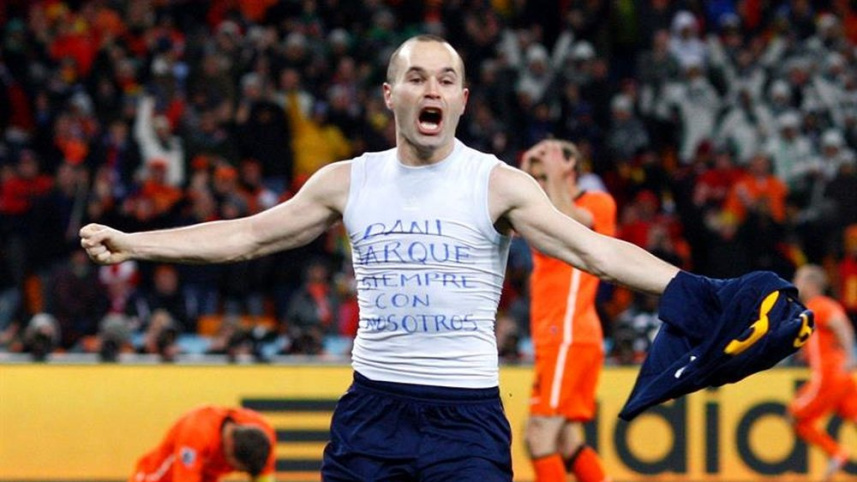
After the goal, Iniesta began to run like a madman. As he ran, he tore off Spain’s proud blue jersey in one swift motion. By the laws of football, it was a punishable offense -- a yellow card was inevitable. But could any earthly rule touch him that night?
Beneath the jersey, on his white undershirt, appeared a line written in blue ink -- an immortal message: “Dani Jarque, siempre con nosotros” (Dani Jarque, you are always with us).
Dani Jarque was Iniesta’s teammate at the youth level, a kindred soul. The captain of RCD Espanyol, Jarque, had passed away at just 26, exactly one year before that magical night. During a pre-season tour in Italy, he collapsed in his hotel room due to cardiac arrest -- his wife pregnant at the time.
This untimely death had pushed Iniesta into a bottomless void. He sank into deep grief and depression, unable to sleep night after night. At one point, he even considered quitting professional football altogether.
That goal, therefore, was not just a winning goal.
It was a reunion.
 For all latest news, follow The Daily Star's Google News channel.
 There were 22 players on the pitch, thousands in the stands, millions watching worldwide. But in that moment, it felt as though Iniesta and Jarque were alone -- together, beyond time.
Teammates embraced him, the world around dissolved into joy. Yet within that celebration, a silence lingered -- where only emotions could speak.
That night, the trophy was lifted to the sky. Spain made history.
But within that history, more quietly, more deeply, another story was written.
Because some friendships are like that.
Where even absence becomes a kind of presence.
Comments