


A star is born: When 18-year-old Messi dazzled

The summer of 2006 in Germany was a time of transition. The reign of the nineties legends was drawing to a close, and world football was searching for a new icon. In Argentina, this search had been an obsession ever since the 1986 World Cup triumph. They were not simply waiting for a footballer -- they were waiting for a saviour in the mould of Diego Maradona.
On 16 June 2006, in Gelsenkirchen, Argentine supporters and the entire world finally found him -- Lionel Messi.

Even before he set foot on a World Cup pitch, Messi had already become a name that struck fear into defenders across Europe. At Spanish club Barcelona, the shy teenager who had once struggled with a growth hormone disorder was transforming into a forward who left even seasoned professionals speechless. His mentor, the legendary Brazilian Ronaldinho, had by then begun to sound the trumpet for Messi's eventual ascension to the throne.
As the 2006 World Cup approached, Messi's name was already accompanied by two La Liga titles and a UEFA Champions League trophy -- though a thigh injury had denied him a place in the final of Europe's premier club competition. The weight of expectation was immense. Argentine supporters would arrive at matches carrying banners depicting their 18-year-old as a future world champion -- a prophecy that would take another sixteen years to fulfil.
The skies above Gelsenkirchen were heavy with anticipation, yet the world's most talked-about teenager was made to wait on the bench until the 75th minute. He had not even featured in the group stage opener against Ivory Coast. Still recovering from his Barcelona injury, Messi had watched as Argentina systematically dismantled Serbia and Montenegro.
Then coach Jose Pekerman gave the signal. The moment the number 19 appeared on the substitutes' board, a thunderous roar erupted -- not only from the stands packed with white-and-sky-blue, but from the VIP box too, where Maradona was leaping about like a man possessed.
Messi looked slight beside the towering defenders, but the force of his arrival was anything but. He needed no time to settle. In the 78th minute, he shook off his marker in an instant and surged forward, the ball seemingly glued to his foot. Five minutes later, he cut in from the left at lightning pace and threaded a perfect pass to Hernan Crespo -- Messi's first World Cup assist, duly recorded.
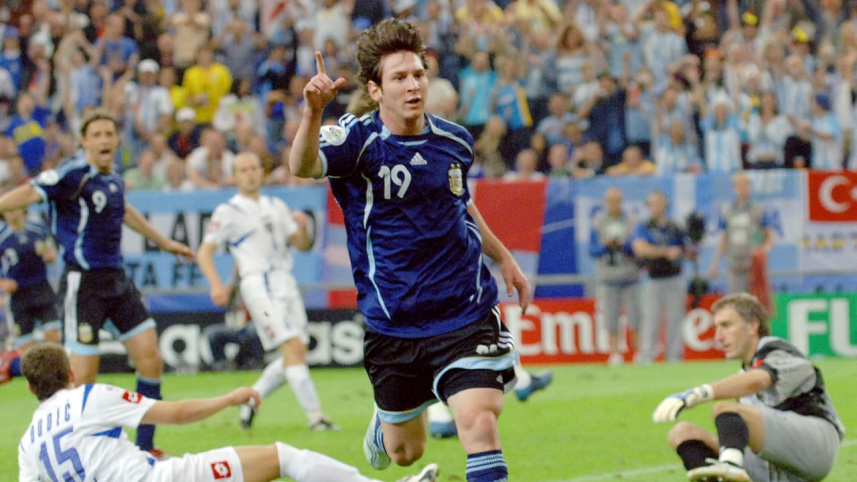
But the true beginning of a legend came five minutes after that. Carlos Tevez played a sharp pass, and Messi's first touch alone was a warning to every defender around him -- he was already beyond them, inside the box, before anyone could react. Not for a single moment did his eyes waver. He then finished emphatically with his right foot, and the ball hit the net. The celebration of that 18-year-old would become a sight the world would revisit for the next two decades.
In the space of just fifteen minutes, that wildcard entry had become the centrepiece of the entire Argentine performance. When the final whistle sounded on a crushing 6-0 victory, it was clear this had been more than a win -- it was the coronation of a new king. A star had been born that day, one who had come to rewrite the future with magic at his feet.
The most important spectator in the VIP box had lost all composure in his joy. The man with whom Messi was destined to be compared for the rest of his life -- Maradona -- was whirling his shirt above his head like a delirious fan. He had, of course, already told the media: "I've seen the player who will inherit my place in Argentinian football and his name is Messi."
What followed was a mixture of wonder and inevitability. Crespo, who had scored from Messi's first World Cup assist, described him at the end of the match as an "understated genius." The tone of the world's media shifted overnight.
Pékerman would later face considerable criticism for leaving Messi on the bench against Germany in a quarter-final that went to a penalty shootout — and ended in elimination. Yet he had seen that debut against Serbia and Montenegro as a necessary stepping stone. He had told Messi: "You have to win by transmitting things, to talk with those with more experience, like Heinze, Roman, Crespo, Gaby Milito, Cambiasso… Get closer and it will serve you because your World Cup is that of South Africa. And you will play many years with the Argentina national team."
In terms of timing, Pekerman was wrong. The ultimate glory would take far longer than South Africa -- it came in 2022, on the pitch of Lusail Stadium in Qatar. But in his judgement of the player, he was not wrong at all.
On that fading June afternoon in Gelsenkirchen, the Messi the world had imagined finally appeared in the flesh. What the world witnessed that day was not merely a substitute coming on -- it was the opening chapter of perhaps the greatest story ever written in football boots.
 For all latest news, follow The Daily Star's Google News channel.
Comments