


‘The butcher of Seville’: When humanity failed on the pitch

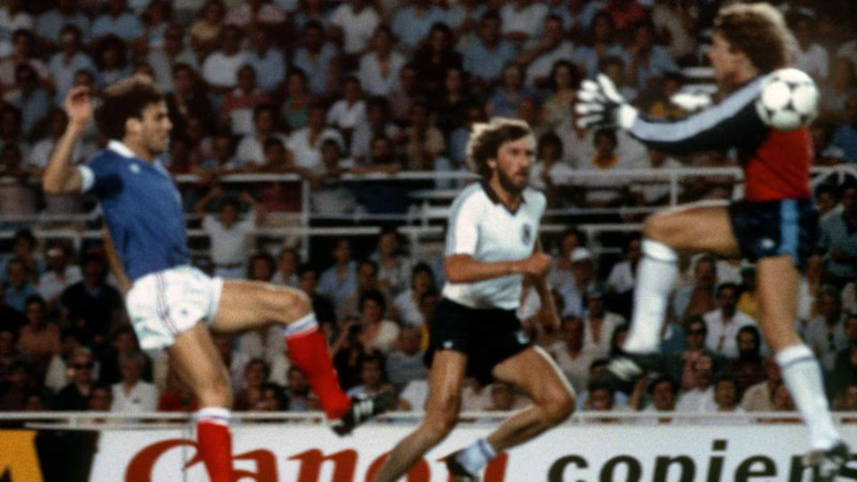
At first, it was hard to comprehend the moment. Was this truly a football pitch, or a battlefield? On a patch of green grass, silence suddenly congealed -- only to explode into fear, anger, and disbelief. Before thousands of eyes, one man lay motionless, while another stood there, unnervingly indifferent.
At the center of that scene were two men from entirely different worlds -- France’s artistic midfielder Patrick Battiston and West Germany’s stern, almost ruthless goalkeeper Harald Schumacher. Their collision was not merely for the ball; it became a harsh test of humanity itself. A chilling memory of terror.

Seville, Spain. The Estadio Ramon Sanchez Pizjuan.
The date: July 8, 1982.
A World Cup semifinal showdown -- where two completely contrasting footballing philosophies faced off. On one side, the French, painting the game with poetic elegance, orchestrated by Michel Platini. On the other, West Germany’s steel-hard, mechanical aggression.
As the second half unfolded, the air on the pitch grew heavier. French coach Michel Hidalgo introduced the young Battiston. In his eyes shimmered the golden dream of conquering the world. Who knew that dream would soon sink into a dark abyss?
Around the 56th or 57th minute, Platini, the French general, received the ball in midfield. He glanced up for a fleeting second, mapping the field, and then released a divine through pass. The ball seemed like a fairytale bird gliding through the air, slicing past the German defense with perfect precision. Chasing it with the speed of a cheetah was Battiston. Ahead of him lay only the open goal -- and Schumacher.
Schumacher rushed off his line. But there was no sign of a genuine attempt to save the ball in his movement -- only the primal cruelty of a hunter. Battiston had already reached the ball, gently nudging it goalward. And at that exact, fragile moment—when his body was suspended in mid-air -- Schumacher hurled himself at the Frenchman with the full force of his body.
No sliding tackle. No intention toward the ball. It was pure destruction -- like a human missile unleashed. Schumacher’s hip and elbow crashed violently into Battiston’s face.
A sound.
Of bone. Of flesh. Of impact.
Then -- silence.
Yes, that horrifying crack tore through the Seville stands, like glass shattering under the blow of a heavy hammer. Battiston was flung to the ground. His body crumpled onto the grass like a lifeless bird with broken wings. The roar of the crowd was sucked away, as if by an invisible black hole. A graveyard silence descended over the entire stadium.
Battiston lay there, motionless -- seemingly lifeless. His eyes shut, his body still, a streak of blood marking his face. The white of his jersey suddenly became a symbol of terror. Some later said it no longer felt like a game, but like witnessing a man standing on the edge of death.
What followed on the pitch was a scene of horror. Platini sprinted to his teammate in desperation. Battiston’s face was pale, his pulse barely detectable, foam gathering at the corner of his lips. Platini later recalled, shuddering, that he thought Battiston might already be dead.
As the medical team carried him off on a stretcher, one lifeless arm dangled over the side -- a haunting image, like the final farewell of a defeated, dying warrior. Three of his teeth were broken, his jaw shattered, and his vertebrae severely damaged. Battiston slipped into a deep coma.
And yet, after this infernal act, as the world looked toward Dutch referee Charles Corver for justice, what followed became another tragedy in football history. His whistle never signaled a foul -- let alone a red card. Instead, he calmly awarded a goal kick.
In the face of a moment that felt like murder, this blindness of the law left the French players stunned.
And Schumacher? His body language was even more terrifying than the referee’s injustice. At one end of the field, as a life battled death, Schumacher leaned casually against his post, chewing gum with chilling indifference. There was not a trace of remorse on his face -- only arrogance. He seemed merely to be waiting for the interruption to end so the game could resume.
That cold gaze, that act of chewing gum -- it was a resounding slap across the face of humanity.
 For all latest news, follow The Daily Star's Google News channel.
 Germany eventually won the match on penalties. But Schumacher lost in the court of humanity. The French press branded him “The Butcher of Seville.”
After the match, when journalists reminded him of Battiston’s broken teeth and shattered jaw, his response sent another shiver through the world. In an icy tone, he said:
“If all he’s lost are his teeth, I’ll pay for his jacket or dental crowns.”
Years later, Schumacher would express regret.
But some moments remain beyond forgiveness.
Because they do not just wound the body -- they wound belief itself.
Comments