


The fault in ‘Brazilliance’, and CR7’s evolving character arc
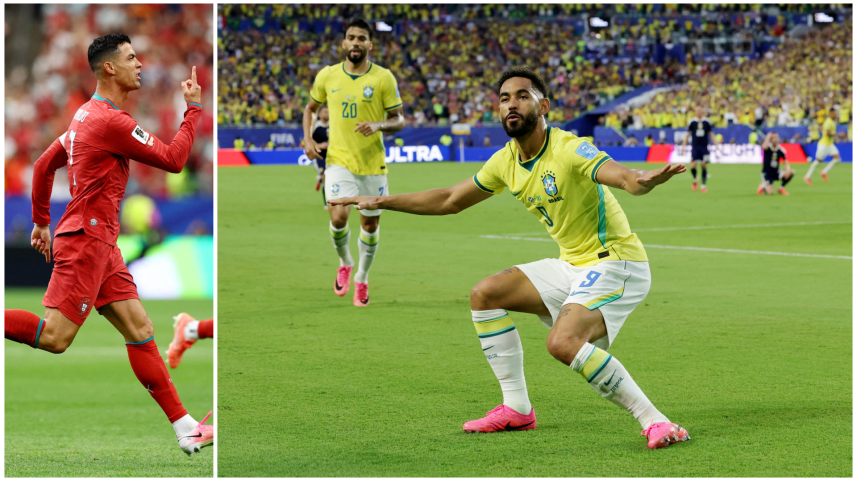
When it comes to a World Cup, where the stakes are astronomical and the pressure cooker whistles constantly, goal celebrations are rarely just random outbursts of joy. If observed closely enough, post-goal rituals can serve as a Rorschach test for a squad’s internal dynamics, occasionally revealing hairline cracks in the armour that a flashing scoreboard tries to hide.
Take Brazil’s breathtaking third goal against Scotland in Boston on Thursday. For 25 seconds, the Selecao treated the world to a throwback to Jogo Bonito -- the beautiful game.

First came 18 seconds of Marquinhos and Gabriel Magalhaes calmly stroking the ball around, luring Scotland’s midfield into a hypnotic chase. Then Brazil shifted gears in an instant: Danilo split the lines, Lucas Paqueta cushioned it, Casemiro released it wide, and Bruno Guimaraes surged down the inside-right channel before squaring for Matheus Cunha to tap in.
“... and that is a goal of the highest quality,” the television commentator could be heard saying. The assist was telepathic -- Guimaraes could only spot Cunha, running in diagonally from behind, on the very edge of his peripheral vision before making the pass.
It was a move so fluid that it felt like the definitive announcement that Brazil were back, or thereabouts, to something close to their vintage best.
And still, the moment the ball rattled the back of the net, the spell was broken by an awkward visual.
Instead of collapsing into a unified heap of yellow shirts, the architect and the executioner set off in completely opposite directions. Guimaraes, perhaps expecting Cunha to chase him in gratitude for the unselfish set-up, wheeled away towards the left side of the pitch.
Cunha, meanwhile, bolted towards the corner flag in the opposite direction to launch into a trending surfer-tribute solo celebration. He did eventually acknowledge Guimaraes by pointing at him, albeit only after covering half the distance to the touchline.
Normally, the script writes itself: the scorer points at the provider, or the provider chases down the scorer. When it comes to South American powerhouses such as Brazil or Colombia, a goal is usually an automatic cue for highly synchronised dance moves.
Cunha did eventually restore some structural balance, offering a delayed “rub the boot” gesture to acknowledge the assist. Making up for the initial separation?
Nitpicking?
At a global event like the World Cup, with all eyes watching, body language becomes material for interpretation. If the Cunha-Guimaraes separation feels like reading too much into a celebration -- or trying to find a non-existent pimple on Da Vinci’s Mona Lisa -- one only had to look at Portugal’s 5-0 demolition of Uzbekistan in Houston a day earlier.
Playing in his sixth World Cup, Cristiano Ronaldo entered that match under an intense, suffocating cloud. After a lacklustre display against the Democratic Republic of Congo, the media knives were out, with calls for the veteran to be dropped. When the deadlock was finally broken in the sixth minute -- Ronaldo swivelling to meet Joao Cancelo’s cross -- the release of pressure was monumental.
Ronaldo then sprinted directly past his team-mates and headed straight for the dugout, where everyone converged to embrace him, before finally unleashing his trademark “Siuuu” roar. The Ronaldo of old would likely have gone for the solo showmanship first before being mobbed by the team.
On this occasion, though, the Portuguese megastar appeared to show immediate gratitude, doing the exact opposite of what a textbook egoist might have done.
Ending a goal drought and adding another layer to his character arc -- talk about changing the narrative.
Genuine growth or masterful theatre?
By the time Portugal’s second goal arrived -- when Ronaldo’s positioning acted as a clever decoy for Nuno Mendes’ free-kick -- the No. 7 was celebrating instantly, raising his hand with an expression so triumphant it looked as though he had scored the goal himself.
It felt as though a refreshing new narrative around the 41-year-old was beginning to take shape: Ronaldo, the team player.
Back to Brazil, their approach and execution against the Scots was nearly flawless. But if they are to survive the deeper, more treacherous waters of the knockout rounds, their chemistry will have to be at its very best, producing moments of brilliance that continue to keep audiences glued to their seats in anticipation.
These are speculations, of course. But then again, what is a World Cup for?
 For all latest news, follow The Daily Star's Google News channel.
Comments