


When 38-year-old Roger Milla danced into history

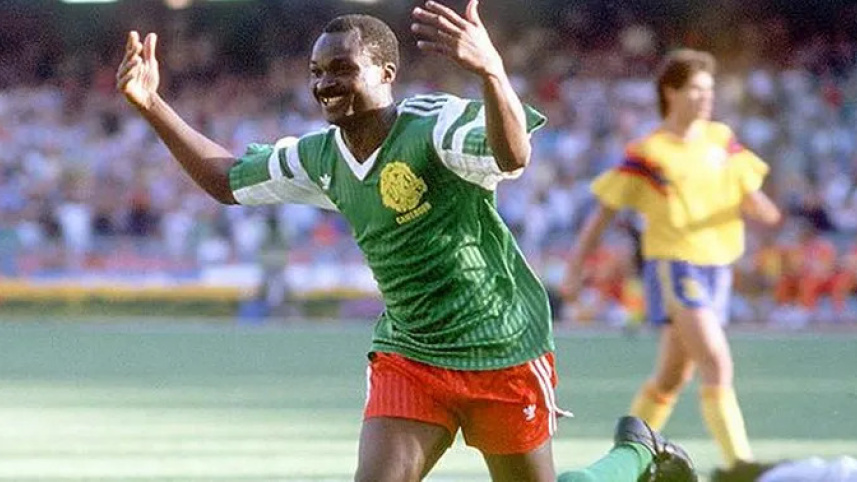
The 1990 FIFA World Cup during an Italian summer -- the pitch was ablaze with tactics, strategy, and fierce competition. Teams from Europe and South America were locked in their battle for dominance.
In that landscape, Cameroon felt like a distant tale -- unknown, overlooked, yet carrying within them an ancient, primal strength. And the symbol of that strength became a 38-year-old veteran footballer, whom many had already written off as a man in the final stage of his career.

The grand stage of world football was alive with giants -- Diego Maradona, Lothar Matthaus, Roberto Baggio -- lighting up the tournament. Yet, it was this veteran who overturned every calculation, every equation of age.
He wasn’t even supposed to be there. Having retired from international football, he was living a quiet life on the Indian Ocean island of Reunion. But at the special request of Cameroon’s president, he laced up his boots once more and returned. The moment he stepped onto the pitch, he gifted the world a magical chapter -- one forever etched into football history as a timeless piece of art. He was none other than Cameroon’s indomitable lion, Roger Milla.
Whenever the ball kissed the back of the net, Milla would erupt into a peculiar celebration of joy. With a wide, unfiltered smile, he would sprint toward the corner flag. Then, placing one hand near his stomach, raising the other in the air, and balancing on one leg, he would sway his hips in a smooth, almost hypnotic rhythm.
Though fans, overwhelmed with emotion, dubbed this celebration “Makumba,” its roots were deeply embedded in Cameroon’s traditional Makossa dance. Whatever the name, for a fleeting moment on Italy’s green turf, it felt as if Africa’s raw, primal, vibrant pulse had descended onto the field. From thousands in the stands to millions watching on television, hearts swayed to the rhythm of his dance.
In football’s grammar, 38 is an age reserved for reminiscing over cups of tea after retirement. But Milla seemed to rediscover a second youth at that very age. Think of his unforgettable brace against Romania, or that magical moment in the pre-quarterfinal against Colombia.
When Colombia’s legendary and somewhat eccentric goalkeeper Rene Higuita dared to dribble the ball near midfield, Milla pounced with the swiftness of a cheetah, stole it, and calmly slotted it into an empty net -- leaving the world stunned.
After every goal, the camera lens would instinctively search for that magician near the corner flag. There was no arrogance in his body language, no aggression -- only the purest expression of joy. It was as if Milla was writing a poem with his movements, proving that age can never dim the essence of a true artist.
Milla’s celebration was not merely personal joy or the thrill of a goal – it was the anthem of a waking continent, a living symbol of Africa’s self-belief. As Cameroon became the first African nation to reach the quarterfinals of a World Cup, it was Milla who stood as the chief architect of that improbable history. Through his dance, he proudly showcased to the world that African football possesses its own beauty, its own rhythm, its own unrestrained identity. His Makossa -- or Makumba -- proved that football is not just about physicality or European tactics; it is also a celebration born from the depths of the human soul.
Today, more than three and a half decades have passed. The rules, tactics, and celebrations of football have evolved countless times. Yet, whenever the 1990 World Cup is remembered, what first comes to mind is that smiling face and that unforgettable hip-swaying dance by the corner flag. Just as art knows no boundaries, joy knows no age -- and through his magical rhythm, Roger Milla painted that truth forever onto football’s canvas. That unforgettable dance will live on as an evergreen verse in the epic of football, etched in the hearts of countless fans.
 For all latest news, follow The Daily Star's Google News channel.
Comments