


From promises to proof: Melbourne Declaration reframes gender equality agenda

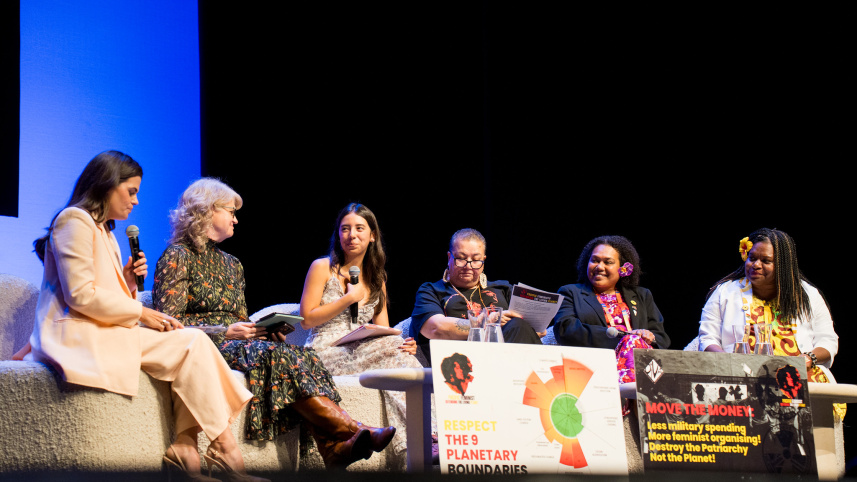
“Three decades after Beijing, and thirty-one years after Cairo, we are still arguing with men over whether a woman’s body belongs to her,” said Deputy Secretary-General of the United Nations, Ms Amina J. Mohammed.
“Securing the rights of women and girls is the world’s unfinished business. If anything, it is moving backward with new technologies amplifying misogyny and online violence.”

To address this, the Melbourne Declaration for Gender Equality – a global commitment to rebalance power, resources, and accountability - was launched this week at Women Deliver 2026 (WD2026). It sets out a path to close the gap between what is possible and the lived realities of girls, women, and gender-diverse people.
The Declaration sets a forward agenda beyond the Conference, shaped by more than 650 voices across regions, generations, and movements. It identifies what is not working and what must change, and is owned not by any single organization, but by the people and movements driving it forward.
Focused on delivery, the Declaration calls on States to uphold their human rights obligations, institutions to strengthen accountability, and funders to resource feminist movements and locally led change. The Declaration has already been endorsed by a number of countries, including Colombia, Finland, France, Mexico, Norway, Slovenia, Spain, the United Kingdom, Uruguay, and Canada.
Hosted for the first time in the Oceanic Pacific, WD2026 has centered First Nations leadership and regional voices, reinforcing the importance of grounding global commitments in local realities and lived experience. As reflected in the First Nations, Indigenous Women’s Statement, this includes recognizing sovereignty, self-determination, and the leadership of Indigenous women, girls, and gender-diverse people in shaping just and sustainable futures. The Melbourne Declaration reflects this – named to honour the place where the global community came together, after months of consultation and congregation, to shape a shared path forward.
Women Deliver President and CEO Dr. Maliha Khan said the Melbourne Declaration marks a decisive turning point.
“It’s a commitment to do things differently. It recognizes that the challenge is not a lack of promises, but a failure to deliver on them. What comes next must be defined by accountability to people, and not just to systems.”
“We are calling for a shift in power toward communities, toward movements, and those most affected by inequality. This is how we build a more just and sustainable future,” said Khan.
The Conference has seen 6,000 delegates from over 189 countries unite, creating a global platform for dialogue, collaboration, and action at a time of growing pressure on gender equality.
This urgency was reinforced by a series of new and renewed commitments announced throughout the Conference, totalling approximately $190M in financial commitments and signalling growing momentum toward implementation.
Key actions included major funding commitments, the launch of global initiatives on health systems and tech-facilitated violence, and strengthened political commitments to deliver on gender equality and sexual and reproductive health and rights.
Throughout the Conference, themes have explored the dismantling of systems that are no longer working, shaped by chronic underinvestment, shrinking civic space, and the rise of coordinated anti-rights movements.
The Declaration responds by calling for a reorientation of the gender equality ecosystem – one that prioritizes public systems, strengthens civil society’s ability to hold power to account, and ensures international actors support, rather than substitute, both State responsibility and locally led leadership.
Paola Salwan Daher, Senior Director for Collective Action at Women Deliver, said the Declaration provides a framework for sustained accountability.
“This is about aligning action with commitments that already exist. The Melbourne Declaration creates a shared reference point for what accountability looks like, across governments, institutions, and funders, and what must change moving forward.”
“The future of gender equality depends on whether we are willing to invest in the people and movements who have always led this work. It makes clear that resourcing feminist movements is critical both to defend hard-won gains and to push forward with renewed clarity, solidarity, and purpose,” said Salwan Daher.
As the Conference closes, attention turns to how governments, institutions, and funders will translate the Declaration into policy, financing, and practice.
“We are at a moment where progress is not guaranteed, where conflict, climate change, economic instability, and shrinking civic space are reshaping the lives of millions.”
“The impact of the Melbourne Declaration will be measured by whether it responds to these realities and delivers change where it is most urgently needed,” said Khan.
 For all latest news, follow The Daily Star's Google News channel.
Key commitments include:
- Women Deliver announced the Adolescent Girls Era Campaign, bringing together 47 organizations to build on the Girls Manifesto and support girls’ participation in advocacy spaces, including international mechanisms.
- The Feminist Health Systems Charter was launched as a significant milestone, highlighting partnership, decolonization, and a systems-based approach to health service delivery. It drew interest from stakeholders, including The Lancet and regional counterparts such as Lebanon. Mexico’s Ministry of Foreign Affairs representative, Geraldine Gachuz, linked the Charter to the Melbourne Declaration and committed to advancing health as a human right, with further developments expected in January 2027.
- The High-Level Parliamentary Forum endorsed the Melbourne Parliamentary Call to Action, a collective call to defend rights, close gender inequalities, and turn commitments on gender equality and SRHR into concrete and accountable action.
- Australia’s Department of Foreign Affairs and Trade (DFAT) announced a second phase of its Accelerating Investment in Women’s Rights initiative, committing approximately US$62.5M to locally led women’s rights organizations and funds over eight years.
- The Children’s Investment Fund Foundation (CIFF) committed US$61M to end child marriage, which significantly impacts girls and adolescent women.
- The launch of PREVENT, a global coalition to prevent technology-facilitated gender-based violence led by The Lotus Flower, two new blended finance facilities by the Women’s Health Empowerment Network, and a reiteration of commitments to SRHR, gender equality, and multilateralism through organizations such as the Global Fund, including from host country Australia.
- Fondation CHANEL, Minderoo Foundation and nine other organizations are part of a recently announced coalition of 11 major Australian philanthropic funders, committing an initial $32.8M over three years. Separately, Fondation CHANEL, the Dutch Ministry of Foreign Affairs and others confirmed over $23M for Leading from the South over the coming years, recognizing the partnership’s tenth anniversary.
- Girl Effect signalled a commitment to partner with governments and communities to expand girls’ access to SRHR, mental health support, digital platforms, and norm-shifting approaches, with catalytic funding to scale what works.
- Mama Cash, alongside the Alliance for Feminist Movements, Gender Funders CoLab and Prospera International, joined a global coalition to launch “Accelerate Together,” an initiative aimed at mobilizing $600M USD annually for grassroots, women-led movements, focusing on areas such as climate action, economic justice, and bodily autonomy.
- The Gates Foundation announced $11.5M in investments in adolescent girls, including a commitment to Girl Effect.
- A number of tools and guidance documents were also launched with embedded consultations, including ADB’s new Gender Equality and Women’s Empowerment Policy, the Gender in Foreign Policy Index, and Guttmacher’s Safe Abortion Calculator.
Comments